Wednesday, December 23, 2015

Film #170: The Innocents

In the realm of horror movies, Jack Clayton’s The Innocents is beyond reproach. And we all realize the horror genre is overflowing with creepy kids. But in the domain of movies about children–the subject of this ongoing series–how does this film fare? The answer is complicated, but assured: it's fully illuminating, even in its inky darkness. In this exquisite adaptation of Henry James’ The Turn of the Screw, the images are boldly frightening, sexually suggestive, deceptively lush, and idiosyncratically shot in dreamy black-and-white Cinemascope by photographer Freddie Francis. Deborah Kerr, in her personal favorite of many acclaimed performances, plays a repressed nanny whose new charges–the alternately rambunctious and preternaturally mature orphans Pamela Franklin and Martin Stephens–prove to be more than her nerves or her faith can take. Is this secluded mansion she now oversees haunted by the ghosts of two sexually libertine servants? Or is she merely being put through the ringer by a couple of untrustworthy brats?

innocents 9Even before the credits roll, we hear a thin, girlish voice (meant to recall the young tones of our female ingenue Pamela Franklin, here playing Flora, though it could also be the voice of the deceased governess Miss Jessel). Words are put to a vaguely secluded theme that soon becomes the movie’s niggling, incessant refrain. Written by composer George Auric and lyricist Paul Dehn, it’s a suitably ancient-sounding tune called “O Willow Waly,” and it reeks of a particularly lonely menace as we sit in the dark, waiting for a movie to begin like we’ve never waited for a movie to begin before or since. And the 20th Century Fox logo happens in silence:


Over the credits, we get a quick glimpse of what we will later learn is the movie’s climax–a clasp of Kerr’s praying hands, over which she breathlessly trembles and sweats, almost in erotic fervor. “I want to save the children, not destroy them,” she confesses in a whisper that flutters amongst twittering night birds. “More than anything, I love children. They need affection, love–someone who’ll belong to them, and to whom they would belong.”

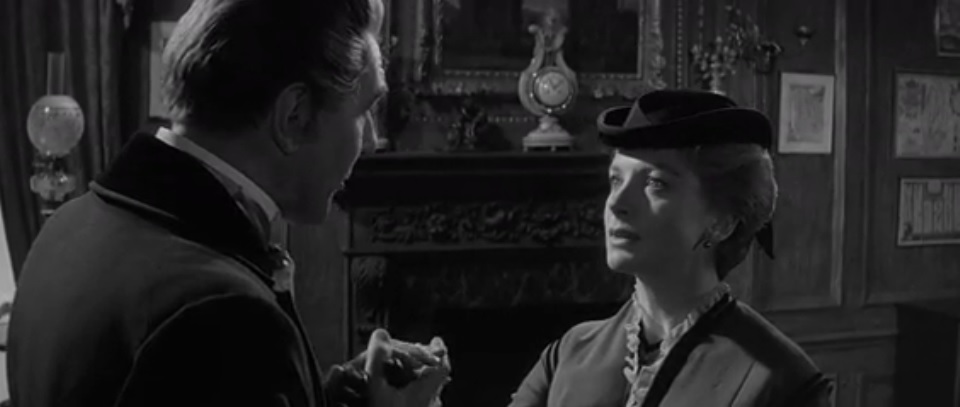
We then eavesdrop on a moderate prologue in which we’re introduced to Michael Redgrave’s coldly profligate uncle as he hires Kerr’s Miss Giddens to take charge of the young rascals foisted upon him (he echoes–or precursors–Miss Giddens’ sentiments about providing them “someone who’ll belong to them, and to whom they would belong”). But he’s upfront about it: he has no time for them, and he’s looking to pay her to love the children for him (tellingly, his first interview question is: “Do you have an imagination?” and we will find Miss Giddens indeed has a fruitful one, of which she’s later a victim). The sheltered daughter of a radically religious country parson, she strikes us as someone of ulterior motives, because as much as she professes to love children, she’s only too willing to let her prospective employer off the hook for leaving his niece and nephew in the lurch as he gallivants carefree, spreading his influence around London. (Of course, she wants the job, so who is she to object?) Giddens clearly develops a crush on this cad, and throughout the rest of the movie, she’s adamant to do his bidding, even if he never appears before her (or us) again. He’s wealthy, but not someone worthy of love, yet she’s been shuttered away for so long, and so past her prime (Kerr is at once too old for the role, and altogether the perfect age for it) that the soulless uncle seems like some kind of perverse hero to her. Maybe, we’re left to conclude, he resembles her own father, who clearly had no room for his own children “mentally or emotionally.”
innocents 14

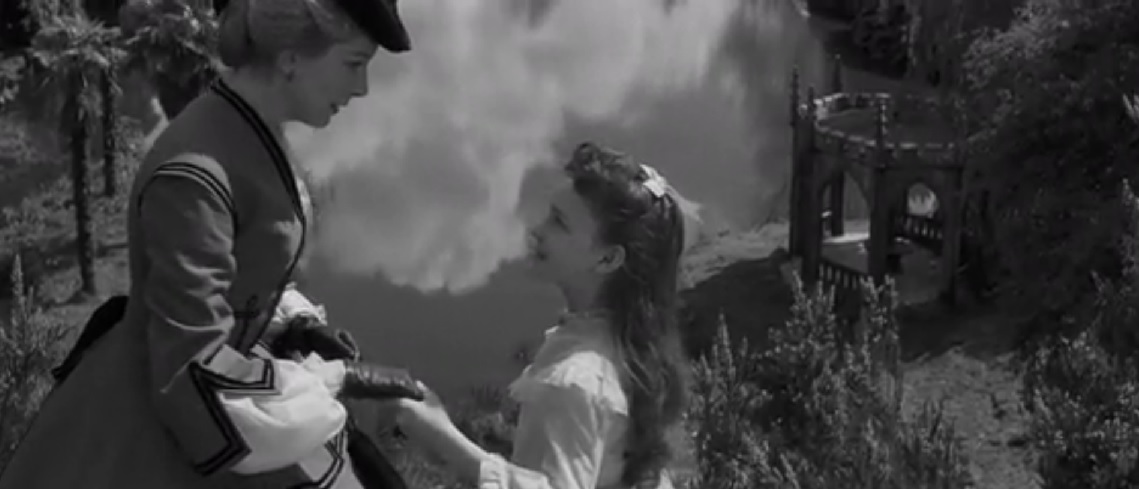
After being regaled of previous governess's appalling fate (and of its secretive quality–she’s told to never to speak of it, ever), Miss Giddens arrives at the cloistered Bligh estate glorified and fully embraced by Franklin’s Flora, who’s positively giddy at having a new person in her orbit. As if her own name were a call to action, Flora responds most powerfully to the blooming countryside engulfing the mansion (often, the movie’s environment, with its croaking frogs and flittering butterflies, feels like it's pulling us headfirst into its dizzying effulgence). As Miss Giddens first wanders beside the landscape’s mirrored pond, she can hear a far off voice calling “Flora! Flora!” When she's finally faced with the young girl, Miss Giddens is confused–to whom did that distant voice belong? She knows that Miles, the nephew, is off at boarding school. However, her faith in the innocence of children quickly brushes such uncertainty aside. She is caught up with meeting the ebullient Flora (whom we first see as a rippling mirror image in the pond–itself mirroring a later disturbing apparition). She’s immediately introduced into Flora’s vivid inner world, which Miss Giddens first sees as being entirely playful. She’s somewhat shocked when Flora introduces her reptilian best friend Rupert (a hapless tortoise), but otherwise, this feels like easy going.
innocents 16

The lively script, largely written by Truman Capote who adapted William Archibald’s play (Archibald had little to do with the screenplay, though he gets co-writing credit) then introduces us to the only adult character who has even a slippery grasp on what has befallen the children in their isolation. Mrs. Grose (Meg Jenkins) is an affable though ultimately simple-minded presence who at once puts Miss Giddens at ease and then, gradually, sets her upon a course to madness. Prone to superstition and secrets (“Stuff and nonsense,” she repeatedly says), she’s an unreliable voice, and the closer we seem to come to the truth via her accounts, the further the truth seems to drift away. Also drifting away are the niceties that first greet Miss Giddens, who first steps into the house overwhelmed by its opulence, and is quickly taken aback when she reaches out to touch some white roses and finds their leaves shedding away in decay. The young girl’s charms and wandering curiosity are discussed, and then Miss Giddens gets startled anew: It wasn’t Mrs. Grose calling Flora’s name earlier. And Flora, then, seems to know of Miles’ impending return to the estate, even though nothing has been mentioned of it. “Promise you won’t go away,” Flora pleads, and Miss Giddens assures her “I expect to be here a very long time.” And then when she and Mrs. Grose talk about the uncle, and the now-dead governess Miss Jessel, Grose lets it slip: “He had the devil’s own eye.”


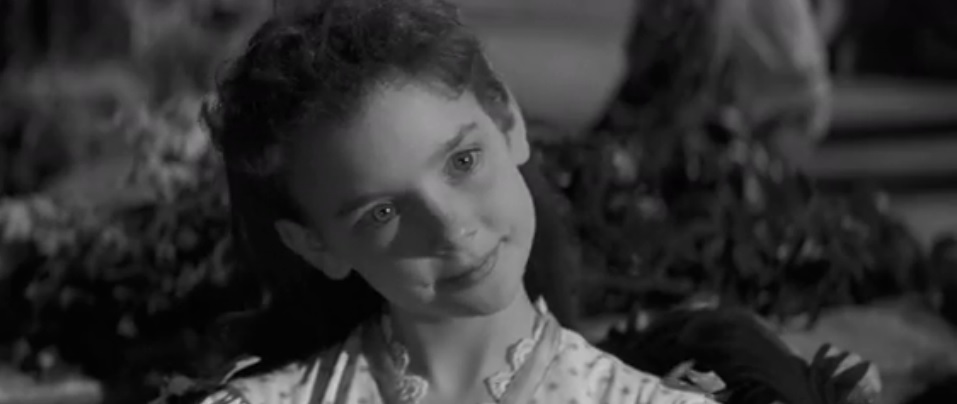
As we take our first of many eerie candlelit tours through the labyrinthine house (shot with uncommonly well-choreographed lighting and creative lens choices--this stuff was really executed  with proper detail), the film continually ratchets up our unease in subtle ways. Flora continually takes joy in the darkest things, whether it be the notion of being in two places at once, or waking before she dies (she misspeaks in delivering her nightly prayers), or being a soul who walks around after expiring (“Isn’t that what happens to some people?”) or ignoring those screeching, predatory sounds of nature that disturb her governess (“We must pretend we don’t hear it…then we won’t imagine things,” Flora instructs). Continually, we find this world rather billowy and beautiful, and at the same time certainly threatening. And Pamela Franklin’s eyes pierce our soul with their odd combination of knowing and purity, particularly when we find her predictions of Miles’ return come true via a letter informing of his dismissal from school (for a reason that’s never fully spelled out). It’s an unsettling moment but, as with many in the film, we can’t quite put our finger on why it is so (though Franklin’s subsequent line “Oh, look–it’s a lovely spider…and it’s eating a butterfly” place the viewer firmly in ghoulish territory).
innocents 17

Miles is played by Martin Stephens, a young actor who’d reached an apex of creepiness in British cinema only the year before when he appeared as the agile and otherworldly leader of the transfixing, blonde-headed children commanding Wolf Rilla’s Village of the Damned. His showing here surpasses that role in many ways, though it also recalls it: as in Rilla’s film, his Miles is “miles” beyond his years, and seems to know more about the cruel universe than either the viewer or the adults in the film have any ken. Like Flora, he first appears as an adorably rambunctious child, full of vigor. His masculine energy instantly captivates his governess, and she gladly reverts back to her preferred role upon meeting him. But Miss Giddens is then quickly suspicious of his ability to dirty up innocence, and this is the feeling that defines their odd relationship throughout the film (Mrs. Grose cackles at the governess’ distrust: “Are you afraid he’ll corrupt you?”). This notion becomes ever more alarming when we see that Miles resembles his uncle so, with his cravat and pompadoured hair, that he strikes the viewer (wholly subliminally) as a bonafide Mini-Me. The can’t be good for Miss Giddens, we know right from the outset, when he boldly hands her some flowers as introduction (“Charm must run in the family,” she cheerfully says to Mrs. Grose).


As Clayton’s masterfully directed piece progresses, Miles’ peculiarity becomes more disconcerting, and its causes become clearer (though the film, in keeping with the times it was made, is unable to articulate any details beyond furtive suggestion). The Innocents was mildly appreciated upon its first release (it won Best Director from the National Board of Review, but otherwise was ignored by critical voices, unjustifiably so). But it’s recently re-entered the conversation when discussing the most deeply layered of horror films, and as such, it’s received a much vaunted 2014 release as part of the Criterion Collection, so we can fully soak up Francis’ complex lighting schemes and deep focus framing. The cinematographer’s work shines brilliantly, particularly during the stunning dream sequences–complicated, lap-dissolving mosaics that have rarely seen equal (this would be a tremendously satisfying movie to see on the big screen). Director Clayton, as well, seductively applies sound and music to his creation, with moments of chatter and then thudding silences that will freeze your soul. Without revealing too much (lest I spoil its surprises), the film reaches only one of its many peaks when the ominous Miles, after a vigorous game of hide-and-seek, colludes with Flora to put on a show for the governess and Mrs. Grose. By candlelight, with a chintzy crown atop his head, he recites a morbid love poem to the departed–one that feels utterly like something out of Edgar Allen Poe, but which was directly written for the film as a kind of counterpart to Flora’s song (this must be a creation of Truman Capote, a poet of the first order):

What shall I sing to my lord from my window?
What shall I sing, for my lord will not stay?
What shall I sing, for my lord will not listen?
Where shall I go when my lord is away?
Whom shall I love when the moon is arisen?
Gone is my lord, and the grave is his prison.
What shall I say when my lord comes a-calling?
What shall I say when he knocks on my door?
What shall I say when his feet enter softly
Leaving the marks of his grave on my floor?
Enter my lord!
Come from your prison!
Come from your grave, for the moon is arisen
Welcome, my lord…

innocents 1

This provokes only one of many alarmed jolts from Kerr’s jittery, unstable governess, who indeed may not be as crazy as she seems (this is the movie's perfect height). Her bedside conversations with Miles become increasingly anxious, and one such encounter leads to a totally wrong-feeling moment between the two–one that couldn’t be shot nowadays without a uproar from concerned parents. Amidst spectral walks through deserted hallways, dusty attics, bug-ridden gardens, and wind-blown bedrooms, Clayton elegantly builds tension, to the point you think you mightn’t be able to stand another minute. The swirling, chaotic climax is the final punch to the gut, a shocking coda to all the dread that’s come before.

As a work about children, this might be the chanciest cinema has to offer, particularly given the time in which it was produced. If it were filmed today, the story might be spelled out too baldly, if it could be filmed at all. As it is, you can feel Clayton and screenwriter Capote dancing so close to the edge that the waltz becomes ridiculously perilous. There are innumerable regal and scuzzy scares in The Innocents. What remains in our consciousness, after the fear is shaken away, is the demarcation of that line between chastity and depravity. That’s exactly what’s so alarming about this movie’s splendid, gorgeously horrifying ambivalence. In the end, it’s concerned with what scurrilous details children might cull from seen and unseen adult sexuality. What can be more disquieting, or less innocent, than that? Yet, I think kids can watch this film and understand it fully.

NOTE: this review originally appeared in 2015 as part of WONDERS IN THE DARK's genre overview called THE CINEMA OF CHILDHOOD. Check the whole lineup out here: 

the-end-the-innocents

Monday, December 21, 2015

Film #169: Sundays and Cybele


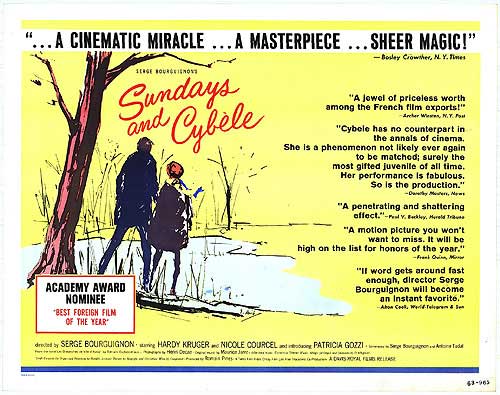
After years of merely seeing the title Sundays and Cybele bandied about, I only recently got the chance to see it courtesy of our heroes at Criterion. I had long had it on my radar, knowing that it won the Oscar for Best Foreign Language Film in 1963. And, then, in 1964, due to arcane Academy rules, it achieved that ancient and odd achievement of being nominated the following for Best Adapted Screenplay (it comes from a novel by Bernard Eschassériaux, who threw in on the screenplay, though he’s uncredited) and also for the legendary Maurice Jarre’s evocative score. When I finally got the chance to see it in 2014, I was seriously blown away by its visual acuity, intense performances and complicated emotions. I could barely comprehend its immense breadth, and immediately wanted to know more about its maker. But here I quickly found myself thwarted. Even in the age of the Internet, there are still artists about whom you can find little. And its director/co-writer Serge Bourguignon is one of them.

So here is what I have learned about him: From 1948-50, he studied at France’s L’Institut Des Hautes Etudes Cinematographiques (the IDHEC, translated as the “Institute for Advanced Cinematographic Studies,” and now known as La Fémis). This is the famed film school that spawned the likes of Alain Resnais, Claire Denis, Volker Schlondorff, Theo Angelopolis, Louie Malle, Costa Gavras, Claude Sautet, Patrice Leconte, Arnaud Desplechin, and Jean-Jacques Annaud, as well as countless other cinematic craftspeople (quite an alumni there). After traveling the world in search of material, he began helming documentary shorts in the late '50s, culminating with his Palme D’or win at Cannes for his short film La Sourire in 1960 (this short is available on the recent Criterion Collection release of Sundays and Cybele, though I must confess, I haven’t yet seen it).

b70-16555

After Sundays and Cybele won the Academy Award, the director moved on to making a now obscure 1965 American western called The Reward, starring Max Von Sydow and Bourguignon’s wife Yvette Mimieux (and where can we see THIS film?). His second French feature, Two Weeks in September, starring Brigitte Bardot, arrived in 1967 and has only recently been released as part of a Bardot box set. After this, Bourguignon threw in on the filming of The Picasso Summer, a 1969 drama adapted from the work of Ray Bradbury and starring Mimieux and Albert Finney (the number of filmmakers who contributed to this film were many, and effectively diluted his contribution, to the point where he’s not even mentioned on IMDb as a collaborator, and this i also a lost film). After this, he apparently divorced Yvette Mimieux (who would go on to wed Stanley Donen in 1972), and ever since, cinematically or otherwise, we haven’t heard word one from Serge Bourguignon. Outside of what’s included in the Criterion’s extras on their release of this film. I doubt one could find out anything about the man.

I can barely imagine what his life has been like being at such peaks and valleys. (Can YOU fancy being married for less than a decade to the stunning Yvette Mimieux?) But I guess he’s found happiness without making films. Even so, Orson Welles said that you only need one to be remembered, and for Bourguignon, it’s clear that Sundays and Cybele is his one. Its original title is Les dimanches de Ville d’Avray (or Sundays in Ville d’Avray, referring to the Ville-d’Avray suburb of Paris, where the film’s action takes place). Somehow, the film’s title in the Criterion days has been transmogrified into Sundays WITH Cybele, but I’m going with the title Bourguignon’s movie is most well known by–Sundays AND Cybele–which is, I find, radically more poetic. I must admit, I am fiercely curious as to the filmmaker’s abandonment of an art form of which he was a downright master. But I can easily see how someone with his baffling sensitivity would've been disillusioned with the sickening complexities of the film industry, particularly given his disappointing history with it.

When one views Sundays and Cybele, one is seeing the work of an absolute innocent–and it’s a mirror reflecting the innocence of the film’s lead characters, much like the mirror reflections we constantly see in the film’s pond waters. Any person who could make a movie like this would instantly be destroyed by any sniveling studio overlords, be they American or European. It’s a miracle that it made it as far as it did in mass acceptance. Still, in fact, this is a movie that has been, in my view, actively suppressed for many years, and it’s only now, with its Criterion release (bless them), that it’s becoming a work that has a new salvo of fans behind it. Yes, I know it was released on VHS in the early 90s; but why has it not seen screens since Criterion’s 2014 release? (I know why…) Anyway, I’m just happy to be part of the crowd that has, at least recently, embraced this masterpiece.

sundays-and-cybele-still-520x250

It doesn’t take a genius to figure out what the problem is here. We now live in a world where the kind of relationship displayed in Sundays and Cybele cannot even be conceived of without the collective population making instant judgments (and these judgments definitely make a fatal and defiant appearance in Sundays and Cybele). There is, apparently, no room in this present world for a heightened, and chaste, friendship between an adult and a child. Even mentioning this concept makes me, myself, culpable. These days, the only adults that need to be saying word one to a kid are the kid’s parents. Anyone else is suspect. And I have to say, I find this sad. How anyone can be a teacher or an adult be a friend to kids nowadays? I had many adults as friends as a kid, and I was also totally aware of how an adult could take advantage of me. Yet I forged many friendships–even ones that I still have–with non-family adults when I was young. I feel there is a madness existent now, particularly in American culture, regarding relationships between non-parental adults and kids under 18 (and even older). I understand: there are maniacs out there–maniacs who are close to, or even fellow family members with kids. But it’s just so sad. That major majority of adults–those who aren’t pedo perverts–are labeled with the same stickers as the tiny minority who are. We’ve gotten to the point that the only humans who can talk to kids are the ones who are related to them (even though it is those related to them who are the most likely suspects of wrongdoing). I think all of this–even the very notion of it–is sick. In the end, this culture has made me–a childless singleton–wary of being around kids. And how strange, and wrong, is that? Whew.

sundayscybele

Is it possible for the world today to take a look at Sundays and Cybele and understand that it displays an intense friendship between a damaged, childlike man and a child? I wonder about that. When I first saw the movie in 2014, I immediately thought: “This is why I haven’t seen this movie. It’s been suppressed.” I think the world of children, and of adults, changed with the release of Kramer Vs. Kramer in 1979 (remember, that was the #1 box office success of that year, and in collusion with the Reagan era, was the film that let formally clueless, coked-up parents know that their kids should be their prime priority). The other big things that happened soon after, at least in American culture, were the TV films Adam (1983, about the kidnapping and death of John and Reve Walsh’s child–John Walsh later became the host of FOX’s massively successful reality crime show America’s Most Wanted) and Something About Amelia (an Emmy winner in 1984, starring Ted Danson and Glenn Close, in which the father has an incestuous relationship with his daughter). Both of these TV movies (along with 1981’s Fallen Angel, with 13-year-old Dana Hill being seduced into child porn by a jerk perfectly played by character actor Richard Masur) received massive ratings and critical acclaim, and seemed to instantly ratchet up the idea that kids–all kids, everywhere–were in stranger danger danger danger.

Why am I talking about all of this? Because when I first watched Sundays and Cybele in 2014, I immediately felt this movie was supremely weird, and wonderful, and that it might unduly offend or at least trouble the average viewer. By its end, I understood its heart. This is a movie about a heightened friendship. It is not a film about a romance, although the actual child in this relationship–played brilliantly by Patricia Gozzi–is 12 years old and openly expresses a desire to eventually marry the adult Pierre (Kruger) when she reaches the legal age of 18 (she even does the mathwork for them, and he clearly has no problem with this, though we wonder if he has any grasp of reality after his wartime experience). Kruger’s Pierre–a onetime jet pilot–has been scarred by what we see in the film’s pre-credits sequence, where he crashes his plane, downed in the early Vietnam War, right into the face of an innocent Vietnamese girl. This is how the film starkly, fastly begins, with that ridiculously contrasting black and white. With this, we can at least understand that a psychological barrier has been set up for Pierre–it’s one laden with supreme guilt.

cybele 3

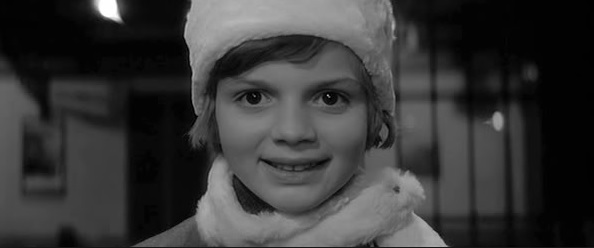
And so, when we see Pierre first blankly connecting with Cybele, we get it. At that point, she is being abandoned by her actual father at a train stop, where she is supposed to arrive at a parochial school. As her father asks Pierre, waiting lonely  at the station, to direct them to St. Maugerite’s boarding school, Cybele instantly connects with Pierre (with both of them glaring strikingly into Bourguignon’s camera). At that train stop, they smile at each other and recognize the caring in each other’s eyes. But they are separated still. Cybele demands that her father explain why she is being abandoned, but he says that he will come back and visit her. He never does. “She mustn’t cry,” Pierre says, insisting on meeting her. And he offers her pieces of a star. Pierre is a man, but a child, too. The trauma of war has left him in a state of arrest, and even regression. He’s in a cool relationship with Madeleine (an extremely sexy Nicole Courcel), one on which she places much more importance than he. When she approaches him in her underwear, clearly post-coital, and asks how he feels, he says he feels like nothing. He’s no longer ready for the responsibilities of adulthood, and though they’re sexually active, Madeleine has no idea there’s anything impeding their relationship. Neither does Pierre, frankly.

sundays3

It’s difficult to see Pierre’s following of Cybele as anything but stalking nowadays, and again, that’s sad. Cybele is someone who needs love, and her father and the nuns clearly have no affection left. When her father leaves her luggage outside of the school, it’s Pierre who retrieves it, and that’s what leads to their alliance (at the subway station, we see someone exiting the train with a cello, and the auteur theorist in us think of Hitchcock’s cameo in Strangers on a Train). And then, amongst cinematographer Henri Decaë’s finest widescreen shots, we see the image shrink to a tiny silent-film circle, where Pierre realizes Cybele’s father isn’t coming back. The film is never about Pierre’s guilt for loving Cybele. Their friendship–which is never a physical relationship–is unencumbered by naughtiness. Pierre cannot remember sex, or love, and it’s only the trees in nature that spark him. He admits to his girlfriend Madeleine that he’s unhappy, and without identity. But she never believes it…that is, until she can do nothing but believe it. (At the hospital she works at, Madeleine strike up a flirtation with a doctor that later leads to darker depths.) I love that Pierre’s connection with Madeleine seems complete and faithful. He really cares for this woman, and his love for Cybele is something completely different. It’s a connection without sex, but also equally intense. Vertigo also plays a part in the film, referring to Hitchcock once again.

sundays 3

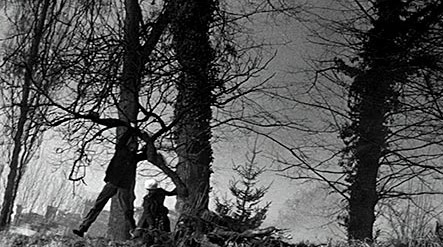
The images I recall most from Sundays and Cybele are the ones that involve Pierre and Cybele (who keeps her real name obscured from Pierre until just the correct moment–she tells him her name is Francoise for most of the film) as they aimlessly wander the watery park paths, their reflections dappling in the ponds they pass, with their dreamy mirror images blending their bodies in with their woodsy surroundings. I love absolutely everything about Bourguignon’s direction (key shots are framed through glass, too), and his mastery of not only black-and-white, but of widescreen photography is never less than magical (the older I get, the more I realize that the matching of Cinemascope and B&W is the stuff of complete wonder). His vivid reflections upon water are visions I have never seen assayed in quite the same way in all of cinema history. Geez, I think that I could watch this movie at least ten more times and get something new out of it. So I hope you forgive me when I say I’ve seen it only once.

Without spoiling the film for you, I should say that it is Patricia Gozzi who stands as its ultimate heroine. She’s so amazingly INTO this role. Her performance here is unmatched–she’s appealing and smart; she’s innocent, and preternaturally mature, and so she knows the limits of this relationship, even if Pierre doesn’t. In fact, she’s way ahead of him, even if she can’t truly express or understand what’s going on in Pierre’s past or present (I do love Hardy Kruger in this movie, too–it may be his most soulful role in a very long career). Make no mistake: the shattering final moments of this film will forever haunt your thoughts. There are stinging tears here. I mean, these young tears burn.


NOTE: this review originally appeared in 2015 as part of WONDERS IN THE DARK's genre overview called THE CINEMA OF CHILDHOOD. Check the whole lineup out here: 

Sunday, December 20, 2015

Film #168: Ponette

Many movies deal with children confronted with the horrors of humanity–wartime, racism, poverty, crime. Yet, in its own quiet way, Jacques Doillon’s diminutive Ponette is among the most powerful of them all, simply because it gets the details of childhood correct. It also never shirks away from the toughest images of abject grief. One should be warned: it’s pretty nigh impossible not to view this movie through a sheen of constantly falling tears. Victoire Thivisol, in the title role, was only four years old when the film was shot, and this must be regarded as a miracle. It’s tempting to read up on how Doillon actually elicited this highly emotional work from such a young soul, but to do so might spoil our impressions of Thivisol as a performer (she would take the 1996 top prize at the Venice Film Festival–as far as I know, the youngest actor to ever win any sort of major award). And this is deserved: by any measure, as her performance is unforgettable.


The film is exceedingly, wonderfully simple. With a tiny cast on her forearm, Ponette is the survivor of a car crash that took her mother’s life. As the film begins, her father (Xavier Beauvois) is comforting her in her hospital bed, and getting ready to drive her back to a boarding school. He expresses anger at his deceased wife–one senses that their relationship was on the skids anyway–while Ponette is still unable to accept that her mother is gone forever. As a parting show of love, she gives her daddy her teddy bear to keep, and he gives her his watch, which she sweetly keeps on her wrist throughout the picture. Doillon then follows this girl, with his camera wisely never lifting above her eyeline, as she struggles to come to terms with her loss.
 
Elizabeth Kubler-Ross once broke down the approach of death into five stages: denial, anger, bargaining, depression and acceptance. One can see each of these stages illustrated here in Ponette’s journey, too, never with a heavy hand and in very much the same order. Some of the film’s most fascinating scenes have her on the playground with her classmates, navigating this process. The film is filled with nominal talk of God and Jesus, and Heaven–both the adults and the kids indulge in this–and we get the sense that Ponette is alternately comforted, confused and infuriated by some of this stuff (at one point, she chides a teacher for feeding her lies). One bossy girl sends Ponette on a playground obstacle course where the ground is a lava pit of Hell, and where there are only scattered islands of safety to which to jump. Her nominal “boyfriend” Mathias listens as she expresses her mind-twisting sadness, and then he kisses her cheek, comforting her in a scene of such aching intimacy that we’re both amused and relieved when he decides to give her his most prized possession: a Batman toy. “You’re nutty, but nice,” he says. All of this dovetails in a superb scene where Mathias and Carla decide to give Ponette one final test, exiling her to a trash bin for five minutes, to replicate the feeling of death and to strengthen her bravery. Just when we think the film is being unimaginably cruel, her friends find pity for the weeping Ponette and rescue her, excitedly telling her she’s passed muster (and Doillon even finds it possible to wring some laughs from the situation).


To imagine Doillon actually writing this movie–well, it’s nearly unthinkable because he’s got the strange logic and cadence of childhood thought and speech down perfectly. There’s no way that the film was improvised–we know that’s just not an option–yet everything feels ridiculously authentic. We’re forced into realizing that this filmmaker has got a preternatural connection to the world of childhood (and, again, I can’t stress enough the intelligence he shows with his always-close-to-the ground camera, as well as his light hand with Phillippe Sarde’s gentle score). I love the scene where a group of girls are having a giggly but somehow mature nighttime talk about boys and then, later, try and hoodwink Mathias into “marriage” with Carla (“You’re like daddies,” one girl tells him. “You don’t like love,” and then another girl takes offense: “My daddy likes love”). But then we’re stunned when a playground bully produces a pretty realistic toy gun and then pushes Ponette around, blaming her for her mother’s death. This is rough going here, and unlike anything ever seen in cinema–lithe, but mean.

Still, the moments in which Thivisol, alone, commands the screen are the film’s jewels (and she’s in nearly every shot, often in extreme close-up). The pain and turmoil on her frankly adorable face are imminently palpable throughout, and her tears are a real trial for the filmgoer. This is not a movie to watch lightly. And just when Ponette’s depression gets absolutely unbearable–to the point where she discusses with Mathias her wish to die, and then later begins digging in the dirt to join her mother–Doillon provides us with a release valve for all this unrelenting sadness and tension. It’s a twist that’s totally believable, and totally welcome, and it leads Ponette to the only place she really can go–to a nook where she can learn to live again.


NOTE: this review originally appeared in 2015 as part of WONDERS IN THE DARK's genre overview called THE CINEMA OF CHILDHOOD. Check the whole lineup out here: