1) I was SOOOO excited to meet Keir Dullea (star of my favorite movie of all time, Kubrick's 2001: A Space Odyssey) after a screening of Otto Preminger's Bunny Lake is Missing at NYC's Film Forum. He signed my posters from 2001 and David and Lisa (he was REALLY impressed to see the David and Lisa poster; he said he hadn't seen it in over 30 years). As he was waiting for his car after the autograph session, I approached him and, struggling for a question, asked if he found Kubrick to be humorous in any way. He seemed flummoxed and answered, basically, "No, he was way too caught up in the details of making the movie to crack any jokes." I dunno why I asked this question; I suppose I had heard about Kubrick's cutting-up with Malcolm McDowell and Peter Sellers while making A Clockwork Orange and Dr. Strangelove, respectively, and I just wanted to know if the great director's mood was just as light on the 2001 set. I guess it wasn't.
 2) At the terrific 2008 TriBeCa Film Festival, Matthew Modine submitted a fine short film he directed and starred in called I Think I Thought. He also participated in a Kubrick-centric symposium following a 40th Anniversary screening of 2001 (in case you don't know, Modine played Private Joker in Kubrick's 1987 movie Full Metal Jacket). After the program, I followed Matthew outside and got my picture taken with him, plus he gave me a really nice autograph humorously illustrated with a peace symbol (which famously appeared on his helmet in Full Metal Jacket). I gave Matthew the web address to FILMICABILITY, and told him I'm trying to write articles about my 2000 favorite movies. He asked which one of his own films made it on to my list, and I answered Full Metal Jacket (of course), Birdy (Alan Parker, 84), Married to the Mob (Jonathan Demme, 88), Short Cuts (Robert Altman, 93), and Baby It's You (John Sayles, 83). He said those were good choices, and that he would definitely visit my site. I hope he did!
 3) NYC's Walter Reade Theater (part of Lincoln Center) showed Malcolm McDowell's newest movie Never Apologize in September of this year. A filmed version of McDowell's one-man show about his relationship with the late director Lindsay Anderson (with whom McDowell did three of his most notable films, known as "the Mick Travis Trilogy": If..., O Lucky Man!, and Britannia Hospital), Never Apologize was great fun. But I really showed up not only to see If... and O Lucky Man! on the big screen (both of which looked resplendant), but to meet Malcolm McDowell himself. Note: I believe I set a record few could match: McDowell would be the third Kubrick movie hero I'd met in one year.
 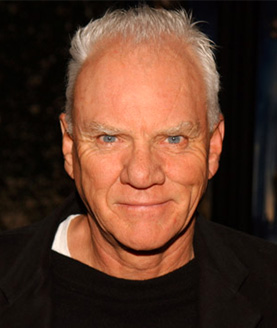 The star of A Clockwork Orange came ambling into the theater about ten minutes before O Lucky Man! ended and I got to speak with him, all by my lonesome, right inside the theater's lobby. I failed to get a picture with him (dang it!), but I did get him to sign his photo in my massive Stanley Kubrick Archives book, as well as my O Lucky Man! and Time After Time posters. I asked him only three questions: (1) Who has the famed golden-threaded suit from O Lucky Man! (he does--"though I don't think I could fit into it now"--and he told a fascinating story about why Anderson decided to include the suit as an element in the movie). (2) Why was If... filmed in both color and black-and-white? He smiled and said he'd been asked that question hundreds of times. His answer: the black-and-white sequences were done out of necessity because the location in which they were filmed wouldn't allow for the sort of lighting that color film required, so Anderson just resorted to shooting the sequences in B&W (sometimes the answers behind such bafflements are just that simple). And (3) when is the famed Stanley Kubrick museum exhibit going to make it to the States--more specifically, to New York? He told me the big problem was shipping all this valuable stuff from London to the U.S. I told him I thought it'd be a massive financial success, and that the effort would be more than worth it. He assured me when he got back to London, he would speak to Kubrick's widow, Christiane, about bringing the exhibit here (it excites me to know that, if it happens, I may have had a hand in it; it looks like the most amazing thing ever!!!) Malcolm then invited me in to sit with him as we watched the joyous final scene of O Lucky Man! together. Listening to Alan Price's kickin' title song, I whispered to Malcolm "This is the best original rock-and-roll score ever written for movies." He gave me a playful punch in the arm and a "Damn right!" smile. What a thrill!!!
4) Working at the sadly now-defunct Kim's Video in the East Village during the first half of 2008 provided me with a few short Brushes with Greatness. The first: helping a bearded Ryan Gosling (The Believer, Stay, The Notebook, and Oscar nominee for his brilliant showing in 2006's Half-Nelson) as he tried to locate a copy of John Huston's great 1972 boxing movie Fat City. Knowing the difficulty of finding a single title amongst the legendarily vast collection at Kim's (which is soon to be relocated to a small town in Sicily, of all places!), I stepped out from behind the counter to find the film for him (while wondering if he was researching a new role), and he said, "Oh, you don't have to do that!" I answered "Hey, I'd do it for anyone else. That's what I'm here for!"
 5) I was struck dumb at Kim's when I found the beautiful Chloe Sevigny standing in front of me, renting (strangely enough) Lindsay Anderson's If... I acted as if she were not a huge movie star (as you're supposed to do in NYC), and I recommended O Lucky Man! to her. As to let me know what name was on her account (so I could type it into the Kim's computer system), she humbly showed me her driver's licence (as if I didn't already know who she was). I can still feel that shock of hidden desire that shot painfully up my spine as I locked glances with her big, beautiful blue eyes. What a stunner she is!
 6) I met three directors I admire at Kim's, too: the wonderful Kelly Reichardt (the director, pictured below, of Old Joy and my #3 movie of 2008 Wendy and Lucy), Chuck Workman (the Oscar-winning director of Precious Images and the man who compiles all the film history tributes at each year's Academy Awards), and David O. Russell (Spanking the Monkey, Flirting with Disaster, Three Kings and I Heart Huckabees). I quickly complimented them all on their work.
  7) I'll never forget sitting in the front row at the TriBeCa Film Festival's 2001: A Space Odyssey symposium and looking straight at Buzz Aldrin, the second man to step foot on the moon, as he discussed his impressions of 2001 and his trip to that great gray rock in the sky. I didn't get to meet him: famously shy, Aldrin made a bee-line to the door (refusing to give autographs) once the photo ops were over. But it was incredible hearing him speak about the details of his most famous mission.
 8) At the same film festival, I saw the unmistakable Michael Moore (Bowling for Columbine, Roger and Me, Sicko, Fahrenheit 9/11) making his way through the crowd. He kindly made time for a quick handshake, after which I patted him on the back and thanked him for both his films and his political bravery.
 9) Through my good friend, photographer/filmmaker Richard Sandler (The Gods of Times Square), I got to meet another accomplished photographer, Sylvia Plachy, a number of times. Pictured at right below (with director Rebecca Dreyfus, maker of 2008's Self-Portrait with Cows Going Home and Other Works: A Portrait of Sylvia Plachy), the brilliant and generous Ms. Plachy is also notable as being the mother of Oscar-winner Adrian Brody (she and her husband regaled me over dinner about Adrian's experiences filming The Pianist with Roman Polanski, and his more recent travails playing the famed matador in the yet-to-be-released bio-pic Manolete). I got to feel famous myself, however briefly, as we shared a few laughs over drinks. I even gave her an original drawing of mine (which I titled "Self Portrait Without Cows"). She told me later she had my drawing framed and that it was now hanging up in her pad. Wow!
  10) At the film festival, I talked briefly with legendary filmmaker Melvin Van Peebles--the man behind the groundbreaking Sweet Sweetback's Baaaaadassss Song. I mentioned how much I particularly loved 1970's The Watermelon Man, and he kindly told me some tales about his experiences filming that subversive and underseen masterpiece. What a guy!
 All this, plus I got to see magician David Blaine performing on the streets, NYC Mayor Michael Bloomberg and NY Governor David Patterson speechifying at the TriBeCa Film Festival's opening press conference, This is England and Somers Town director Shane Meadows outside of the Strand book store, Blair Witch Project co-director Daniel Myrick at the opening party for his newest movie The Objective, character actor and acting professor Austin Pendleton (What's Up Doc, A Beautiful Mind, Skidoo, Catch-22, My Cousin Vinny, The Muppet Movie, Mr. and Mrs. Bridge) at a Whole Foods Market, and music legend Nick Lowe (below) performing an intimate and extra-entertaining 30-minute set at a small TriBeCa venue. All these fine people, in their own small ways, helped make 2008 a memorable year indeed for me. Now I have 2009 to look forward to!


