Showing posts with label Catinca Untaru. Show all posts

Wednesday, November 16, 2016

2006--The Year in Review

2006 is dominated by two movies for me: one, a sickeningly tense historical thriller about the new realities in the fight against terrorism, and the other, an utterly transporting epic about the power of imagination (actually, one of two such stories this year, both commandeered by young girls). Tarsem Singh's The Fall--which I didn't see until its summer 2008 US release--and Guillermo Del Toro's Pan's Labyrinth were positively psychotropic in their assured visions, yet The Fall had so much more weight to it because of its tremendous lead performances from Lee Pace (as a depressed silent-era movie stuntman laid up with a broken body and heart) and the astonishing Catinca Untaru, a Romanian girl who at seven years of age delivers the kind of searing, funny, charming performance that actors ten times her age would love to have on their resume; her performance is a miracle, and I'm particularly glad to give this near-toddler my Best Actress nod. In The Fall, she plays a young hospital patient with an awkward arm cast who pays friendly visits to Pace's character and gets drawn into his vividly bold tales of fantasy. The Fall is such a superb film--surprisingly, maybe the greatest superhero movie ever (it gets to the heart of why we find such tales fascinating). It's so gorgeous as it tours us literally all around the world (it was filmed on location in over 20 different countries) and it's so damn moving that it's wholly difficult for me to not award it Best Picture (if I was choosing it as a film from 2008, when I first saw it, it'd win assuredly). But The Fall really had its first showing (probably unfinished) at a film festival in 2006, so I have to consider it a product of that time. Still, if I had one 2006 film to steer people towards, it'd be this one. I love Del Toro's cult hit, but it doesn't move me nearly as much as The Fall, though Pan's Labyrinth greatly impresses my eyes. However, given all this, I'm proud to award the top spot to among the most gut-wrenching movies ever made.

Paul Greengrass' United 93 is, markedly, the earliest narrative commentary on the 9/11 tragedy and, to date, the very last cinematic word on the subject. Will any film director ever in history be able to give us the sense of actually being there, on the earth, above on the flight, in the conference rooms and the towers, at that moment the planes hit the World Trade Center? United 93 sets an impossibly high bar. Greengrass made a daring choice in casting many of the aviation and military officials that were actually working that day (Ben Sliney, the newly-named Federal Aviation Administration's head officer, recreates his nascent hours on the job with such incredible power that I had to nominate him for Best Supporting Actor). This lends a dazzling palpability to what we see. But then we have the superb actors cast as the passengers on the doomed flight, all of them (the ones playing the terrorists included) forming a spectacular ensemble that inseparably mingles with the unimaginably authentic work from the real-life non-actors. The British filmmaker Greengrass gives more aching truth to his work with cinematographer Barry Ackroyd's textbook-correct handheld camerawork, while the obscuring sound design, sharp editing. and nearly invisible special effects are all perfectly utilized to put us right in the seats of some who lost their lives that day. United 93 is a film that succeeds horribly and magnificently even though we know how it has to end. To this day, after watching it over and over, it still gets my blood up. It's that powerful--I can't state it any more starkly. I stand in wonder: how did this filmmaker do it? How was he able?

I really adored many other movies from 2006--Alfonso Cuarón's astoundingly mournful and masterful sci-fi tale Children of Men (the perhaps rightful favorite of many movie lovers); the chilly but moving Cold War yarn The Lives of Others (led by the haunted Ulrich Muhe, who was dying of cancer while the film was being made); Old Joy, Kelly Reichardt's little-seen, low-key yet profoundly revealing story of fading male friendship; Todd Field's almost anthropological dissection of American suburban malaise Little Children (with one-time child star Jackie Earle Haley returning to greatness); Apichatpong Weerasethakul's Syndromes and a Century, an eerie anecdote cementing this Thai newcomer's work as an alternative to stale Western cinema; the hilariously muscle-spraining Borat: Cultural Learnings of America for Make Benefit Glorious Nation of Kazakhstan, a perfect translation of Sasha Baron Cohen's humor from the small screen to the big--a rare success in that fashion and one which made him a worldwide star; Shane Meadow's This is England, an exacting '80s-set recount of a British kid's intro into the punk-driven skinhead movement, with young Thomas Turgoose heading a superb cast; Darren Aronofsky's challenging, time-hopping romance The Fountain; and Robert Altman's cinematic wake, a raucously prescient farewell to movies and a worldwide love letter based on Garrison Keillor's A Prairie Home Companion. I, too, adored Martin Scorsese's maze-like crime film The Departed, but as I have already given accolades to this genius for Taxi Driver, The Last Waltz, Raging Bull, The Last Temptation of Christ, Goodfellas, and A Personal Journey with Martin Scorsese Through American Movies, I'm not in the position of having to sheepishly hand him, as the Academy did, a make-up award for a fine but lesser film. I have no doubts as to the best movie of 2006: it's the one that captures me once I see a single frame of it and lets me go only at its brutally crushing end. There will, I hope, never be another like it. NOTE: These are MY choices for each category, and are only occasionally reflective of the selections made by the Academy of Motion Picture Arts and Sciences (aka The Oscars). When available, the nominee that actually won the Oscar will be highlighted in bold.

PICTURE: UNITED 93 (US, Paul Greengrass)
(2nd: The Fall (US/India, Tarsem Singh)
followed by: Children of Men (US/UK, Alfonso Cuarón)
The Lives of Others (Germany, Florian Henckel von Donnersmarck)
Old Joy (US, Kelly Reichardt)
Little Children (US, Todd Field)
Syndromes and a Century (Thailand, Apichatpong Weerasethakul)
Borat: Cultural Learnings of America for Make Benefit Glorious Nation of Kazakhstan (US, Larry Charles)
This is England (UK, Shane Meadows)
A Prairie Home Companion (US, Robert Altman)
Inside Man (US, Spike Lee)
Friends with Money (US, Nicole Holofcener)
The Fountain (US, Darren Aronofsky)
Scott Walker: 30 Century Man (UK, Stephen Kijak)
The Departed (US, Martin Scorsese)
Pan’s Labyrinth (Mexico, Guillermo Del Toro)
Away From Her (Canada, Sarah Polley)
Talladega Nights: The Ballad of Ricky Bobby (US, Adam McKay)
Inland Empire (US, David Lynch)
Idiocrasy (US, Mike Judge)
Casino Royale (US/UK, Martin Campbell)
Tell No One (France, Guillaume Canet)
Babel (US/Mexico, Alejandro González Iñárritu)
Alpha Dog (US, Nick Cassavetes)
The Pervert’s Guide to Cinema (UK/Austria/Netherlands, Sophie Fiennes)
Letters from Iwo Jima (US, Clint Eastwood)
The Prestige (US, Christopher Nolan)
Half Nelson (US, Ryan Fleck)
The Good Shepherd (US, Robert De Niro)
Longford (UK, Tom Hooper)
Maxed Out: Hard Times, Easy Credit and the Era of Predatory Lenders (US, James D. Scurlock)
12:08: East of Bucharest (Romania, Corneliu Porumboiu)
The Hoax (US, Lasse Hallstrom)
Notes on a Scandal (UK, Richard Eyre)
The Prestige (US, Christopher Nolan)
Marie Antoinette (US, Sofia Coppola)
Apocalypto (US, Mel Gibson)
The Wind That Shakes the Barley (UK/Ireland, Ken Loach)
The Break-Up (US, Peyton Reed)
Sherrybaby (US, Laurie Collyer)
Manufactured Landscapes (US, Jennifer Baichwal)
Jindabyne (Australia, Ray Lawrence)
Black Book (Netherlands, Paul Verhoeven)
Iraq in Fragments (US, James Langley)
Perfume: The Story of a Murderer (Germany/France/Spain/US, Tom Tykwer)
The Queen (UK, Stephen Frears)
The Bridge (US, Eric Steel)
The Namesake (India/US, Mira Nair)
The Little Death (US, Morgan Nichols)
Rescue Dawn (US, Werner Herzog)
This Film is Not Yet Rated (US, Kirby Dick)
Jesus Camp (US, Heidi Ewing and Rachel Grady)
Little Miss Sunshine (US, Jonathan Dayton and Valerie Faris)
An Inconvenient Truth (US, Davis Guggenheim)
A Guide To Recognizing Your Saints (US, Dino Montiel)
The TV Set (US, Jake Kasdan)
The Illusionist (US, Neil Burger)
Volver (Spain, Pedro Almodóvar)
Who Is Harry Nilsson (And Why Is Everybody Talkin’ About Him?) (US, John Schienfeld)
Rocky Balboa (US, Sylvester Stallone)
Infamous (US, Douglas McGrath)
Dreamgirls (US, Bill Condon)
Flags of Our Fathers (US, Clint Eastwood)
Black Snake Moan (US, Craig Brewer)
Hollywoodland (US, Allen Coulter)
Monster House (US, Gil Kenan)
Jonestown: The Life and Death of Peoples Temple (US, Stanley Nelson)
Southland Tales (US, Richard Kelly)
Happy Feet (US/Australia, George Miller)
The Last King of Scotland (UK, Kevin MacDonald)
The Host (South Korea, Bong Joon-ho)
Shortbus (US, John Cameron Mitchell)
The Black Dahlia (US, Brian De Palma)


ACTOR: Ulrich Muhe, THE LIVES OF OTHERS (2nd: Sasha Baron Cohen, Borat: Cultural Learnings of America for Make Benefit Glorious Nation of Kazakhstan, followed by: Ryan Gosling, Half Nelson; Thomas Turgoose, This is England; Leonardo DiCaprio, The Departed; Lee Pace, The Fall; Richard Gere, The Hoax)

ACTRESS: Catinca Untaru, THE FALL (2nd: Laura Dern, Inland Empire, followed by: Kate Winslet, Little Children; Julie Christie, Away From Her; Helen Mirren, The Queen; Judy Dench, Notes on a Scandal; Maggie Gyllenhaal, Sherrybaby)

SUPPORTING ACTOR: Jackie Earle Haley, LITTLE CHILDREN (2nd: Mark Wahlberg, The Departed, followed by: Forrest Whitaker, The Last King of Scotland (won as Best Actor); Ben Sliney, United 93; Stephen Graham, This is England; John C. Reilly, Talladega Nights: The Ballad of Ricky Bobby)


SUPPORTING ACTRESS: Jennifer Hudson, DREAMGIRLS (2nd: Shareeka Epps, Half Nelson, followed by: Cate Blanchett, Notes on a Scandal; Frances McDormand, Friends With Money; Abigail Breslin, Little Miss Sunshine; Phyllis Sommerville, Little Children; Adriana Barraza, Babel)


DIRECTOR: Paul Greengrass, UNITED 93 (2nd: Tarsem Singh, The Fall, followed by: Alfonso Cuaron, Children of Men; Kelly Reichardt, Old Joy; Florian Henkel von Donnensmark, The Lives of Others; Todd Field, Little Children; Apiachapong Weerasethakul, Syndromes and a Century)


NON-ENGLISH LANGUAGE FILM: THE LIVES OF OTHERS (Germany, Florian Henkel von Donnensmark) (2nd: Syndromes and a Century (Thailand, Apichatpong Weerasethakul), followed by: Tell No One (France, Guillaume Canet); Paprika (Japan, Satoshi Kon); Letters from Iwo Jima (US, Clint Eastwood); 12:08: East of Bucharest (Romania, Corneliu Porumboiu); Black Book (Netherlands, Paul Verhoeven); Volver (Spain, Pedro Almodóvar); The Host (South Korea, Bong Joon-ho))

DOCUMENTARY FEATURE: SCOTT WALKER: 30 CENTURY MAN (UK, Stephen Kijack) (2nd: The Pervert’s Guide to Cinema (UK/Austria/Netherlands, Sophie Fiennes), followed by: Maxed Out: Hard Times, Easy Credit and the Era of Predatory Lenders (US, James D. Scurlock); Iraq in Fragments (US, James Langley); The Bridge (US, Eric Steel); This Film is Not Yet Rated (US, Kirby Dick); Jesus Camp (US, Heidi Ewing and Rachel Grady); An Inconvenient Truth (US, Davis Guggenheim); Who Is Harry Nilsson (And Why Is Everybody Talkin’ About Him?) (US, John Schienfeld); Jonestown: The Life and Death of Peoples Temple (US, Stanley Nelson))

ANIMATED FEATURE: PAPRIKA (Japan, Satoshi Kon) (2nd: Monster House (US, Gil Kenan), followed by: Happy Feet (US/Australia, George Miller))


ANIMATED SHORT: EVERYTHING WILL BE OK (US, Don Hertzfeld) (2nd: The Danish Poet (Norway/Canada, Torill Kove), followed by: The Little Match Girl (US, Roger Allers))

LIVE ACTION SHORT: LA MORTE ROUGE (Spain, Victor Erice) (2nd: West Bank Story (US, Ari Sandel), followed by: Touch (US, David Hamilton))


ORIGINAL SCREENPLAY: Florian Henkel von Donnensmark, THE LIVES OF OTHERS (2nd: Paul Greengrass, United 93, followed by: Nicole Holofcener, Friends With Money; Shane Meadows, This is England; Kelly Reichardt and Jonathan Raymond, Old Joy)


ADAPTED SCREENPLAY: Alfonso Cuaron, Timothy J. Sexton, David Arata, Mark Fergus, and Hawk Ostby, CHILDREN OF MEN (2nd: Sasha Baron Cohen, Anthony Hine, Peter Baynham, Dan Mizer and Todd Phillips, Borat: Cultural Learnings of America for Make Benefit Glorious Nation of Kazakhstan, followed by: Todd Field and Tom Perrotta, Little Children; William Monahan, The Departed; Dan Gilroy, Nico Soultanakis, and Tarsem Singh, The Fall)


CINEMATOGRAPHY: Colin Watkinson, THE FALL (2nd: Emmanuel Lubezki, Children of Men, followed by: Wally Pfister, The Prestige; Guillermo Navarro, Pan's Labyrinth; Barry Ackroyd, United 93)

ART DIRECTION: PAN'S LABYRINTH, Marie Antoinette, The Fall, Perfume: The Story of a Murderer, The Fountain


COSTUME DESIGN: THE FALL, Marie Antoinette, The Fountain, The Prestige, Dreamgirls


FILM EDITING: UNITED 93, Children of Men, The Departed, The Fall, Inside Man

SOUND: UNITED 93, Children of Men, World Trade Center, Apocolypto, Casino Royale


SOUND EFFECTS: WORLD TRADE CENTER, Apocolypto, Letters from Iwo Jima


ORIGINAL SCORE: Clint Mansell, THE FOUNTAIN (2nd: Gustavo Santolalla, Babel, followed by: John Powell, United 93; Philip Glass, Notes on a Scandal; Alexandre Desplat, The Painted Veil)


ORIGINAL SONG: “I Need to Wake Up” from AN INCONVENIENT TRUTH (Music and lyrics by Melissa Etheridge) (2nd: “O Kazakstan” from Borat: Cultural Learnings of America for Make Benefit Glorious Nation of Kazakhstan (Music by Erran Baron Cohen; lyrics by Sacha Baron Cohen, Anthony Hines, Beter Baynham, Todd Phillips, Dan Greaney, Jeff Poloquin and Patton Oswalt), followed by: “A Father’s Way” from The Pursuit of Happyness (Music and lyrics by Seal))


ADAPTED OR SONG SCORE: Richard A. Dworsky, A PRAIRIE HOME COMPANION (2nd: Tom Eyen and Henry Krieger, Dreamgirls)


SPECIAL EFFECTS: CHILDREN OF MEN, United 93, Pan's Labyrinth

MAKEUP: PAN’S LABYRINTH, Apocolypto, The Fall

Thursday, January 1, 2009

Film #100, and The Best Movie of 2008: The Fall (and Its Most Overrated Movie: The Dark Knight)

In the spring of 2008, I was wandering around New York City when I saw a stunning poster plastered all over a city wall.


Always on the lookout for new movie posters (which trump trailers as my preferred way of being notified about new films), I saw this masterful work of art glued to these battered bits of particle board and exclaimed inside "WHAT IS THIS??" I read the fine print. At the top, it said "David Finscher and Spike Jonze Present." Two heavy-hitter directors, that's for sure...but they just were generously lending their names as helpful "presenters" of the project, much like David Lynch did with Terry Zwigoff's Crumb, for instance. Still, I was impressed they liked this movie enough to do that.

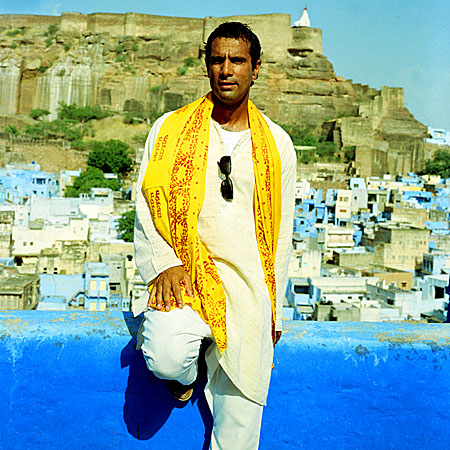
And I read on. No one I knew was involved...and then I got to the writer and director credits. Tarsem Singh (pictured below), acclaimed director of arguably the best music video ever, REM's "Losing My Religion," was at the helm. I then knew The Fall was going to be an event. Singh's 2000 release The Cell was a flawed but strangely beautiful movie. However misbegotten it was (and I did have many problems with it), I knew when I saw The Cell that at least a new and ambitious autuer was upon us. But, by 2008, I had totally forgotten about Tarsem (as he was known earlier, in his MTV-Award-winning days). He had seemed to have disappeared from the moviemaking scene in the intervening years. So I got a rush when I saw that The Fall, after a long 2-year run as a film festival staple, was soon to hit theaters. I knew nothing about the movie's plot, and wanted to know nothing about it. I knew only that it had to be seen.


The Fall is the best movie of 2008 for a number of reasons. It reminds us of the power of imagination. It highlights an unusual relationship, beautifully played by two largely unknown leads. It is visually stunning (to say the least). And, though it is a period piece, set in the 1920s, it has a lot to say about the sickly current state of movies.

Now, I must go off on a tangent.

In a year that gave us not only the coddled, overrated The Dark Knight, but also Iron Man, The Incredible Hulk, The Punisher, another James Bond movie (Quantum of Solace), another Indiana Jones movie (Indiana Jones and the Kingdom of the Crystal Skull), and The Spirit, (not to mention TV's Heroes), I think its safe to say that the Superhero meme has taken over moviedom. And there's more to come, with Watchmen now being touted as the movie we should be most looking forward to in 2009 (yawn).


But what do superheroes mean to us moviegoers? Do we or should we care about them as characters? Take, for instance, Bruce Wayne--in my view, this is hardly a person about which we should give two shits. Honestly: it's hard to muster up any feeling whatsoever for spoiled rich boy Bruce Wayne and his dim, ineffective grappling with mental illness, and with the admittedly unfair and bloody death of his parents. Even The Dark Knight itself is clearly uninterested in him; unlike in the vastly superior Batman Begins, there's not one shining moment for its star, Christian Bale. Let's face what we all know to be true: The Dark Knight would not be memorable at all were The Joker not in it. Subtract the late Heath Ledger's truly incredible supporting performance from the mix and The Dark Knight melts into a shapeless mess. But this should come as no surprise. At its heart, in whatever form it takes, the Batman franchise is REALLY all about its villains; this makes Christopher Nolan's new take on Batman not so far away from its campy 60s-era TV progenitor, for which millions of viewers tuned in each week to see Vincent Price as Egghead, Cliff Robertson as Shame, Cesar Romero as The Joker, or Burgess Meredith as The Penguin (the show's impressive guest star roll call could go on and on). Already, love-blinded fanboys all over the net are frothing at the mouths as they speculate about who'll be cast as Batman's next big screen nemesis, with Marion Cotillard (Oscar winner for last year's wonderful La Vie En Rose) intriguingly being submitted in some corners as the perfect Catwoman.

See, the villain is definitely the thing. All the movie's irritating fans crow about is how "relevant" The Dark Knight is to our present socio-political climate, comparing it ridiculously to The Godfather Part II in terms of highbrow quality. Namely: they like to make correlations between the chaos-loving Joker and the terrorists bedeviling our collective psyche these days. But the terrorists aren't in this thing just to create upheaval (though it might seem as such by the less attentive among us); they've got they're own reasons for creating the mayhem that they do--some of them are even understandable (if reprehensible). To match their politically- and culturaly-motivated efforts up to The Joker's merely-for-sick-fun actions proves a particularly dim worldview is endemic amongst Batman fans.

I have to posit this thought as well: if Bruce Wayne is such a great guy, instead of spending all his money on thrillseeking battles with nasty people, why doesn't he give some of his trillions to the more downtrodden denizens of the world? The fact that so many movie fans hold the "hero" of The Dark Knight up to such high regard tells me one depressing thing: they think make-believe guys in tight suits who kick the asses off bad guys are MUCH more interesting than guys who might direct their efforts and their cash in much more conventionally constructive directions.


The amazing thing about Christopher Reeve as Superman was that, throughout his charming and heartfelt performance, he convinces us that Clark Kent and Superman were one and the same person. Therefore, we cared. Not so with anyone who has played Batman in the movies. Michael Keaton as Bruce Wayne and Michael Keaton as Batman? Two different people. Christian Bale as Bruce Wayne and Christian Bale as Batman? Two different people (and, yes, I realize that, in both cases, this is by design, but so what? It still distances us from the character, and stands as a fundamental flaw in the Batman persona). Dismissing the Val Kilmer and George Clooney Batmans outright, this makes Adam West the ideal Batman, 'cuz he's a campily square, unctuous ass with or without the blue leotard. But let's remember: Chris Reeve as Clark Kent and Chris Reeve as Superman? Same lovable, idealistic, moral guy. Thus, Superman (Richard Donner, 1978) and Superman II (Richard Lester, 1980) remain, for me, the best superhero movies made to date (not including Indiana Jones and James Bond movies; both are superheroes, yes, but cut from differing cloths).

With that in mind, Iron Man remains the finest all-out superhero movie of 2008--much more comprehensible and enjoyable than The Dark Knight--because it convinces us that Tony Stark is identical both outside and inside the Iron Man suit. This is only one reason why Iron Man is superior to The Dark Knight. And also: again, The Dark Knight would be a blah movie without The Joker. But who remembers the villain in Iron Man? No one. Why? Because the villain isn't the point there. The point is Tony Stark, our hero (humorously flawed as he is). He's the center of attention. And Robert Downey Jr's funny, gutsy, smarty-pants performance is the jewel in the movie's crown.

Now, why am I talking about Iron Man and The Dark Knight so much in a review that's ostensibly about The Fall? Simple. The Fall, too, is about superheroes. But it casts them as vulnerable humans. AND it takes care to recognize what worth such characters add to our lives. These are exactly the elements that superhero movies need to survive and thrive.


The Fall takes place at a Los Angeles hospital in the 1920s. Roy (Lee Pace) is a different kind of superhero--a silent movie stuntman. But he's been explosed to a glum reality: he's not indestructible. He's been seriously injured while performing superhuman feats for the camera. Now he's in this hospital, recovering not only from paralysis, but from a broken heart as well. It is the latter malady, in fact, that has festered and become more serious. Jilted in romance, Roy now wants to take leave of life by suicide. Only problem is, his damaged legs won't allow him to procure the morphine needed to ensure his death.

The Fall is very much also about lies and their intrinsic relationship to storytelling, so it shouldn't come as a shock that Roy feels forced to LIE to someone in order to get his precious morphine. That someone is Alexandria, played by the mesmerizing Catinca Untaru. Alexandria is a vivacious, intelligent 6-year-old with an arm that may or may not have been broken by an abusive father. While poking around the hospital, she strikes up a conversation with Roy, and the two become fast friends. Desperate to connect with someone, Roy also targets Alexandria as someone who can be easily manipulated. So he regales and slyly blackmails her with episodes from a floral fairy tale involving six incredible men: The Blue Bandit (played by Emil Hostina at first, then later by Pace); explosives expert Luigi (Robin Smith); master of knowledge Charles Darwin (Leo Bill); an all-powerful Indian (Jeetu Verma); a mystical swordsman (Julian Bleach); and a muscular African slave (Marcus Wesley). This unforgettable team of heroes band together on a hunt for the head of the evil Spanish Governor Odious (Daniel Caltagirone), who's horribly (and humorously) wronged them each.


Roy's telling of this story -- or, more specifically, Alexandria's imagining of it -- provides The Fall with its most stupendous imagery. Some reviewers faulted the film for not making this part of the movie more clearly plotted. But the fact is that the fantastical portions of The Fall do not constitute the film's point; they are, after all, representations of a story that's being made up on the fly, for ulterior motives, and as such the story's holes intentionally appear. These are lusciously fun scenes to watch, but Tarsem Singh clearly wants to interest us more in how the bond between Roy and Alexandria is to play out. That said, just take a look at this gorgeous gallery of images from the fantasy sequences in The Fall and tell me, with a straight face, that this is not a movie that NEEDS to be seen.


Pace and especially Untaru are mesmerizing in their roles. In reading about The Fall, I've discovered that Singh actually tricked Untaru--who was too young to take direction--into delivering much of her performance, filming when she wasn't aware that the cameras were rolling. This doesn't make her showing here any less perfect. Untaru, with her chubby face and big eyes, delivers for me the single best bit of acting of 2008. And Pace is nearly her equal! Their funny, quirky, emotional scenes together are unforgettable.


I love how The Fall ends up being a movie about the movies. It makes the connection between the wonder moviegoers must have felt at watching the world's first films being projected right in front of them, and the wonder most of us present-day moviegoers want to feel again. And I love how, even though it's a superhero movie, it's quick to remind us that even superheroes must die. And I love that the film is basically an extended homage to The Wizard of Oz (each of the fantasy characters also appear in Alexandria's "real" life--just like The Tin Man, The Cowardly Lion, The Scarecrow, The Wicked Witch, and The Wizard were "played" by people in Dorothy's Kansas).


Here at 2008's end, I'm wondering still why I'm not hearing more about The Fall. Why is it not on more year-end top ten lists? And why is it not in serious contention for the Best Picture Oscar? It's the year's biggest independent movie, fully financed by the money Singh made by directing TV commercials and music videos (the globetrotting Singh worked for four years on the film, and must have set a record for the number of locations used: the hospital scenes were filmed in South Africa, and the fantasy scenes were filmed in--get this--India, Indonesia, Cambodia, Brazil, Los Angeles, France, the Fiji Islands, China, Romania, Bolivia, the Czech Republic, Turkey, Nepal, Egypt, Argentina, and the South Pacific's Andaman Islands). It clearly sports the year's most opulent production design (by Ged Clarke), costumes (by Bram Stoker's Dracula Oscar winner Eiko Ishioka), music (by Krishna Levy), makeup (by Leon Von Solms), and photography (by Colin Watkinson). And, written by Singh, Dan Gilroy and Nico Soultanakis, it easily stands alongside Charlie Kaufman's also-underseen Synecdoche, NY as 2008's most original movie (even if it is a remake of an little-seen 1981 film called Yo Ho Ho). It's a mystifying crime of colossal magnitude that The Fall isn't being seen and loved by more people. It certainly has more brains, heart, and pure gumption than that lazy ol' Dark Knight.