Just to break up The 9 Years a bit, here's another edition of my film clip series SIDE ORDERS. We start with the first film ever made -- and no, it's not Women Leaving A Factory by the Lumiere Brothers. That was the first film over 30 seconds, and was made in 1895. This is Thomas Edison's Kinetoscopic Record of a Sneeze, filmed on Jan. 7, 1894. So that means we just passed the 115th Anniversary of the art form! Thanks to the Library of Congress, an indefatigable reference source for movie history.
Here's one of my favorite love scenes of all time, from George Stevens' 1951 film A Place in the Sun. Montgomery Clift is a poor boy working a factory owned by the father of Elizabeth Taylor. They're conducting an affair while Clift is also off getting frumpy factory co-worker Shelley Winters "in trouble." Steven's claustrophobic, intimate handling of Clift and Taylor's first dance together undoubtably propelled the director into receiving his first Oscar that year (as did the film's superior, Oscar-winning black-and-white photography by William C. Mellor). I, and millions of other filmgoers, have swooned over the palpable nervous energy these two actors have together, and Taylor--with her famous final line--has never been sexier. Great film, and the winner of four more Oscars for its screenplay (by Michale Wilson and Harry Brown), costumes (by Edith Head), editing (by William Hornbeck) and music (by Franz Waxman).
This is a short scene from a movie I love, but on which very few people agree with me: Franklin Schaffner's Papillon, released in 1974, with Steve McQueen as Henri "Papillon" Cheriere, a prisoner at the brutal jungle prison that was once run out of French Guiana in South America. Papillon spends most of the movie trying to figure out how to escape from this hellhole, with fellow prisoner and best friend Dustin Hoffman acting as his one investor. It's an exciting film, both in action and in its filmmaking quality. My favorite sequences come when Papillon is thrown into solitary confinement for a ridiculous number of years--a state which drives him to despair and lunacy. Occurring during this period, the following is a dream sequence of such stunning power (I love its brevity) that I think it's been hard for many viewers to forget; I've even seen it referenced in an episode of The Sopranos. The two men to whom Papillon is running to greet are supporting characters who earlier met bloody fates. I feel this is an undeniably powerful sequence, especially in the context of the film. TURN THE SOUND UP FOR THIS.
I've always been a big Peanuts fan. So, of course I love the TV shows taken from Charles Schulz's strip and, perhaps against my better judgment, I like the movies, too--Snoopy Come Home, Race For Your Life Charlie Brown, and A Boy Named Charlie Brown. This scene, from the latter film, made in 1969, is unusual in that it gives a visual voice to one of the strips more inscrutable characters: Schroeder, the Beethoven-loving, piano-playing wunderkind. It's a perfect scene to lift out of the movie, because it involves no plot: it's just a beautifully-designed bit of Bill Melendez animation that puts pictures to what's going through Schroeder's head as he assays Beethoven's "Moonlight Sonata" on his toy piano. This scene never fails to bring a tear to my eye, somehow, especially when I note Schroeder's lovingly pained expression as he finishes the piece. It's a scene that indelibly illustrates fandom.
Showing posts with label Side Orders. Show all posts
Showing posts with label Side Orders. Show all posts
Sunday, May 3, 2009


Saturday, March 28, 2009
SIDE ORDERS #10
To start off in the latest edition of SIDE ORDERS, I have the simple but powerful video that pops up in the middle of Barry Shear's 1968 movie Wild in the Streets. An incendiary work like this couldn't be produced today; its premise: the youth have taken over America, and a pop star, Max Frost, is elected to the U.S. presidency. All people over 35 are put into concentration camps and fed LSD (the film is partially inspired by that ol' 60s bromide "Never trust anyone over 30"). Produced by Corman-competitors AIP (Arkoff International Pictures, named for Samuel Z. Arkoff) and Oscar-nominated for its editing (amazingly enough), Wild in the Streets is a sometimes campy but ultimately frightening look at the hate that lay inside even the most peace-loving sixties hippie; it's also very politically savvy. The landmark soundtrack, including the hit song "The Shape of Things to Come," was largely written by Brill Building denizens Barry Mann and Cynthia Weil. Here's just four of this married songwriting team's greatest hits: "On Broadway" by The Drifters, "We Gotta Get Out of This Place" by The Animals, "You've Lost That Lovin' Feelin'" by The Righteous Brothers, and "Don't Know Much" by Aaron Neville and Linda Rondstadt. Though I have no idea if he actually did the vocals or not (he probably didn't do the singing), the on-screen performer here is Christopher Jones, the late 60s movie star who later memorably appeared in David Lean's Ryan's Daughter. Jones voluntarily cut short his movie career after discovering he liked painting better (he was also extremely distraught over the Manson-perpetrated murder of his friend and one-time lover Sharon Tate). He was offered the role of Zed in Tarantino's Pulp Fiction, but turned it down. Still, in both this and Ryan's Daughter, he's a resonating presence.
Lord of War, directed by Andrew Nichols (Gattaca), was an only intermitantly interesting film from 2005 with Nicholas Cage as an arms dealer selling his wares to third-world countries. My initial feelings upon hearing the movie's title are: blah. But I'm extremely enthusiastic in my support of its astounding credits sequence, which details the birth of a bullet. As they used to say with Saul Bass-designed openings, it alone is worth the price of admission.
The Knack, and How To Get It won the Palme D'or at the 1965 Cannes Film Festival and was American-born Richard Lester's first film post-Beatles (he directed the Beatles' vehicles A Hard Day's Night and Help!). The Knack is a frantic romp in which its lead (Michael Crawford, later more famous for being the original Phantom of the Opera on Broadway) is a wimpy London schoolteacher trying to learn how to pick up girls from his more romantically successful upstairs neighbor (Ray Brooks). The strangely alluring Rita Tushingham is the girl who may or may not be made just for him. Lester (pictured right) made an extremely smart and funny movie, but only IF you're paying attention (and even if you're not, there's a lot of fantastic visual humor in it). Extremely influenced by the French Nouvelle Vague, it has a playful attitude towards cinema, utilizing a myriad of camera tricks to jolt the audience into laughter. It also has a terrific trailer, backed by jazzbo John Barry's potent score. By the way, even though it's in English, the British brogues are so thick that I recommend The Knack, and How To Get It be watched with the subtitles on. As such, though, it's a perfect film for its singular time and place.
I think seeing normal people at work at what they do is one of the prime subject matters that has been left by the wayside cinematically. I always love it when I'm seeing people on-screen making a gainful living. And, as a movie lover, I'm especially interested in seeing people make movies. As far as I know, this scene from Albert Brooks' Modern Romance is the only scene in film history that follows what a film editor does. As editing is possibly the most important element of moviemaking, I find this scene to be an invaluable resource. It's also quite nostalgic, having been made before the digital editing revolution. So here, with Albert Brooks and Bruno Kirby (as his assistant), we get to see what went into editing movies when we had flat-bed editing tables and splicing tape and so many more valuably tactile elements to the art. The two guys are working with footage shot for a low-budget sci-fi movie starring George Kennedy (and directed by "David," played by Simpsons creator and Oscar-winner James L. Brooks). Though this movie is largely about Brooks' troubled relationship with his girlfriend Kathryn Harrold, I'm very thankful Brooks took the time to concoct this brilliant scene, which stands as a mini-lesson in the art of film editing (there's even a later moment where Brooks and Kirby are struggling to create sound effects for this crappy movie).
With 1980's The Long Riders, writer/director Walter Hill, for a short time, seemed like the new Sam Peckinpah. But, as we now know, NO ONE can keep that game up. Peckinpah--the director of The Wild Bunch, The Getaway, Ride the High Country, and Bring Me The Head of Alfredo Garcia--was a singular film personality. Still, this shootout scene remains the best ersatz Peckinpah available; hell, since this movie, no one has even TRIED to replicate the Peckinpah mystique. The casting of The Long Riders is perhaps its greatest wonder: James and Stacy Keach as Frank and Jesse James; David, Keith and Robert Carradine as Cole, Jim, and Bob Younger; David and Randy Quaid as Ed and Clell Miller; and Nicholas and Christopher Guest as Robert and Charlie Ford. This is a feat, to be sure; four set of acting brothers in one movie? The chances of this ever happening again in cinema history are the same as being the victim of an avalanche 30 times in a row! Witness this kinetic scene, with perfect editing and sound (no score) that has the James gang riding into Minnesota's Northfield, ready to rob the town bank, not knowing that they're being tracked by pissed-off authorities. An incredible scene, replete with Peckinpah-like slow-motion that arguably comes close to outdoing the master. Finally, for fun, an old rotoscoped video I used to see in between movies on HBO's "Video Jukebox" in the early 1980s. I don't know anything about the artist, Hilly Michaels, except that the video and the song "Calling All Girls" kicks-fucking-ass! One of the best videos ever made!
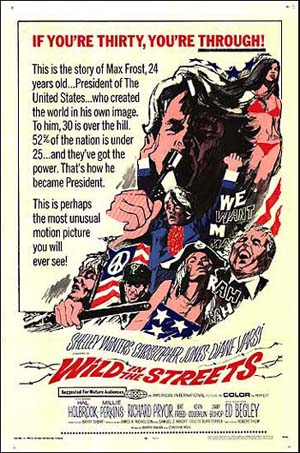 that ol' 60s bromide "Never trust anyone over 30"). Produced by Corman-competitors AIP (Arkoff International Pictures, named for Samuel Z. Arkoff) and Oscar-nominated for its editing (amazingly enough), Wild in the Streets is a sometimes campy but ultimately frightening look at the hate that lay inside even the most peace-loving sixties hippie; it's also very politically savvy. The landmark soundtrack, including the hit song "The Shape of Things to Come," was largely written by Brill Building denizens Barry Mann and Cynthia Weil. Here's just four of this married songwriting team's greatest hits: "On Broadway" by The Drifters, "We Gotta Get Out of This Place" by The Animals, "You've Lost That Lovin' Feelin'" by The Righteous Brothers, and "Don't Know Much" by Aaron Neville and Linda Rondstadt. Though I have no idea if he actually did the vocals or not (he probably didn't do the singing), the on-screen performer here is Christopher Jones, the late 60s movie star who later memorably appeared in David Lean's Ryan's Daughter. Jones voluntarily cut short his movie career after discovering he liked painting better (he was also extremely distraught over the Manson-perpetrated murder of his friend and one-time lover Sharon Tate). He was offered the role of Zed in Tarantino's Pulp Fiction, but turned it down. Still, in both this and Ryan's Daughter, he's a resonating presence.
Lord of War, directed by Andrew Nichols (Gattaca), was an only intermitantly interesting film from 2005 with Nicholas Cage as an arms dealer selling his wares to third-world countries. My initial feelings upon hearing the movie's title are: blah. But I'm extremely enthusiastic in my support of its astounding credits sequence, which details the birth of a bullet. As they used to say with Saul Bass-designed openings, it alone is worth the price of admission.
The Knack, and How To Get It won the Palme D'or at the 1965 Cannes Film Festival and was American-born Richard Lester's first film post-Beatles (he directed the Beatles' vehicles A Hard Day's Night and Help!). The Knack is a frantic romp in which its lead (Michael Crawford, later more famous for being the original Phantom of the Opera on Broadway) is a wimpy London schoolteacher trying to learn how to pick up girls from his more romantically successful upstairs neighbor (Ray Brooks). The strangely
 alluring Rita Tushingham is the girl who may or may not be made just for him. Lester (pictured right) made an extremely smart and funny movie, but only IF you're paying attention (and even if you're not, there's a lot of fantastic visual humor in it). Extremely influenced by the French Nouvelle Vague, it has a playful attitude towards cinema, utilizing a myriad of camera tricks to jolt the audience into laughter. It also has a terrific trailer, backed by jazzbo John Barry's potent score. By the way, even though it's in English, the British brogues are so thick that I recommend The Knack, and How To Get It be watched with the subtitles on. As such, though, it's a perfect film for its singular time and place.
I think seeing normal people at work at what they do is one of the prime subject matters that has been left by the wayside cinematically. I always love it when I'm seeing people on-screen making a gainful living. And, as a movie lover, I'm especially interested in seeing people make movies. As far as I know, this scene from Albert Brooks' Modern Romance is the only scene in film history that follows what a film editor does. As editing is
 possibly the most important element of moviemaking, I find this scene to be an invaluable resource. It's also quite nostalgic, having been made before the digital editing revolution. So here, with Albert Brooks and Bruno Kirby (as his assistant), we get to see what went into editing movies when we had flat-bed editing tables and splicing tape and so many more valuably tactile elements to the art. The two guys are working with footage shot for a low-budget sci-fi movie starring George Kennedy (and directed by "David," played by Simpsons creator and Oscar-winner James L. Brooks). Though this movie is largely about Brooks' troubled relationship with his girlfriend Kathryn Harrold, I'm very thankful Brooks took the time to concoct this brilliant scene, which stands as a mini-lesson in the art of film editing (there's even a later moment where Brooks and Kirby are struggling to create sound effects for this crappy movie).
With 1980's The Long Riders, writer/director Walter Hill, for a short time, seemed like the new Sam Peckinpah. But, as we now know, NO ONE can keep that game up. Peckinpah--the director of The Wild Bunch, The Getaway, Ride the High Country, and Bring Me The Head of Alfredo Garcia--was a singular film personality. Still, this shootout scene remains the best ersatz Peckinpah available; hell, since this movie, no one has even TRIED to replicate the Peckinpah mystique. The casting of The Long
 Riders is perhaps its greatest wonder: James and Stacy Keach as Frank and Jesse James; David, Keith and Robert Carradine as Cole, Jim, and Bob Younger; David and Randy Quaid as Ed and Clell Miller; and Nicholas and Christopher Guest as Robert and Charlie Ford. This is a feat, to be sure; four set of acting brothers in one movie? The chances of this ever happening again in cinema history are the same as being the victim of an avalanche 30 times in a row! Witness this kinetic scene, with perfect editing and sound (no score) that has the James gang riding into Minnesota's Northfield, ready to rob the town bank, not knowing that they're being tracked by pissed-off authorities. An incredible scene, replete with Peckinpah-like slow-motion that arguably comes close to outdoing the master. Finally, for fun, an old rotoscoped video I used to see in between movies on HBO's "Video Jukebox" in the early 1980s. I don't know anything about the artist, Hilly Michaels, except that the video and the song "Calling All Girls" kicks-fucking-ass! One of the best videos ever made!
Wednesday, March 18, 2009
SIDE ORDERS #9
For my first entry into this month's quickly-written SIDE ORDERS, we have the opening scene of Morton DaCosta's 1962 musical masterpiece The Music Man. If one were listing great opening scenes of any movie or stage production, one would have to include "Rock Island," the incredible white-rap penned by Meredith Wilson. The amazing thing about this scene is that only two of the characters on this chugging train will ever be seen in the movie again (and you only see the film's lead character, Robert Preston's Harold Hill, very quickly). It's a whiz-bang opening, filled with glib turn-of-the-20th-century references that now sound like otherworldly gibberish (though if you know what these guys are talking about, it deepens the piece). When I was a kid, I used to listen to the soundtrack of The Music Man on a cassette I recorded off of TV. Thus I can recite "Rock Island" (and the rest of the movie) completely by rote; I'm apparently the only one in the world who considers it one of the most notable movie musicals. I'd love to do "Rock Island" in kareoke one day, but, alas, I think this is simply a beautiful, unattainable dream.
I was talking to my friend Stacy McClendon in Atlanta today, and she admonished me for not including the soundtrack to Midnight Cowboy on my recent list of the 170 best soundtracks ever. I do think John Barry's theme to the Oscar-winning movie is brilliant, but the soundtrack as a whole--excepting Nilsson's "Everybody's Talkin'"--seems packed with filler (Midnight Cowboy is just one of scads of films that sport a catchy title theme which fails to take deep root in the score's body). Anyway, me and Stacy kept chatting, and I mentioned that I thought Ferrante and Teicher's version of the song was one of the 100 greatest singles of the rock era. Stacy then revealed to me that she was a Ferrante and Teicher uber-fan. See, this is why Stacy is my friend; she knows what's cool. Ferrante and Teicher, the piano-playing pair that cornered the market in 60s/70s-era elevator music, are the shit--just take a look at them performing John Barry's Midnight Cowboy theme in frilly tux shirts and cool sideburns. Then you can consider yourself edumacated.
One of the greatest of recent credits sequences: Kuntzel and Deygas's wonderfully retro title sequence to Steven Spielberg's Catch Me if You Can, from 2002, with astonishing music from John Williams.
Bugsy Malone's "My Name is Tallulah," written by Paul Williams, was crafted as the intro for the film's star, Jodie Foster, who in this same year, was nominated for an Oscar for a similarly precocious role as the underaged NYC prostitute Iris in Martin Scorsese's Taxi Driver. As fine as she is here, Foster doesn't do the vocals (all the singing in Bugsy Malone was overdubbed by adults, to surprisingly laudable effect). Pay close attention to the background players here, as well as to the expertly scaled-down sets and costumes: though it's a 30s-era gangster movie, there are nothing but kids in the cast. It's really a one-of-a-kind movie, Bugsy Malone (directed by Alan Parker, who also did four more musicals: The Committments, Pink Floyd The Wall, Fame, and Evita).
Finally, just because I love the film, the original trailer to Dan O'Bannon and John Carpenter's perfect sci-fi spoof Dark Star. Somehow, this movie's dread-filled atmosphere still gives me chills, even while it delivers uproarious laughs.
And now, finally, speaking of uproarious laughs, the famous "vessle with the pestle" scene from The Court Jester (Melvin Frank and Norman Panama, 55). Courtesy of Danny Kaye, has there ever been in cinema a more impressive diplay of verbal gymastics? I don't think so. (By the way, that's Glynis Johns as Maid Jean, and on the throne, Angela Lansbury and Cecil Parker, with Basil Rathbone off to the side).
Friday, December 26, 2008
SIDE ORDERS #8
For this edition of the video roundup I call SIDE ORDERS, I've again fallen back on my love for the marriage of movies and music:
The single best trailer this year was for Michael Haneke's stunning shot-by-shot remake of his 1990s classic Funny Games. This has the drive and flavor of a trailer for one of Kubrick's movies, right down to the choice of music, graphics, and shots. Alone, by itself, this trailer is a damn rocketship that DEMANDS you see Haneke's disturbing indictment of his own viewers as slavishly thirsty consumers of movie violence.
I loved Chicago when I first saw it in 2002, but subsequent viewings have left me sometimes resentful that director Rob Marshall cribbed so much glitter from the directorial stylings of Bob Fosse (who deserves an article all his own on filmicability soon). Fosse's sadly short film directorial career included only five films: 1969's Sweet Charity, 1972's Cabaret (1972 was the year Fosse became the only director in history to win the Oscar, the Tony and the Emmy in one year--a entertainment feat that the world will not ever see matched), 1974's Lenny, 1979's All That Jazz, and 1983's Star 80. On stage, he was behind the choreography and often the direction of such titles as The Pajama Game, Damn Yankees, How To Succeed in Business Without Really Trying, Sweet Charity, Pippin (a version of this starring Ben Vereen, William Katt, Martha Raye and Chita Rivera is still available on DVD and is worth searching out), Dancin', Chicago, and Big Deal (I was lucky enough to see the latter on Broadway while Fosse was still alive--it was actually the first Broadway musical I ever saw, and I loved it, even if it wasn't critically embraced.)
Fosse himself should have directed Chicago on film, but fate had different plans--he died in 1987 at age 60. Still, if one were to look for the director nowadays who do the best Fosse imitation, one would have to stop at Marshall. Studied in every detail, Chicago is very much a Bob Fosse film that's been channeled through the adoring hands of a fan (Marshall even dedicated the film to Fosse and credited him with the choreography). The legendary director's presence can be sensed most egregiously in the nearly climactic number "They Both Reached For The Gun," which follows lawyer Billy Flynn (Richard Gere) as he manipulates both the statements of his murderous client Roxie Hart (Renee Zellweger) and the snarlings of the Windy City's rabid maddog press. Fittingly, this is all performed in an alternate dreamscape (common to Fosse's works) as if Hart is Flynn's ventriloquist dummy, and the press is loping about on marionette strings pulled by the flashy counselor. Coupling a chugging tune, quicksilver editing, note-perfect performances, and creepy Fosse-esque sets/makeup/costumes, "They Both Reached For The Gun" is a powerful defense for the film's eventual win as Best Picture of 2002, if only as a tribute to Fosse's singular genius.
When I first sat down to watch Lina Wertmuller's passionate WWII/Holocaust comedy Seven Beauties, I never expected to see an opening like this! It still stands as one of my twenty favorite beginnings to any film ever. Consisting almost wholly of vintage footage of wartime atrocities, it's punchily narrated (Oh yeah) by the film's lead, Giancarlo Giannini, and jazz scored by Enzo Jannacci. An angry yet amusing damnation of war and its mongers.
Usually, when songs come sweeping into animated movies, I feel them stopping the whole show cold. With notable exceptions like Snow White, Lady and the Tramp, and Beauty and the Beast, I've rarely felt as the addition of songs deepens the quality of animated films. Not so with Randy Newman's "When She Loved Me," the only number written for 1999's Toy Story 2. By the end of this heartrending segment (directed by John Lasseter and Ash Brannon), the viewer cannot help but be moved to their very core. In four minutes flat, the movie vividly reminds us of the adoration we all had for our favorite childhood toys, and the regret most of us have for treating them so poorly once we grew up; it also reminds us somehow of the people we've forgotten in our lives--the ones who once meant so much to us, but who are now nowhere to be found. As such, this scene is one of cinema's sublime contributions to humanity. Sung with typical emotion by Sarah MacLachlan, "When She Loved Me" has set up permanent shop in my soul. It'll always remain one of my favorite movie moments, and is definitely film history's premier match-up of songwriting and animation.
Finally, this little bit of film first appeared on TV as part of Sesame Street, which I watched without fail every day when I was a kid. Recently, one of my friends sent me a link to Lower Case n on YouTube, and I almost doubled over with a nostalgia stroke! This has to rank as the most haunting 1-minute-movie of all time. Written and recorded by Steve Zuckerman in 1970, it was submitted to the Children's Television Workshop from his San Fernando Valley studio, where he concocted the piece solo on a four-track recorder. This unprecedentedly melancholy cartoon (I wish I knew who animated it) is decorated with colorful flower-power-era images and an earwormy tune with evocative lyrics:
In an unknown and far-off place
There was a lower-case n.
Lonely and cold, she would stare off into space
And it was known that she would cry now and then.
Lower-case n
Standing on a hill
The wind is very still
For the lower-case eh-en...
Then one day a rocketship
Came racing from the sky.
It landed on the hill and it opened up a door
And somethin' started comin' outside...
It was a lower-case N!
(She's not lonely anymo-o-re)
Standing on the hill
(There are two that stand for su-u-ure)
The wind is very still
For the lower-case eh-ens!
The single best trailer this year was for Michael Haneke's stunning shot-by-shot remake of his 1990s classic Funny Games. This has the drive and flavor of a trailer for one of Kubrick's movies, right down to the choice of music, graphics, and shots. Alone, by itself, this trailer is a damn rocketship that DEMANDS you see Haneke's disturbing indictment of his own viewers as slavishly thirsty consumers of movie violence.
I loved Chicago when I first saw it in 2002, but subsequent viewings have left me sometimes resentful that director Rob Marshall cribbed so much glitter from the directorial stylings of Bob Fosse (who deserves an article all his own on filmicability soon). Fosse's sadly short film directorial
 career included only five films: 1969's Sweet Charity, 1972's Cabaret (1972 was the year Fosse became the only director in history to win the Oscar, the Tony and the Emmy in one year--a entertainment feat that the world will not ever see matched), 1974's Lenny, 1979's All That Jazz, and 1983's Star 80. On stage, he was behind the choreography and often the direction of such titles as The Pajama Game, Damn Yankees, How To Succeed in Business Without Really Trying, Sweet Charity, Pippin (a version of this starring Ben Vereen, William Katt, Martha Raye and Chita Rivera is still available on DVD and is worth searching out), Dancin', Chicago, and Big Deal (I was lucky enough to see the latter on Broadway while Fosse was still alive--it was actually the first Broadway musical I ever saw, and I loved it, even if it wasn't critically embraced.)
Fosse himself should have directed Chicago on film, but fate had different plans--he died in 1987 at age 60. Still, if one were to look for the director nowadays who do the best Fosse imitation, one would have to stop at Marshall. Studied in every detail, Chicago is very much a Bob Fosse film that's been channeled through the adoring hands of a fan (Marshall even dedicated the film to Fosse and credited him with the choreography). The legendary director's presence can be sensed most egregiously in the nearly climactic number "They Both Reached For The Gun," which follows lawyer Billy Flynn (Richard Gere) as he manipulates both the statements of his murderous client Roxie Hart (Renee Zellweger) and the snarlings of the Windy City's rabid maddog press. Fittingly, this is all performed in an alternate dreamscape (common to Fosse's works) as if Hart is Flynn's ventriloquist dummy, and the press is loping about on marionette strings pulled by the flashy counselor. Coupling a chugging tune, quicksilver editing, note-perfect performances, and creepy Fosse-esque sets/makeup/costumes, "They Both Reached For The Gun" is a powerful defense for the film's eventual win as Best Picture of 2002, if only as a tribute to Fosse's singular genius.
When I first sat down to watch Lina Wertmuller's passionate WWII/Holocaust comedy Seven Beauties, I never expected to see an opening like this! It still stands as one of my twenty favorite beginnings to any film ever. Consisting almost wholly of vintage footage of wartime atrocities, it's punchily narrated (Oh yeah) by the film's lead, Giancarlo Giannini, and jazz scored by Enzo Jannacci. An angry yet amusing damnation of war and its mongers.
Usually, when songs come sweeping into animated movies, I feel them stopping the whole show cold. With notable exceptions like Snow White, Lady and the Tramp, and Beauty and the Beast, I've rarely felt as the addition of songs deepens the quality of animated films. Not so with Randy Newman's "When She Loved Me," the only number written for 1999's Toy Story 2. By the end of this heartrending segment (directed by John Lasseter and Ash Brannon), the viewer cannot help but be moved to their very core. In four minutes flat, the movie vividly reminds us of the adoration we all had for our favorite childhood toys, and the regret most of us have for treating them so poorly once we grew up; it also reminds us somehow of the people we've forgotten in our lives--the ones who once meant so much to us, but who are now nowhere to be found. As such, this scene is one of cinema's sublime contributions to humanity. Sung with typical emotion by Sarah MacLachlan, "When She Loved Me" has set up permanent shop in my soul. It'll always remain one of my favorite movie moments, and is definitely film history's premier match-up of songwriting and animation.
Finally, this little bit of film first appeared on TV as part of Sesame Street, which I watched without fail every day when I was a kid. Recently, one of my friends sent me a link to Lower Case n on YouTube, and I almost doubled over with a nostalgia stroke! This has to rank as the most haunting 1-minute-movie of all time. Written and recorded by Steve Zuckerman in 1970, it was submitted to the Children's Television Workshop from his San Fernando Valley studio, where he concocted the piece solo on a four-track recorder. This unprecedentedly melancholy cartoon (I wish I knew who animated it) is decorated with colorful flower-power-era images and an earwormy tune with evocative lyrics:
In an unknown and far-off place
There was a lower-case n.
Lonely and cold, she would stare off into space
And it was known that she would cry now and then.
Lower-case n
Standing on a hill
The wind is very still
For the lower-case eh-en...
Then one day a rocketship
Came racing from the sky.
It landed on the hill and it opened up a door
And somethin' started comin' outside...
It was a lower-case N!
(She's not lonely anymo-o-re)
Standing on the hill
(There are two that stand for su-u-ure)
The wind is very still
For the lower-case eh-ens!
Sunday, November 23, 2008
SIDE ORDERS #7
This month, SIDE ORDERS begins with a vintage 1980 TBS late movie opening which stars my favorite theater in the United States, Atlanta's Plaza Theater (open since 1939 and still going strong). This is pure nostalgia for me, and a suitable sort of policy trailer / theater intro for the superlative movie scenes you're about to see!
While working at the Plaza, I met Patrick Flynn. An accomplished moviemaker (his color and then B&W super films are superb) and photographer (you can see some his stuff on West End ATL's Blue Tower Gallery site), Patrick worked at the Plaza for a record-breaking 15 years, also while toiling away as a bartender and waiter at other Atlanta establishments. Along with all the other idiosyncratic Plaza employees and satellites of the 1990s, Patrick and I would have incisive, insightful conversations about a whole host of bizarre, quite taboo subject matters--usually of a darker bent--while we waited for the next movies to be let in. All of us had a wonderful time working at that theater. I don't see its truly one-of-a-kind quality being repeated in our lives, but at least we were lucky to once have treasured the Plaza as our homebase. Anyway, over the years there, I found that Patrick and I shared the same passion for a key movie blockbuster from our childhoods: Ronald Neame's 1972 epic The Poseidon Adventure. I've discovered, through the years, that The Poseidon Adventure has a very rich cult following that can quote the film by heart. This doesn't surprise me a bit. If you were a kid in the early 1970s, The Poseidon Adventure was the shit! It's got a terrific cast--Gene Hackman, Ernest Borgnine, Stella Stevens, Roddy McDowell, Arthur O' Connnell, Leslie Nielsen (whose scenes are now pure folly after his precise self-spoofery in Airplane and Police Squad!/The Naked Gun). It's got Red Buttons protecting cute Carol Lynley, and bratty kid Eric Shea running around with his little chickie sister Pamela Sue Martin. Producer Irwin Allen's runaway moneymaker was nominated for Oscars for its well-crafted photography, sound, costumes, art direction, score (by John Williams), and for Shelley Winters' iconic supporting performance as the movie's lovable, heroic fat lady. And it won two awards: one for its song ("The Morning After," which my elementary school class sang on stage as part of our graduation ceremony) and for its beautiful special effects. Lemme tell ya, the movie was a bonafide phenom.
If you're a lover of The Poseidon Adventure, you naturally count the capsizing of the huge boat as one of your favorite movie moments. In his excellent DVD commentary on the movie--the only one I've heard in which a director admits his mistakes as well as his successes--Ronald Neame (at one time a close collaborator with fellow Brit David Lean) details the tremendous amount of work that went into making this sequence operate as well as it does. Neame and his editors took detailed care in making sure, camera-wise, the sequence makes sense. If you notice, the angle of the camera is always kept fully in synch with the supposed position of the boat. This make this sequence take hold of us, along with the performances of the stars as well as the brave extras (including the guy who falls at the end, which was done on the first take). Wolfgang Petersen, director of the stinky 2006 remake Poseidon failed to heed Neame's example in his doofus multi-million dollar recreation of this scene; Petersen did a supremely messy job convincing the viewer of the disaster's reality, while Neame--at a fraction of the cost--achieves brilliance. I can't count how many times Patrick Flynn and I have marveled at this scene--seriously, it must be in the 50-time range. And, still, we're positive this is one of the most exciting and significant moments in movie history.
For the tuneful portion of SIDE ORDERS, I include this scene from Herbert Ross's neglected 1981 musical Pennies From Heaven. The best scene in screenwriter Dennis Potter's incredibly downbeat Great Depression fable has Christopher Walken playing a barroom pimp who approaches the shy Bernadette Peters after she's been jilted by failing sheet-music salesman Steve Martin. Walken is slimily attempting to recruit her as a prostitute, and as a result, she joins the fantasy-obsessed Steve Martin in imagining her enemies as a singing, dancing player in a 1930s musical. This scene is sheer magnificence, with Walken delivering one of the most notable one-scene performances ever. He's an accomplished dancer, with training from the vaudeville greats; if you didn't know that by now, what with his appearance in that Fatboy Slim video, then his scene in Pennies From Heaven will clue you in. Do yourself a favor and watch the whole movie: it's filled with marvels like this.
This gear-jamming car chase from Peter Yates's 1968 film Bullitt helped the movie win Oscars for its sound and editing. Even then, moviegoers had never seen anything like it; seen now, it's still a model of the artform. Just watch the rhythm of the cuts and listen to the battling car engines and you'll realize it's immeasurably influential. It's been long noted that more hubcaps are lost in this scene than there are available on the cars in action. See if you can count 'em!
In Alan J. Pakula's The Parallax View, Warren Beatty plays a small-time journalist investigating a possibly CIA-run program designed to train assassins to kill prominent political figures. Beatty sets himself up as an entrant into this program, and he's invited to the Parallax Corporation's headquarters to test for the program. He sits down, hands in the proper place, and they show him this movie, all the while recording his internal responses. The movie that they project--that we see--is unlike anything ever witnessed in mainstream cinema. It is disturbing to the nth degree. Composed of famous photographs from movies, journalism, advertising, and pop culture, and coupled with dissonant music from David Shire, this spoiler-free montage from The Parallax View will instantly make you want to see the whole movie.
Finally, a trailer from one of my favorite movies. This time: Woody Allen's first foray into dramatic filmmaking, 1978's Interiors (with a couple of scenes that weren't in the final film).
While working at the Plaza, I met Patrick Flynn. An accomplished moviemaker (his color and then B&W super films are superb) and photographer (you can see some his stuff on West End ATL's Blue Tower Gallery site), Patrick worked at the Plaza for a record-breaking 15 years, also while toiling away as a bartender and waiter at other Atlanta establishments. Along with all the other idiosyncratic Plaza employees and satellites of the 1990s, Patrick and I would have incisive, insightful conversations about a whole host of bizarre, quite taboo subject matters--usually of a darker bent--while we waited for the next movies to be let in. All of us had a wonderful time working at that theater. I don't see its truly one-of-a-kind quality being repeated in our lives, but at least we were lucky to once have treasured the Plaza as our homebase. Anyway, over the years there, I found that
 Patrick and I shared the same passion for a key movie blockbuster from our childhoods: Ronald Neame's 1972 epic The Poseidon Adventure. I've discovered, through the years, that The Poseidon Adventure has a very rich cult following that can quote the film by heart. This doesn't surprise me a bit. If you were a kid in the early 1970s, The Poseidon Adventure was the shit! It's got a terrific cast--Gene Hackman, Ernest Borgnine, Stella Stevens, Roddy McDowell, Arthur O' Connnell, Leslie Nielsen (whose scenes are now pure folly after his precise self-spoofery in Airplane and Police Squad!/The Naked Gun). It's got Red Buttons protecting cute Carol Lynley, and bratty kid Eric Shea running around with his little chickie sister Pamela Sue Martin. Producer Irwin Allen's runaway moneymaker was nominated for Oscars for its well-crafted photography, sound, costumes, art direction, score (by John Williams), and for Shelley Winters' iconic supporting performance as the movie's lovable, heroic fat lady. And it won two awards: one for its song ("The Morning After," which my elementary school class sang on stage as part of our graduation ceremony) and for its beautiful special effects. Lemme tell ya, the movie was a bonafide phenom.
If you're a lover of The Poseidon Adventure, you naturally count the capsizing of the huge boat as one of your favorite movie moments. In his excellent DVD commentary on the movie--the only one I've heard in which a director admits his mistakes as well as his successes--Ronald Neame (at one time a close collaborator with fellow Brit David Lean) details the tremendous amount of work that went into making this sequence operate as well as it does. Neame and his editors took detailed care in making sure, camera-wise, the sequence makes sense. If you notice, the angle of the camera is always kept fully in synch with the supposed position of the boat. This make this sequence take hold of us, along with the performances of the stars as well as the brave extras (including the guy who falls at the end, which was done on the first take). Wolfgang Petersen, director of the stinky 2006 remake Poseidon failed to heed Neame's example in his doofus multi-million dollar recreation of this scene; Petersen did a supremely messy job convincing the viewer of the disaster's reality, while Neame--at a fraction of the cost--achieves brilliance. I can't count how many times Patrick Flynn and I have marveled at this scene--seriously, it must be in the 50-time range. And, still, we're positive this is one of the most exciting and significant moments in movie history.
For the tuneful portion of SIDE ORDERS, I include this scene from Herbert Ross's neglected 1981 musical Pennies From Heaven. The best scene in screenwriter Dennis Potter's incredibly downbeat Great Depression fable has Christopher Walken playing a barroom pimp who approaches the shy Bernadette Peters after she's been jilted by failing sheet-music salesman Steve Martin. Walken is slimily attempting to recruit her as a prostitute, and as a result, she joins the fantasy-obsessed Steve Martin in imagining her enemies as a singing, dancing player in a 1930s musical. This scene is sheer magnificence, with Walken delivering one of the most notable one-scene performances ever. He's an accomplished dancer, with training from the vaudeville greats; if you didn't know that by now, what with his appearance in that Fatboy Slim video, then his scene in Pennies From Heaven will clue you in. Do yourself a favor and watch the whole movie: it's filled with marvels like this.
This gear-jamming car chase from Peter Yates's 1968 film Bullitt helped the movie win Oscars for its sound and editing. Even then, moviegoers had never seen anything like it; seen now, it's still a model of the artform. Just watch the rhythm of the cuts and listen to the battling car engines and you'll realize it's immeasurably influential. It's been long noted that more hubcaps are lost in this scene than there are available on the cars in action. See if you can count 'em!
In Alan J. Pakula's The Parallax View, Warren Beatty plays a small-time journalist investigating a possibly CIA-run program designed to train assassins to kill prominent political figures. Beatty sets himself up as an entrant into this program, and he's invited to the Parallax Corporation's headquarters to test for the program. He sits down, hands in the proper place, and they show him this movie, all the while recording his internal responses. The movie that they project--that we see--is unlike anything ever witnessed in mainstream cinema. It is disturbing to the nth degree. Composed of famous photographs from movies, journalism, advertising, and pop culture, and coupled with dissonant music from David Shire, this spoiler-free montage from The Parallax View will instantly make you want to see the whole movie.
Finally, a trailer from one of my favorite movies. This time: Woody Allen's first foray into dramatic filmmaking, 1978's Interiors (with a couple of scenes that weren't in the final film).
Tuesday, September 23, 2008
SIDE ORDERS #6
We start off with this edition of SIDE ORDERS with a fascinating, mysterious, graphically boisterous trailer for one of the world's perfect drive-in movies: Monte Hellman's 1971 masterpiece Two-Lane Blacktop.
Despite his steady inprovement (there's not a movie I'm looking forward to more than his Lincoln bio-pic in 2009), Steven Spielberg has never helmed a better scene than this transportative one from 1977's Close Encounters of the Third Kind. Though there are no stars present here, no effects utilized (except for the Oscar-winning sound and cinematography), and none of John Williams' landmark score as background, this harried segment set inside an air traffic control station is THE scene that captured every CE3K viewer's strict attention. Following The Godfather and Jaws, Close Encounters instantly became a pair with that year's other monster hit Star Wars as the two 1977 movies that truly ushered in the blockbuster era of moviemaking.
John Cameron Mitchell followed his 2001 on- and off-screen debut with 2006's controversial Shortbus (which graphically follows the sex lives of a variety of NYC denizens). But his performance and direction of Hedwig and the Angry Inch is still his to best. No wonder, since he performed the role off-Broadway hundreds of times. Still, given that, his envisioning of the piece's premiere song, "The Origin of Love," written by immanently talented Stephen Trask, is nothing less than a revelation. He uses the animation of Emily Hubley (the daughter of renowned animators John and Faith Hubley) to add punch to the company's already electric performance of this unforgettable song. Watch and learn...
Here we have Psycho and the greatest trailer ever filmed. Unintentional star (yeah, right...) Alfred Hitchcock was still producing the Alfred Hitchcock Presents TV series when he had the idea to adapt Robert Bloch's stunning Ed Gein-inspired novel into a big-screen event (Hitch's TV photographer John L. Russell and art director Robert Clatworthy were both justifyably nominated for Oscars, along with Hitchcock as director and Janet Leigh as supporting actress). So funny, creative, with such a ham at its center, the Psycho trailer is a great little film unto itself. Imagine a contemporary filmmaker doing a trailer like this these days! It's an impossibility, though I'd love to see it happen.
And then imagine Hitch doing it again ten years later!!!! Here's his darker, mostly on-location trailer for his first British movie in 50 years, 1971's Frenzy (which I consider one of the most personal and perverse films of the great director's career).
Hitch was and is definitely the most identifiable film director ever. Only Charlie Chaplin comes close.
Monday, August 4, 2008
!!!My 100th filmicability Post: Side Orders #5
Thought I'd celebrate by keeping my post brief. Here are some of my favorite scenes:
The truly creepy, nightmare-causing dungeon elevator ride taken by Hans Conried, Peter Lind Hayes and Tommy Rettig (where can I get a beanie like that?) in Roy Rowland's adaptation of Dr. Seuss's The 5000 Fingers of Dr. T. This is kind of a scary movie for kids, I think, but it's cool because of that. Imagine watching THIS as a tyke:
Here I highlight the work of special effects master Ray Harryhausen in one of his best films: the 1969 classic The Valley of Gwangi. Here, after lovey-dovey stuff between James Franciscus and Gila Golan, we get what we came for: cowboys fighting dinosaurs. Check this out:
The greatest stage play-to-film adaptation: Mike Nichol's version of Edward Albee's Who's Afraid of Virginia Woolf?. The whole thing's available on YouTube, but you should really DVD it if you've never seen it. It's one of the world's most beautiful black-and-white films, photographed by Haskell Wexler. Here's a ten-minute chunk starring Elizabeth Taylor and Richard Burton as the perpetually battling George and Martha, and Sandy Dennis and George Segal as their confused guests. The scene begins brilliantly with Martha's revelation of undying "love" for her put-upon-pie George.
Now I'm posting a clip from Dziga Vertov's silent classic Man with a Movie Camera. No story to recount, except to say that this experimental documentary photographs men photographing the day-to-day industrial workings of 1920s Russia. Amazing editing that works well with any piece of music you choose to accompany it. This is the silent era precursor to the MTV style of editing. Here, the pictures are seen with the Alloy Orchestra as score.
Finally, I'm featuring a short film by Simon Tofield called Simon's Cat: TV Dinner . It's the best representation I've ever seen on film of both cat and cat-owner behavior. If you don't have a furball that purrs, it's just like this, my friends. I love my fuzzy gray ones Marty and Angelo despite of and because of it all.
Friday, July 25, 2008
Side Orders #4: The Music Edition

I've been fooling around on playlist.com all day making a new set of tunes for my facebook page. My playlists are also a new feature on filmicability; just scroll down the sidebar a bit and you'll see the playlist box ! Honestly, I'm almost as much of a music junkie as I am a movie nut, so be sure that it's a collection worth listening to: it's quite diverse, once you plumb its depths. There's something for everybody there! And so, needless to say, as a result of my playlisting, I'm in a massively tuneful mood today, so for this edition of SIDE ORDERS, I'm highlighting some of my favorite musical scenes in movies, coincidentally all commanded or supported by great female actors.
My first choice is a rather unusual one. TV producer Bruce Paltrow, husband of actress Blythe Danner and father of the lovely Gwyneth, made only his second feature film in 2000 with the kareoke-based comedy-drama-musical Duets. Now, a whole movie about kareoke competitors sounds
 goofy, I know, but I checked it out anyway, mainly because its cast was so fine: Gwyneth is in it, natch, but so is Huey Lewis (a really effective actor, I might add), Paul Giamatti (who spiritedly sings Otis Redding's "Try A Little Tenderness"), Maria Bello, Scott Speedman, Andre Braugher (who performs a surprising a capella number I won't reveal here) and, in smaller roles, Angie Dickinson and Maya Rudolph. Boy, was I surprised by this movie. It's a little slight and even dumb sometimes, but it always has its heart in the right place, and it really gets the excitement of kareoke down. I'm an avid kareoke performer, so I should know. You can feel your heart racing along with our heroes as the track gears up and they sidle up to the mike. There's lots more going on in Duets than you might think, but I won't get into plotlines; just see it on a lazy Sunday afternoon and don't demand too much of it, and you won't be disappointed.
 I especially found touching the strained-but-softening relationship between kareoke conman Lewis and his estranged daughter Paltrow. She's longing for a relationship with her long-wandering father, and he doesn't want any of it, until he finallly comes around in this scene where he invites her up to sing with him. Paltrow's jittery happiness here is palpable, probably because she was so pleased to do this one film with her own father behind the camera. Because of this, I think her performance in this scene is very fetching; she looks so happy that she's gonna cry, and that make me tear up a bit. Vivid is the father/daughter interplay between these two singers performing together for the first time, as each gets intimate with the other's specific vocal inflections (I love how Lewis and Paltrow wordlessly communicate with their eyes, microphones, and hand gestures.) It's a bittersweet scene, too, because Bruce Paltrow sadly passed away soon after the release of Duets, a loss that notoriously and, of course, understandably left Gwyneth devastated. Lewis and Paltrow has a top 40 hit with this version of Smokey Robinson's 80s hit "Crusin'" but I think the version recorded for the movie is better. All around, this is a sublime moment in a charming little flick.
 I enjoyed immensely French director Francois Ozon's See The Sea and Sitcom, but nothing prepared me for 8 Women. I sat down expecting to see something quite dark, since I knew the film was about the locked-house murder of the man in the lives of the titular women: his sexbomb sister (Emanuelle Beart), his wife Gaby (Catherine Denueve); their two daughters, Suzon (Virginie Ladoyen) and Catherine (Ludivine Sagnier); Gaby's wackadoo sister Augustine (Isabelle Huppert), and their moneygrubbing mother (Danielle Darriaux); the house cook (Firmine Richard), and the new maid, Louise (Fanny Ardant). What I DIDN'T know about the movie was that it was a musical! So when this charming first number between the two reunited sisters first popped up, I was flabbergasted in a way I can't ever say I had experienced. I was also aroused, perhaps guiltily, because I adore Sagnier (who later left her little girl look behind in Ozon's sexy Swimming Pool) and especially Ladoyen, whom I'd thought was the most achingly beautiful woman in movies since I'd seen her in Benoit Jacquot's mesmerizing A Single Girl (which is basically a loving 90-minute study of Ladoyen's face). This girly, pinkish scene is textbook cuteness all the way, a return to childhood for these two joyful characters--a celebration of an innocence about to be shattered...
 James Ivory is often considered to be a British director, since so many of his films take place in the UK. Before he gave us one of 1998's best movies, A Soldier's Daughter Never Cries, he'd delivered such tastes of Brit angst and joy as The Remains of the Day, Maurice, A Room With A View, Quartet, and Howards' End. But Ivory is not British! He was all-American, Berkeley CA-born in 1928, which makes him well-suited to helm this story about an American expatriate family living in France who struggle losingly to hide their red-white-and-blue background. A Soldier's Daughter Never Cries is structured in three chapters: The first, "Billy," tells of the adoption of a little French boy (Samuel Gruen) by the family, which consists of writer/father Bill (Kris Kristofferson), intellectual social butterfly mother Marcella (Barbara Hershey) and spoiled daughter Channe (played at seven by Luisa Conlon). The second chapter "Francis" takes up seven years later. Channe (Leelee Sobieski) and Billy (Jesse Bradford) are now in their mid-teens, and Channe finds herself drawn in school to a flamboyant, effeminate opera enthusiast named Francis (Anthony Ross-Costanzo) who becomes her best friend and eventually her slight burden. And the finale, "Father," sees the whole family adjusting to their move back to the states when Bill gets sick and starts longing for his homeland once again.
A GREAT MOVIE. Nothing like it--luminous, vivid, cleverly written and cast. Just a perfect film, really. Nothing wrong with it. In my favorite scene, Channe and Francis are in class when Francis is visited by his mother (Jane Birkin), with whom he has offered a performance in class. Channe has no idea what's about to come, and neither do the giggling classmates. Side note: while working at Kim's Video in Manhattan, the star of this scene, Anthony Ross-Costanzo (who was nominated for an
 Independant Spirit Award for his supporting performance, and deserved an Oscar nomination as well) came ambling up to the counter where I was stationed. I recognized him immediately!! I said "Oh, my God! Anthony Ross-Costanzo, right?" and he was SHOCKED. He said I was the first person who ever recognized him. I told him I loved Soldier's Daughter, and he stated laughingly that I was one of the ten people who'd seen it. He was very flattered by my recognition and said he was going to be having dinner with James Ivory soon and that he'd mention how much I liked the movie! (I was blown away by the notion of my love of the film being discussed in this fashion, as Ivory is one of the greatest directors alive.) I asked him why he didn't do more movie work, and he said he was too busy singing, which makes sense as you will see. He told me that Ivory didn't tell Sobieski what he was going to do in front of the class, which is how he got such a strong reaction from her. Anthony then nicely pointed out that the store needed to move the James Ivory films out of the British section and into the American Directors section. I said "Yeah, I know...we'll get on that, man." But Ivory's work is still stubbornly stuck there in UK section beside the David Lean and Mike Leigh movies, dang it!
Finally, I will highlight a scene from Ken Russell's highly underrated film version of the Who's rock opera, Tommy, about the deaf, dumb and blind kid (Who front-man Roger Daltry) who sure plays a mean pinball. Everybody knows the story. The cast is filled with rocking legends: Elton John (as the giant-booted Pinball Wizard), Tina
 Turner (the leggy, overstimulated Acid Queen), Eric Clapton (a blues-spounting priest at a church that worships graven images of Marilyn Monroe), Who drummer Keith Moon (the devious Uncle Ernie), now-forgotten Brit-rocker Paul Nicholas (as pain-in-the-ass Cousin Kevin), Jack Nicholson (yes, he sings), and Oliver Reed (he sort of does too). But the movie is stolen hands down by the busty, sexy, incredible Ann-Margret, playing Tommy's mother, whom we follow from her late teens to her middle-age. Ann won her second Oscar nomination for this spellbinding role. In fact, she's so great, I have to show you two scenes. I just can't pick between the two. Both are SO stunning. In the first, we see how Tommy is shocked into his affliction. His real father (Robert Powell) has supposedly died in the war, and his mother is about to have sex with her new husband-to-be Oliver Reed. But Tommy's disfigured dad makes a surprise return and the results are terrifying. The direction here is hot and jolting; when I saw this at nine years old, it really affected me deeply--perhaps you could say it even wounded me. But I greatly treasure the scar it left.
Now this is the thing that landed Ann the Oscar nom and and won her a Golden Globe. This is not only because she was positively volcanic, but because she performed so joyously in the sloppy climactic muck of this famous bit, which I will now set up for you: Tommy has just won the pinball championship and bested Elton's Wizard. Mom is at home watching the spactacle on TV, surrounded by riches in her all-white bedroom, but disappointed still in how life has turned out for her and her mentally-blocked son. By the end of this notorious number, you will know that Ann-Margret earned her paycheck the day or three this was filmed. By the way, I must say here that I could not get enough of Tommy when I was a kid; I'd say that, next to 2001: A Space Odyssey, it's the movie I've seen the most on the big screen--maybe about 40 times. For a music- and movie-loving kid with a fascination with pop art and beautiful women, this scene and this film itself was, ironically, a goddamn eye- and ear-opener. As the ads for Tommy promised, my senses would never be the same.
Pretty good tunes, huh? Love 'em, love 'em, love 'em to pieces.
Wednesday, June 18, 2008
Side Orders #3
Okay, this isn't really an opening to a movie I like, but it does feature a favorite opening song of mine---I mean, it rocks, and you can't get it out of your head!! A real earworm. Anyway, this is sort of a fan vid for a movie called The Sheriff and the Satellite Kid (El sheriff y el pequeño extraterrestre in Italian!). I have an interesting little story about this movie under my belt, but for right now, just enjoy the theme to this 1979 romp starring Italian superstar Bud Spencer as a Southern U.S. sheriff trying to protect a little E.T. tyke (played by former Close Encounters of the Third Kind kid Cary Guffey) from evil, black-suited U.S. forces. (Do you think it's possible Spielberg just saw this on TV one day and said "Heyyy, I think I can make something of this...")
Oh, boy, does this screenplay pop. Paper Moon, Peter Bogdanovich's fine blend of retro-comedy trappings with disarmingly modern touches, also has one of the best scripts around. It's written by Alvin Sargeant, who's also provided the screenplays for Julia (Fred Zinnemann, 77), Dominick and Eugene (Robert M. Young, 88), Ordinary People (Robert Redford, 80), and the last two Spiderman movies by Sam Raimi. This scene, adapted from Joe David Brown's novel Addie Pray, is one of his career best. In it, Tatum O'Neal plays the watchful Addie, a worldwise moppet who meets up with conman Ryan O'Neal at her mother's funeral ("Baby, I bet your ass is still warm," O'Neal whispers into her grave). He agrees to drive her to an aunt in Missouri, but not before deciding to make a little money off the girl. What follows is the explosive, rightfully famous "Nehi and Coney Island scene."
I always think the best trailers are the ones in which at least some of the footage is specifically shot for the advert. Case in point: many of the the opening shots of this preview for Bob Fosse's All That Jazz don't appear in the movie (though they were obviously part of the shoot for the short opening credits sequence). Definitely in hindsight, such a trailer makes the movie AND the preview more special, if not more symbiotic. The editing here is superb, and it's already a wonderfully edited (by Alan Heim) movie! My advice is to see All That Jazz, even if you think you won't like it. Believe me, it's a weird trip--very sobering, energetic, cynical, and stunning to look at. A life-changing movie for me.
It's rare a movie has a scene in it that sticks out so perfectly and unusually as does this one from Michael Mann's The Insider (1999). What's unusual about it? Well, it stands out largely on the backs of two actors who barely have another moment in the film. Here, Russell Crowe is Jeffery Wigant, a "big tobacco" scientist about to take the stand to say that cigarette companies knew nicotine was addictive. But Crowe is in the background only here as two character actors--Wings Hauser as the tobacco lawyer, and Bruce McCall as the Wigant lawyer--battle it out, with McCall making a VERY memorable one-scene impression in The Insider, a film that gets better and better each time I see it.
Saturday, May 31, 2008
Side Orders #2
Here we go with more clips, previews and other fun stuff:
I think, from now on, I'll start these Side Orders posts of with an opening from a movie I like. Now, when most people cite great credits sequences, they're usually in that Saul Bass/Kyle Cooper mode of thinking--animated graphics and the like. But what about the ones where the graphics aren't the whole magilla? Case in point: the credits to Lindsay Anderson's O Lucky Man! After a silent, sepia-toned prologue we get the surprising initial chords to the movie's title song, the first lob in a most perceptive and rocking soundtrack. Written and performed by former Animal Alan Price, O Lucky Man's chugging, singable score serves as a Greek chorus to the story of Travis, an ambitious coffee salesman who has his mettle tested by the forces of sex, charity, poverty, excess, rock and roll, big business, religious institutions, the military-industrial complex, the court system, the medical industry, and the prison industry! Wow. Rich photography from Miroslav Ondricek compliments this wonderful performance clip. By the way, the man with the glasses and the leather jacket? That's the sly director Anderson.
I ran across this marvel while watching That's Entertainment!, the 1974 compendium of great (mostly musical) scenes from MGM movies. Frank Sinatra saunters on and introduces this remarkable scene from Broadway Melody of 1940, saying "we won't see the likes of this again." Goddamn straight! This was Fred Astaire's first major MGM movie, not with Ginger Rogers as partner but the "Female Fred Astaire," Eleanor Powell. I'm wondering now if Astaire shold be known as the Male Eleanor Powell? She is just spellbinding. This must have been very fun for Astaire, after dragging Rogers around for eight years because he was now partnering with a lady who could easily match him on the dance floor (Rogers was fine, but not Astaire's equal.) This "challenge" dance number, shot amidst a strange black-based, mirror-bedecked set, is absolute proof that dancers are athletes first and artists a hair's-bredth close second--I mean, athletics make the art possible (it's chicken and the egg all over again). Anyway, enjoy this percussively tasty morsel, performed to "Begin the Beguine!"
1990's Life is Sweet is my favorite Mike Leigh movie, largely because of the twin sisters portrayed in the film. One, Nicola (Jane Horrocks) is a pissy, chain-smoking, unemployable tangle of nerves and barely pent-up rage; the other, Natalie (Claire Skinner) is an even-tempered but saddened, lonely woman working daily as a plumber. Here Leigh fills the frame with their bright red hair, pale skin and eyeglasses as they have one of their typical, dead-end arguments. Best scene in a 1990 movie filled with great scenes.
Here I have graphic artist Pablo Ferro's jarring, commanding preview to Dr. Strangelove, another in my series of Best Trailers Ever! We've all seen the movie, but the detailed composition of this trailer really refreshes it for us! It makes us want to see the movie (again!) but, as with all previews of its quality, it really stands as a movie unto itself...a movie about a movie.
Thursday, April 17, 2008
Side Orders #1
Side Orders is going to be a regular column devoted to three or four little scenes from various movies, with the occasional video, short, commercial, and trailer popping up. Unlike my reviews, which can be long, I will brief in these pieces. They're designed for me to write quickly so you can read 'em quickly. Anyway, here we go:
I first wanted to feature a series of trailers that I liked, but I couldn't think of one, really, that ever made want to see a movie more than than the preview for Francis Coppola's 1983 film of S.E. Hinton's Rumblefish. I was convinced that this was going to be one of the greatest things to hit the screen in a long time--and it so was not. This piece is a perfect example of trailer alchemy--when a trailer producer gets a so-so movie to promote and makes it look like a masterpiece. This one is exceedingly well-edited and benefits greatly from the movie's clattering Stewart Copeland score. Truth is, since it's completely reliant on sound and imagery alone (and is, of course, much shorter), the preview's quite a bit snappier than the often overbaked film.
This next item is instantly famous to anyone who grew up during the 1970s. In fact, I'd say that this is in the competition for most well-known TV commercial of all time, and certainly one of the most economically powerful. Its lead is Iron Eyes Cody, the Native American film and TV performer who was, in reality, of Italian decent. Cody adapted two Indian children with his wife and worked tirelessly for the rights of Native Americans before his 1999 death. The asshole in me sort of thinks it's funny that he's in this famous bit of "Indy" pop culture...
Ken Shapiro was the co-writer, director and star of 1974's pioneering skit film The Groove Tube. Without this spoof of television, complete with fake commericals and new shows, would there have been an SCTV or even a Saturday Night Live? Probably not for a while longer, at least. Anyway, this is the picture's final segment, and I just think Shapiro's impassioned and seemingly off-the-cuff performance makes it a guaranteed smile (especially that bit with the surprised cop).
And, finally, I was going to write about the movie Hair, but I think I just wanna put up, for right now, my most treasured moment from the movie. You don't need to know anything about the plot to enjoy this stand-alone scene commandeered by decisive performances from Dorsey Wright (as hippie "Lafeyette") and Cheryl Barnes as his abandoned wife who confronts him in Washington Square Park with their young son in tow. I saw this 1978 movie first on cable in 1979/80, and I remember even then breaking down crying at this part of the film. Barne's performance of the song, and her compelling acting, coupled with the extremely smart, restrained direction by Milos Forman, and the clean backing track production all still really get to me. I recently saw Hair play again under the Brooklyn Bridge here in NYC, and when "Easy to Be Hard" washed acoss the screen, I was again reduced to tears (so much so that a nearby kid voiced concern about me). It rightfully recieved a long ovation from the crowd, because it is subliminty in four minutes flat.
Subscribe to:
Posts (Atom)