Showing posts with label romance. Show all posts

Monday, March 30, 2015

Film #167: Harold and Maude

5_haroldmaudeplage
 
MAUDE: A lot of people enjoy being dead. But they’re not dead, really. They’re just backing away from life. Reach out. Take a chance. Get hurt even. But play as well as you can. Go team, go! Give me an L. Give me an I. Give me a V. Give me an E. L-I-V-E. LIVE! Otherwise, you got nothing to talk about in the locker room.

Rewatching Hal Ashby’s Harold and Maude again for the first time for what must be at least a decade, I’m struck most–in my middle age–by its naivete and glorious youthfulness. With its gorehound death fascination and breathy strivings for an actively-voiced life, it feels like a movie written by a smart, frustrated teenager (actually, screenwriter Colin Higgins penned it in his mid-20s while attending Stanford University, studying alongside Taxi Driver screenwriter Paul Schrader; sadly, he had little chance to best this work as he died unfairly at 47 after having penned such funny but not nearly as heartfelt classics as Silver Streak, Foul Play, 9 to 5, and The Best Little Whorehouse in Texas). As a screenplay, it is an assured work that cleaves to simple wisdoms, and it's further seasoned by Hal Ashby’s then-still nascent but preternatural filmic style. Roger Ebert, who hated it upon release, slammed the movie for not having a strong visual sense, but I vehemently disagree; it’s the first of Ashby’s works sporting a meticulously designed look, and it's the entry point into that great director's limited but almost unassailable body of work (even though his debut film, 1970's The Landlord, is also essential).

To go even further–way further–I don’t think it’s out of order to declare Harold and Maude one of the most loved movies ever made. Ask anyone who’s seen it and they’ll tell you it’s among their favorites. Lots of guys dig it but women, especially, seem to respond remarkably to its quirky grace (when I worked at video stores, 9 times out of 10 when the film was being rented, it was by a woman, and most likely one going back for seconds or thirds). I’m not usually one to react de facto to rashly popular movies, but this is one I stand behind with gusto. Even today, I see a lot of what is admired in, say, Wes Anderson’s work as dependent on this film both in style and emotion (just take a look at some of Ashby's perfectly centered images and tell me Wes Anderson doesn't worship this movie).

As a kid, after years of seeing it advertised in the Atlanta Journal-Constitution, I pretty much fell into an immediate crush with Harold and Maude. I can easily flash back to my first time seeing it at 14 years old, circa 1981, at Atlanta's now-defunct Rhodes Theater. I remember the look of the deep red velvet chairs in the theater auditorium being mirrored by the warm browns and reds of that sly opening sequence set to the first of Cat Stevens’ many contributions to the soundtrack, the gentle and ultimately vociferous “Don’t Be Shy.” I remember the vaguely cola-tinged smell of the theater, and feeling disturbed that Ashby and cinematographer John Alonzo chose not to reveal Harold’s face until way deep into its its oddly-paced, strangely-framed single-shot opening (Harold isn’t seen until he suitably blows out a match).


Meanwhile, Cat Stevens’ work had long been a staple on our turntable at home, thanks to his Greatest Hits record, so hearing his voice so brilliantly used throughout must have made full impact on my rather instant love for this film (Stevens’ creaky vocal style is unmistakable). Years later, after I had tried to hunt down a soundtrack to no avail, I finally realized watching Harold and Maude was the only way I would ever hear some of these tunes (“Don’t Be Shy” and “If You Want to Sing Out, Sing Out” were written specifically for the film, and a soundtrack has now been properly compiled here; I’m dismayed that Stevens wasn’t nearly well enough considered for the Best Song Oscar in 1971). But he was way ahead of the pack then, so I guess I shouldn't be surprised.

In all the right places, I laughed hard with Harold and Maude upon first seeing it. Like a true cultist, my deep adoration for the film grew from that very first glimpse. I suspect I also share with many of its fans a feeling as if it were a movie made especially for me. The opening’s punchline–the revelation of Harold’s penchant for so literal gallows humor–felt so fresh, so perfect for the misplaced 14-year-old kid I was, with a similar dark view of things. I’m pretty positive almost every teenager has had at least fleeting fantasies about ending their life, fueled mainly by the wonder of how the news would be received by the living (this is something that powers Harold’s love of his bizarre hobby).

So I remember adoring each of Harold’s fake suicides; the film’s first thirty minutes basically exist as a series of truly black blackout sketches. Cort’s Harold often seems to be playing to an unseen camera, even turning to regard it and the audience beyond at one point (a moment I absolutely love). However, the only actual audience member here (outside of Harold himself, and maybe a couple of his ill-fated dates) is Harold’s widowed mother, played with utmost snootiness by Vivian Pickles. As she barely reacts to the pranks, we can see she’s a humorless, self-absorbed prune, or at least one who’s failed to address in any meaningful way the underlying issues in Harold’s life (Harold’s absent father is barely mentioned and one is left to assume the man’s troubles at home led him to an early grave). As Harold floats face down in the pool in another call for attention, the mother gently swims past his corpse-like body as if it were an errant leaf on the water’s surface. In the opening, he hangs himself and, with his tongue turning blue, Pickles’ exasperated Mrs. Chasen (she might be the widow of the famed restaurateur Dave Chasen, of Hollywood’s Chasen’s) utters the film's indelible first line “I suppose you think that’s very funny, Harold.” And it’s difficult for even the toughest countenance to shake the shock of its bloodiest scenario, where Pickles walks into a darkened bathroom and, with a joltingly split-second zoom-out, discovers its mirrored walls splattered with red plasma while Harold, tongue out, lies in a sanguine bathtub pose. His mother turns and promptly has a well-deserved breakdown (I like that the movie has some sympathy for her). Meanwhile, all Harold wants to do is feel something, anything, even if it’s unpleasant.

Harold and Maude famously didn’t perform very well box-office-wise upon its 1971 release. A clearly confused Paramount Pictures saddled the film with possibly the ugliest ad campaign in movie history, badly illustrated with criminally underdone graphics. The reviews were cruelly dismissive, even by smart critics like Ebert and the New York Times’  Bosley Crowther. Remember, this was the era of A Clockwork Orange, McCabe and Mrs. Miller, The Last Picture Show, Punishment Park, Sunday Bloody Sunday, Carnal Knowledge, The French Connection, The Beguiled and Two-Lane Blacktop. Not many smiles or expressions of love in those films, so maybe the executives and pundits were befuddled (though Ebert never, ever updated his opinion). Luckily, there was a hungry audience lying in wait for some true blue feelings, and by the mid-1970s, it was a midnight movie and repertory theater staple guaranteed to pack the house (I remember seeing it, up until the mid-80s, in well-attended theaters and often paired with a lesser sanity-juggling film, Philippe de Broca’s King of Hearts). I wonder now if Harold and Maude would have found wider success more quickly had Harold been portrayed as a more traditionally attractive hippie dude rather than as an ahead-of-his-time proto-goth type. Still, I’m extremely glad Ashby and Higgins (and Cort) decided to go another way. Harold now seems so much more approachable (the film would feel much more dated with a longhair in the lead). And now, as it should be, Ruth Gordon’s Maude is the de facto flyer of the freak flag here.


Sweetly inexpressive as Cort is in the film' first half–and it’s easy to love the pale-skinned, wide-eyed damaged child in him–Ruth Gordon is the presence who makes the movie sing. She’s central to many of its most memorable images: fiddling with her still-red hair and eating an orange while sitting on a gravestone; in a field of flowers, admiring an average daisy while sticking up for the subtle differences between each one; confidently carrying a bright yellow umbrella through a rainy funeral procession; dancing and singing to a jangly player piano; coquettishly telling Harold his words of love makes her feel like a schoolgirl (oof, this kills me!); throwing the coin that Harold just made for her into an errant corner of the sea “so I’ll always know where it is.” She has all the best dialogue and so cheerfully gives endless hell to a variety of authority figures (the clergy, the police, the military–they’re all skewered here, which surely contributed to its anti-establishment cult status). Maude has lived through much–there’s a wonderful scene where she begins to tearfully ruminate on her long-gone husband--and we find ourselves constantly wanting to know more about her. But she’s had a hard life and is so aware that going over and over this misery is not going to do anyone–certainly not Harold nor herself–any good.

Yet that moment where she lets loose may be the movie’s center. It’s revealed late in the film, in a quick don’t-blink glance, that Nazi-commandeered tattoo on her wrist, which leaves us to understand her lust for life and impatient conquering of death. Harold, meanwhile, has lived through nothing, and nothing is exactly what’s left in his soul. It takes Maude’s joie de vivre, seasoned with a true and not at all funny intimacy with eternity, to shake him out of his prison…yet she never holds this against him. Maude generously realizes each life must have its path. Gordon is wonderful in the film–always strong, at times girlish, totally sexy, consistently lively and interesting. She’s a prize who doesn't deserve to be alone, and it’s natural to see how Harold could fall for her without even considering the difference in their age as an impediment. Even though Gordon won her Oscar for her malevolent turn in Polanski’s Rosemary’s Baby, her later career owed so much more to her lovely showing here. She later always arrived in movies as the elderly person one totally wishes to be in their own advanced years (I particularly like her subsequent turns in Tony Bill’s My Bodyguard and Steven Verona’s Boardwalk). Interestingly, in today’s present cinema where there seems to be no space for the aged, there is no one who matches Ruth Gordon’s gorgeous likeness.


Arguably, Harold and Maude is a one-joke film, overtly simple and appealing. I can envision having a hard time battling a smart person who has no affection for it. But it’s a tale goosed by Ashby’s deadpan visual style (the editing is always sumptuous, and often his setups, particularly in the psychiatrist’s office, look downright Kubrickian; I also love the wider tableaus in the film, most especially in the field of daisies and then, in a later matching shot, a field of gravestones, and of course, the final shot). The movie is far from perfect: a couple of its most ratcheted-up scenes still make me wince, most notably the final “date” with the actress (Ellen Geer) who joins Harold on the Hari-Kiri mat, and then the unbearably far-fetched scene that has Harold, with Maude’s help, ducking the draft by feigning an overdone madness.

Instead, I prefer its more subtle and quiet moments: the replanting of the “little tree,” Harold’s suggestive caressing of that vaginal wooden sculpture in Maude’s boudoir or his enjoyment of the evocative scent machine, or the two of them sharing a junkyard lunch and a seaside sunset. Fortuitous is the landing of both the movie's leads (Maude was very nearly played by Peggy Ashcroft or Celia Johnson, and both Richard Dreyfuss and Bob Balaban were considered as Harold). Its music, too, was arrived at by chance (Elton John, after having to drop out of the project--even as a possible lead for the film--wisely suggested Ashby contact Cat Stevens). These essential elements support each other as the crux of the film’s most luminous minutes, where Stevens’ heartbreaking tune “Trouble” plays over a smartly cut montage that directs our eyes one place and then tricks us so perfectly to another (gosh, this sequence is so absolutely superb; it brings me to tears every time, and I still get goosebumps as I see Harold piloting that absurdly cool Jaguar/Hearse down the road, rolling down the window to feel the wind in his face as that ethereal piano plinks away on the soundtrack).

harold31Finally, this movie just seems like it had to happen. I mean, where would cinema be without the image of Bud Cort and Ruth Gordon clutching each other in such gentle, understanding ecstasy? Years after seeing it for the first time as a young romantic, I still happily regard much of Harold and Maude‘s slightly-flawed brilliance as an essential part of who I am now. I imagine that those excited moviegoers–all who rescued such a humble daisy of a movie from obscurity, and who long showed such undying devotion for it–feel exactly the same way. Ashby and company, maybe with an abandon they had little note of, ultimately made us in this wildly strange tribe of lovers want to go out and love so much, much more.

Trouble / Oh trouble, set me free / I have seen your face / And it’s too much, too much for me / Trouble / Oh trouble, can’t you see / You’re eating my heart away / And there’s nothing much left of me / I’ve drunk your wine / You have made your world mine / So won’t you be fair / So won’t you be fair / I don’t want no more of you / So won’t you be kind to me / Just let me go there / I have to go there / Trouble / Oh trouble move away / I have seen your face / And it’s too much for me today / Trouble / Oh trouble, can’t you see / You have made me a wreck / Now won’t you leave me in my misery / I’ve seen your eyes / And I can see death’s disguise / Hangin’ on me / Hangin’ on me / I’m beat, I’m torn / Shattered and tossed and worn / Too shocking to see / Too shocking to see / Trouble / Oh trouble, move from me / I have paid my debt / Now won’t you leave me in my misery / Trouble / Oh trouble, please be kind / I don’t want no fight / And I haven’t got a lot of time.


Tuesday, January 13, 2015

Film #166: A Matter of Life or Death (AKA Stairway to Heaven)


matter-of-life-death-bfi-00o-6ct

Out of the seventeen movies Michael Powell and Emeric Pressberger made together, A Matter of Life and Death was their sixth, sandwiched in between two other humanistic yet fantastical tales, 1945’s “I Know Where I’m Going!” and Black Narcissus (47). This team was, at the time, used to dazzling audiences with their idea-dense, often passionate and visually rich flights of imagination (thanks to their collaboration with legendary cinematographer Jack Cardiff). Yet A Matter of Life and Death feels somehow different, maybe because it’s such a glorious mix of so many genres. It first feels almost like science-fiction, with that quick, witty tour of the galaxy at the film’s outset (this is the first glimpse of the subtle but often brilliant special effects featured throughout the movie). Then it most certainly feels like a war picture in the spectacular opening scene between David Niven’s presumably doomed RAF pilot Peter Greene and Kim Hunter’s June, the “Yank girl” he radios as his plane is going down (few movies, if any have had the temerity to begin with such florid and unbound emotions—I mean, what gorgeous close-ups we have here–and yet with the two main characters at the edge of being separated not only by space but by life itself).


For a while, the film becomes a fantasy, as we are taken into another world…a world that may be Heaven (though Powell and Pressberger purportedly wanted to avoid inferring anything such; they balked at the American retitling Stairway to Heaven) or it may be simply another dimension that exists only in a dusty corner of Peter Greene’s brain. It does feel like if the directors truly wished to erase the concept of Heaven from the film, they wouldn’t have had new arrivals in the black-and-white world picking up their made-to-measure wings at the sign-in desk, nor would they have given the young Richard Attenborough—as a breathless newbie–his only line is “It is Heaven, isn’t it?” Either way, the film works in the possibility that all Peter Greene is experiencing--including a ghostly visitation by an erring French “conductor” (Marius Goring)–is a hallucination suffered as a result of something nasty pressing down on his brain. In this way, with the introduction of Roger Lievsay’s Dr. Frank Reeves (who's magnificent here), the film also becomes a tense medical drama.
Goring’s foppish conductor is sent down to the Technicolor “real” world in order to bring Greene back where he belongs—in the afterlife, where the numbers aren’t adding up for the first time in a thousand years. Greene, indeed, was supposed to die after bailing out of his crippled aircraft. But the conductor lost him in the British fog, and instead Greene survives, washing up on the shores of Devon (there’s an unusual scene with a nude shepherd boy that was cut out of American prints). In short order, Peter finally meets June, who’s bicycling desperately along the shoreline. With the tiny sound of her bicycle bell, the two profess their instant love for one another, and this complicates matters greatly. Upon his visitation, the conductor apologizes for the mistake, but Peter refuses to go along with him, reasoning that this new romance has saddled him with a fresh responsibility that he must own up to. That it comes as the result of a mistake by the powers-that-be, he argues, is not his fault and certainly not a reason to punish he and June with a prolonged separation.


This disagreement necessitates an appeal to the authorities of this other world, and so a trial date is set, with Abraham Farlan (Raymond Massey), the first casualty of the American Revolutionary War, set as the prosecuting attorney. Peter is told to choose anyone he wants—from Socrates to Abraham Lincoln—as his defense attorney. But it takes an unexpected accident for him to get the representation he truly desires. In its final third, A Matter of Life and Death becomes a dizzying celestial courtroom drama, complete with a white-wigged judge (Abraham Sofaer), a stoic jury (at first composed of members with a certain anti-British bias), and a vast audience of the world’s members, all separated out into their separate cheering sections. It’s fascinating that, in this sequence, the film takes on the subject of rancor between the British and the Americans (this was a big subject in the UK during WWII, with the Americans’ often unwelcome arrival on British shores). Farlan—who naturally despises the British whom he fought against and who killed him–is constantly trying to use Greenes’ nationality against him, while Peter’s defense is just as constantly trying to steer the arguments back to the facts (that June is an American girl, born in Boston, infuriates Farlan even further).


The film ultimately comes to a stalemate on the issue, settling on the equitable notion that there are good and bad things both about those on each side of the pond (this is amusingly done with each of the attorneys sampling bits of radio broadcasts from each country, with Britain’s a burbling, pretentious Churchill-like commentator pontificating endlessly, and America’s a snippet of a goopy Sinatra-like pop song, complete with swooning girls screaming in the background).

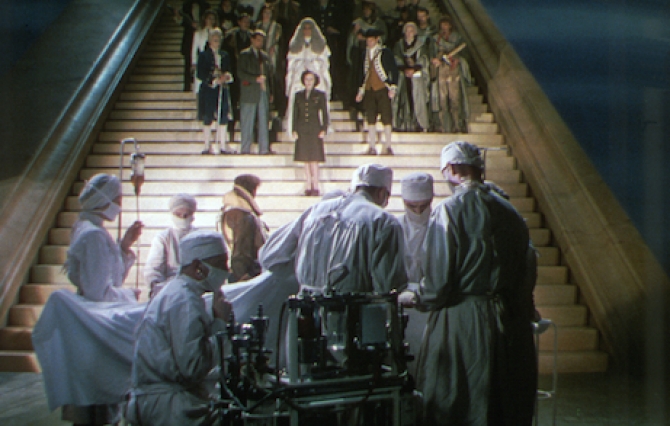
Ultimately, though, A Matter of Life and Death is primarily a sublime love story. That very unusual first scene sets it up so perfectly (I adore it when Niven tells the unforgettably red-lipped Hunter, who’s just confessed she could love a man like Peter, “I love you, June. You’re life and I’m leaving you.”). They enjoy a passionate connection, clawing at life, that feels palpably real despite its unusual pedigree. Powell and Pressberger wisely upend the Wizard of Oz color separation, making the Earthly world vibrantly hued with the possibilities of romance, and the other world coldly reasonable in the starkness of black-and-white (what miracles photographer Cardiff performs all throughout). The unforgettable climax is set against the massive stairway (built at huge cost to the filmmakers) that stands as perhaps the film’s most provocative or at least memorable image. While Peter is on the operating table in the real world, he finally also appears in the other world as a witness for the trial. June appears here, too, and it takes a supreme sacrifice on both their parts to prove that their love is substantial. “Be careful,” Farlan warns. “In the whole universe, nothing is stronger than the law.” But the defense counsel counters just as emphatically: “Yes, Mr. Farlan. Nothing is stronger than the law in the Universe. But on Earth, nothing is stronger than love.” Very few movies convince us of this as vigorously, and with such agile intelligence, as does A Matter of Life and Death. 


NOTE: This piece first posted as a part of WONDERS IN THE DARK's overview of the best romantic movies ever made. Take a look at the complete collection here.

Sunday, January 4, 2015

Film #165: Breaking The Waves

I first encountered Lars Von Trier’s brilliant Breaking the Waves very much like most American audiences did: in late 1996, a year dominated by indie-flavored movies like Fargo and The English Patient, it was nominated for a slew of Golden Globe awards (including the top three Drama awards, yet it would only garner one eventual and clearly unavoidable Oscar nod). When these nominations came down, I was dumbstruck, because Breaking the Waves had not yet played in my hometown of Atlanta, but had definitely made a splash in Cannes earlier that year. I wasn’t even able to make it out to the one theater showing it that year, it was so low on my priorities. I was a fool (as I still haven't ever seen it on the big screen).

When I finally did catch it on video in mid 1997, I was doubly dumbstruck--I found it to be a complete masterpiece, to the point where it still remains the most recent entrant into my personal top twenty films of all time. As overwhelming as it is, with Von Trier and cinematographer Robby Muller working at their absolute apex, it was Emily Watson that impressed me most. Her Bess, so loving and trustful, passionate about life, and completely devoted to so much she experiences, was unlike any fictional character I had ever encountered. She felt like a wide-eyed child, but yet she was very much an alluring woman, with a woman’s fullest desires, but perhaps without the wherewithal to understand those drives, except to say that she knew she totally had to follow them to what she saw as their natural end. She is like a strong but tiny bird one wants to help survive the cold outside. The fact that she had equal desires to be faithful to God and to her church complicated matters, especially since the church she follows (in early '70s Scotland, where the film is set) has a very dim view of women’s thoughts or contributions, except as earthly birth vessels.


Bess’ love of Jan, an oil rig worker toiling somewhere off the angry Scottish coast, is a force to behold. It’s seriously a love unlike any other I have witnessed in movies. It is complete and devoted, carnal and innocent, wild and reckless. Bess gives herself over completely to Jan (played also impeccably by Stellan Skarsgaard), to the point where the viewer even wonders if Jan is taking advantage of this simple minded girl (which is certainly something the late Katrin Cartlidge, exquisite as Bess’ widowed sister-in-law, wonders as well–her character is a nurse, so she’s deeply investing in Bess’ well-being all throughout, and even sternly yet gently warns Jan not to break her heart).  There is never really a moment where we suspect Jan is truly deceiving Bess, though. He obviously loves her innocence and her devotion to what she believes, and of course her revelry in their shared desire (just look at him as he looks over at Bess adoringly while they’re at the cinema together; her eyes are trained on the movie–she’s the perfect movie watcher, so ready to believe what she sees–and his eyes are trained so intently, deeply on her…it’s all just so ridiculously sweet).

The film begins with Bess confessing her love for Jan to God, to whom she talks–repeatedly throughout the film–in a empty church all by herself (presumably because none of the church father’s will truly listen to her without judgement). Early on, we have a sense that Bess is at least a creative type, if not a tad bit off, because she takes on the role of God in her confession. Her God voice is a deep, chiding one, impatient with her girlish selfishness…it seems like a voice that comes wholly outside of her personality and intelligence quotient, so we sense that maybe there’s a psychosis happening here. But I don’t think she is insane (though I do think she is driven to do insane things, by her own misunderstandings). In the end, Bess is simply trying to reconcile the love of a God who thinks her silly (as she portrays him, or as she has been taught to think of him) with the love of a flawed man who thinks she’s absolutely wonderful. Breaking the Waves chronicles a woman who follows God, but not as devoutly as she does the vital man who loves her, and whom she takes as her husband.

As this is a Lars Von Trier film, Watson’s character is certainly run through the wringer (Bjork, Charlotte Gainsbourg, and Kirsten Dunst would also assay tortured females in later Von Trier efforts). Bess begins the film completely lovestruck, dancing with abandon at her low-key down-home wedding and losing her virginity to Jan in the bathroom before the reception is even over (you can sense her complete devotion to sex from the outset; yet intimacy, even without sex, is also a fascination for her, as we see in a brilliant moment where she lies awake, listening and giggling as Jan snores away, asleep). There’s not much time for a honeymoon, as Jan is due back on the oil rig in mere days, and when he has to leave for work (for which he will be away for many weeks), Bess’ rage is unleashed. Now that she’s given herself over to a new “God”–one who has a personality which she cannot provide herself–she is left completely without half of her new self.

Jan, too, is torn asunder by his responsibility to work, which takes precedence over his new marriage. One wonders is Jan, too, is taking on perhaps more than he can handle by marrying Bess–he is genuinely shocked by her anger, but there is clearly part of him that finds it charming and romantic (which it is). But he doesn’t quite see the danger in it. However, honestly, who could predict such a future as this?

Tortured by his absence, Bess begs God to provide her for a way to be with Jan once again, and God does indeed provide that chance, but in a dark, perhaps mischievous and even punishing manner. On the oil rig, Jan is stricken with a serious injury after his probably drunken co-workers mishandle a piece of equipment that crashes into his head, knocking him into a coma. Quickly, he is rushed to the coast, where he is interred in the hospital where Cartlidge’s Dodo works as a nurse (there is nothing in cinema like the scene where Bess gets the word that Jan is seriously wounded: she disappears from the moment in a faint that is painfully, palpably real, especially as photographed in that grainy, handheld sheen by cinematographer Muller).

Bess takes Jan’s new arrival by her side as a sign that God is testing her, and so she takes on the full responsibility for his injury. So, when Jan finally comes to and is presumably paralyzed for life, we can feel his pain too. Here he is, a new husband who abdicated his love for a paycheck, and HE’S responsible for that. The guilt he feels is crushing, especially as he realizes that Bess is worth all the love that he can give to her. But he also realizes that he can never give her the full physical intimacy that she deserves, and so a psychosis enters into his own plate of problems. He asks her–for purely selfish reasons–to go out and experience sex with other men, and then come back and tell him all about it. This is his way of achieving consort with her body, yes, but he doesn’t take into account how this will affect her fragile personality–he seems to do it as a perhaps doped-up, bed-bound lark. But, as he is her new “God,” she follows his instructions, to her own eventual fate.

Breaking the Waves is a steamroller, an emotional workout of immense proportions. It is a story of sacrifice and faith, almost to the nth degree. It is not just Bess’s tale–it is Jan’s as well. It’s a journey to enlightenment that they take together, and by the film’s end–and it surely sports a soaring, surprising ending that one would never EVER forget upon seeing it–you are sure that you have witnessed one of the great love stories ever, even if it’s one that does not take the trajectory that any screen romance, before or since, has taken. With Von Trier’s superb direction, Muller’s unusual and groundbreaking photography, the brilliantly curated British pop music soundtrack (featuring Jethro Tull, Elton John, and Deep Purple, among many others), those unforgettably idyllic chapter stops by Per Kirkeby (done in a color-steeped style very different from Muller’s more grungy, documentary-influenced work throughout), and especially the deeply committed performances by Skarsgaard, Cartlidge, Jean Marc-Barr (as Jan’s best friend), and especially by Emily Watson. She gives an astounding performance that takes it place alongside Maria Falconetti in The Passion of Joan D’arc as arguably the greatest ever put on film.

It’s incredibly easy–for me, at least–to see Breaking the Waves as a film that staunchly proves its thesis. On its movie poster, the tagline reads “Love is a mighty power.” After seeing it, you truly stumble away, dazed, saying to yourself “Yeah. It goddamn well is.”

NOTE: This piece first posted as a part of WONDERS IN THE DARK's overview of the best romantic movies ever made. Take a look at the complete collection here.

Tuesday, June 2, 2009

Film #130: Days of Heaven


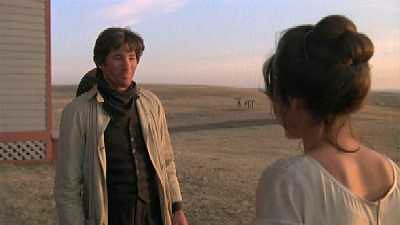
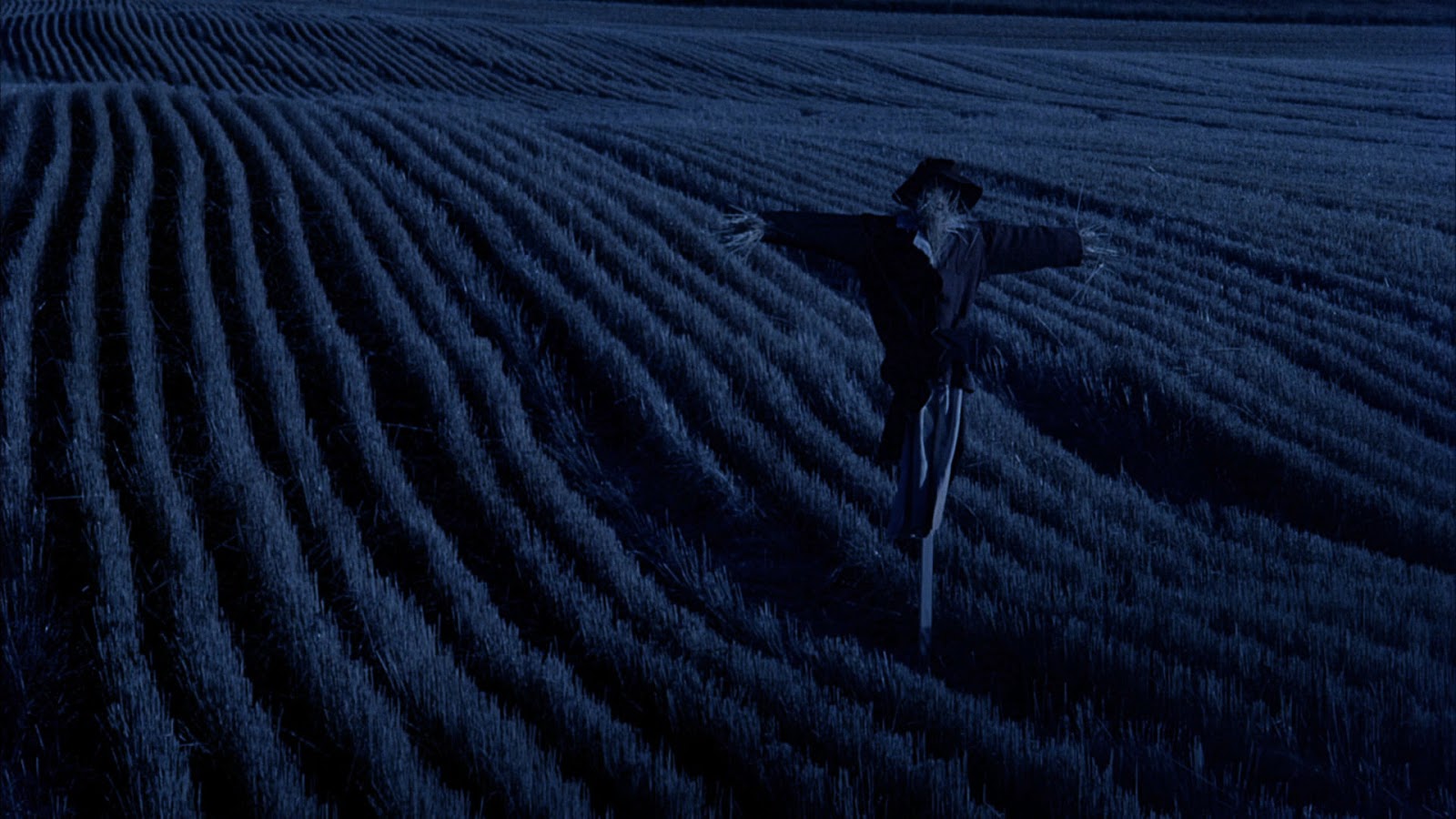
A lonely Victorian house stands guard over winding wheat fields. Greys and oranges seep through the torrid air of a Chicago smelting plant. Smothering swarms of hungry grasshoppers attack a newly-birthed harvest. Nighttime fires rampantly run as murder swirls bloody in the Midwestern breeze. A migrant worker gleefully tap-dances away on a dusty springboard. A brother and sister mount a wacky faux ventriloquist act beneath a secluded gazebo. Two lovers snuggle close atop a moving train packed with the destitute and desperate. And, seen from underwater, a body falls face first into a shallow river.

These images--and so very many others--propel Terrence Malick's Days of Heaven into its largely uncontested position as the cinema's premier showcase for the art of color cinematography. Before the film's 1978 release, its Spanish-born cinematographer, Nestor Almendros, had amassed an unimaginably brilliant photographic resume, having contributed painterly hues to films by Francois Truffaut (The Story of Adele H, The Wild Child), Eric Rohmer (Claire's Knee, Ny Night at Maud's), Monte Hellman (Cockfighter), Barbet Schoeder (More, General Idi Amin Dada). And, trailing his one collaboration with Malick, this meticulous artisan would shoot glorious Hollywood-centric product for Robert Benton (Kramer Vs. Kramer, Places in the Heart), Alan J. Pakula (Sophie's Choice), and Martin Scorsese (his segment for New York Stories, called "Life Lessons," is that great director's most unsung piece). However, given such wonder amongst his doings, Almendros--who died way too soon in 1992--had an unmatched canvas on which to paint with Days of Heaven.
 Malick's regal opus--only his second, after 1974's wry and violent Badlands--is a boldly eloquent study of an accidental, tragic clash between castes. Early on, Richard Gere would hit a career high playing Malick's intrinsically duplicitous working class boy who escapes Chicago lawmen following his accidental murder of a hateful factory boss (Stuart Margolin). With his smudged 13-year-old sister (Linda Manz) and his olive-skinned lover (Brooke Adams) as posse, Gere hops a train bound for the midwest, with survival their only destination. The trio mix with a teeming gaggle of migrant workers taking root as fieldhands on the vast estate of a wealthy wheat baron (Pulitzer Prize-winning playwright Sam Shepard, in his first major role).

As romantic couples are prohibited from employ, Gere convinces Adams to pose as his second sister, and this proves complex when the lonely Shepard--slowly dying from an unnamed disease--falls in love with Adams. This begins a secretive rivalry between Shepard and Gere over Adams' dazed affections, with Shepard's suspicious father figure (the excellent Robert Wilke) constantly casting the hairy eyeball at an oblivious Gere and Adams. Throughout--in a common feature for Malick films--the astonishing Linda Manz dryly narrates this powerful yet subtle melodrama with a sandpaper-thick Chicago accent (she brusquely, endearingly pronounces "fur" as "fuh"). As this spare, deliberately-paced, even documentary-like movie chugs towards its inevitable conclusion, its stirring heartache tears at us (the movie is even potently suspenseful at times, particularly during a zap-tense scene in which Gere and Shepard, deathly suspicious of each other, go duck-hunting with dedicated pointer-dogs in tow).

It's not hyperbole. I can securely assert there's never been anything in cinema like Days of Heaven. Its impossibly wide horizons, juxtaposed with intimate close shots and even detailed macro-photography, make it essential viewing. Regardless of its magnificent Criterion Collection release, if one can see Days of Heaven on the big screen, projected via the warmth of film (as I've been lucky enough to do more than once), they are forthwith advised to do so. Malick is working at genius level here, but Almendros is clearly his closest ally. Valuable second-unit assistance is given from legendary cinematographer Haskell Wexler, while Ennio Morricone provided a suitably stirring and diverse score (his orchestration of Camille Saint-Saëns' "Carnival of the Animals - The Aquarium" over the credits has insured the piece's eternal fame; also, it should be noted that folk legend Leo Kottke's athletic 12-string guitar work provides an upbeat respite). Patricia Norris (The Elephant Man, Scarface, Twin Peaks) crafted the understated and accurate costuming, while production designer Jack Fisk (Raggedy Man, The Thin Red Line, Eraserhead, The Assassination of Jesse James by the Coward Robert Ford) oversaw the movie's unassailable period detail (the locations, not surprisingly, hail from an unspoiled Canada rather than the American midwest).


Even with that mild deception, things are never false, never dull, never wrong in any way here. Malick would net awards for direction in 1978 from the New York Film Critics, the always-reliable National Society of Film Critics, and the Cannes Film Festival, but would be criminally ignored by the inattentive Academy (Almendros took an Oscar for his work, though; meanwhile, Norris, Morricone and the sound design team also got recognized with nominations). I'm thinking that Days of Heaven was a few years ahead of its time and, since the film suffered low box office returns and a unfair pack of tepid critical notices, I wonder if Malick felt he was working so above everybody's heads that he'd do just as well to wait 'til audiences could catch up. The Texas-bred filmmaker went on to disappear into the Paris streets for over twenty years, becoming the J.D. Salinger of the movie world, furtively toiling on unnamed projects and doctoring Hollywood scripts without credit. He'd finally emerge in 1998 with the lyrical WWII epic The Thin Red Line, assuring excited film fans that the man hadn't let time murder his unique voice (in fact, his direction would become even braver with 2005's The New World--still, for my money, the finest film of this decade). These more recent masterworks remind us of Terrence Malick's Days of Heaven and its assured place among the mainstays of cinema.


Friday, May 15, 2009

Film #124: Tess


I prefer watching my fiction to reading it (non-fiction tomes are my reading predilection), so it takes quite a movie to whallop me into reading the book upon which it's based. But when I first saw Roman Polanski's 1980 masterpiece Tess on the big screen upon its release, I rushed out to snap up Thomas Hardy's Tess of the D'ubervilles, published in 1891. It's a rush of a tale--downbeat and downhearted--that's remains floral in emotion and description, telling the story of the shy, comely title character (played by Nastassja Kinski), the daughter of a harried Irish drunkard who, when invited to work for a distant and wealthy relative, catches the eye of her well-to-do cousin (Leigh Lawson), a cocky cad who tries to goad Tess into romance (the disappointing results lead him to a nighttime act of vengeance). Even so, Tess continues her daily duties, milking cows and working the fields, when she meets the farmhand, Angel Claire (Peter Firth), who's her hauntingly innocent romantic ideal. Polanski's surprising, gentle film documents this tragic triangle with a wellspring of gorgeous images--it's the director's most visually poetic work. From the gaggle of white-dressed dancing girls parading madly about the opening scene, to the stunning close-up of Tess reluctantly eating a strawberry fed to her by that man, to the sunrise denouement set at Stonehenge, there's plenty of elegance in which to bathe.


Polanski's then-19-year-old lover Kinski made the jump from awful European B-movies like To the Devil...A Daughter to this picturesque opus with deft ease. Even if Polanski hadn't been exiled to Europe after his Chinatown-era legal troubles, he would have had a difficult time finding an ingenue equally able to assay this role. Actually, it's not that Kinski's performance itself is so accomplished; it's just that she's so resolutely stunning to look at that you can't tear your eyes away. With her pouty lips, blank-slate stare, and naive underplaying, Kinski is an immensely attractive anchor for this massively-scaled movie; she need only be so beautiful that men would kill or die for her, and this she achieves. Polanski dedicated Tess to his one-time wife Sharon Tate (murdered in 1969 by the Manson family), and in doing so, poured untold amounts of love, past and present, into his work. After decades of abrasive, claustrophobic films, during what very likely could have been one of the more ennui-filled episodes of the troubled director's life, Polanski seems to be taking a long-needed walk through a downy meadow. Working from an adaptation co-written by Gerard Brach and John Brownjohn, Polanski finds both the winsomeness and the horror in Hardy's novel and transmits it to screen undisturbed.


The supporting cast--the peaceful Firth, the hissable Lawson, John Collin as Tess' besotted father, and Susanna Hamilton as her best friend Izz, among others--is superb. And the picture won three well-deserved Oscars: for Pierre Guffroy and Jack Stephens' opulent art direction, Anthony Powell's sumptuous costumes, and the delectible cinematography by Geoffrey Unsworth (2001, Cabaret) and Ghislain Cloquet (Cloquet took over camera duties after Unsworth died mid-production). Philippe Sarde's majestic, well-arranged score was nominated for the Oscar, but lost to Georges Delarue's superior music backing A Little Romance, but that didn't stop the Tess soundtrack from taking its place on my turntable regularly in the early '80s. This unmissable, airy yet depressing costume drama was clearly produced by Claude Berri, who would go on to direct the similarly opulent late-1980s epic Jean De Florette / Manon of the Springs. 


Saturday, February 14, 2009

On Valentine's Day: Romance on Film

Valentine's Day (or, as I like to call it, "Sex Day") is here again, to the delight of the attached and the consternation of the unattached. So today I'll be recommending videos that might help both the bitter and the romantically satisfied through the holiday. Now, the problem with most movie romances is that they fail to give compelling reasons why the two people in question have fallen for each other. More often than not, we're just asked to accept these relationships as the real deal simply because the two leads are incredibly attractive. I don't deny this sort of love happens, but it's usually boring to watch. I want my romantic films to dissect a relationship, to help me to a better understanding of love dynamics.

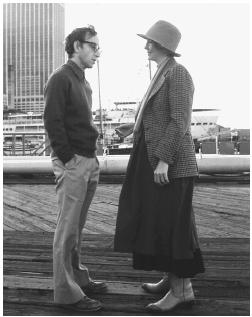
For instance, Woody Allen's Annie Hall, perhaps the greatest filmed trajectory of a love affair, perfectly illustrates the blush of new infatuation with Annie (Diane Keaton) and Alvy (Allen) joyously battling escaped lobsters, discussing death and higher education, and having sex while bathed in red light (to "give it that feel of old New Orleans"), then turns around and illustrates the reasons behind the dissolution of this shaky romance, climaxing in supreme emotional maturity. Or take Joan Micklin Silver's sadly forgotten Chilly Scenes of Winter, starring John Heard as a lonely civil service worker who dallies obsessively with unhappily conflicted married woman Mary Beth Hurt, after meeting her in one of the most sexually charged and funny first-meeting scenes of all time. As in Annie Hall (a film to which Silver owes much), things also sour, but not before some beautiful moments unfold.

Many times I find myself drawn to chronicles of difficult or unusual love affairs. Lavina Currier's riveting Passion in the Desert follows the courtship between a Napoleonic soldier stranded in the desert and the female leopard that comes to his rescue (that's about as difficult as they come). There is poignancy in many moments of Mike Nichol's Who's Afraid of Virginia Woolf?, with Elizabeth Taylor and Richard Burton trading loud, prickly barbs, always realizing that they're perfect for each other, nutjobs that they are. And the love between Sera (Elisabeth Shue) and Ben (Nicolas Cage) in Mike Figgis' Leaving Las Vegas is one of the more honest romances in recent times, because both parties have to own up to and accept each other's screwed-up ways (he's a suicidal alcoholic, she's a downtrodden hooker). The result is sodden bliss.As for the ultimate in more traditionally sweet romances, check out Wes Anderson's Bottle Rocket, with Luke Wilson's frantic wooing of Lumi Cavazos, a Mexican maid who can't speak English but who understands him perfectly. Anderson's witty style owes a great debt to Scottish director Bill Forsyth, who contributed the charming Gregory's Girl to the genre, following the frustrated but ultimately fulfilling search for love amongst a band of geeky high school boys, one of whom has fallen for the new, seemingly unattainable girl on the soccer team. I also appreciate Henry Jaglom's magical Déja Vu, which highlights the role of fate and destiny in this account of the strange, cosmically ordained attraction between a British artist and an American woman on holiday.

There are so many other screen romances worth mentioning: Punch-Drunk Love, The New World, All The Real Girls, The Remains of the Day, David and Lisa, The Lady Eve, The Fountain, Chungking Express, Children of Paradise, The Honeymoon Killers, Dogfight, Beautiful Thing, The More The Merrier, Sherman's March, Harold and Maude, Masculin Feminin, Eyes Wide Shut and The Umbrellas of Cherbourg, but instead I'll conclude by relying on my High Fidelity-esque propensity for list making:

Five fave screen kisses
1. The rapturous, climatic kiss between Diane Lane and Thelonious Bernard in George Roy Hill's A Little Romance.

2. Grace Kelly dreamily delivering a barrage of smooches to James Stewart in Alfred Hitchcock's Rear Window.

3. Tim Robbins and Jennifer Jason Leigh meeting lips on a New York balcony, to the strains of Carter Burwell's emotional score, in the Coen Brothers' The Hudsucker Proxy.

4. Elizabeth Taylor and Montgomery Clift stealing away from a party to make the most of director George Stevens' intimate close-ups in A Place in the Sun.

5. A heartbroken Marilyn Monroe concludes singing "I'm Through With Love" by accepting a tender kiss from Tony Curtis, who's in full drag, in Billy Wilder's Some Like It Hot.

Five fave sex scenes
1. Any searing scene between Daniel Day-Lewis, Juliette Binoche and Lena Olin in Philip Kaufman's ultra-erotic adaptation of Milan Kundera's The Unbearable Lightness of Being.

2. Julie Christie and Donald Sutherland in the "they must be really doing it" scene at the outset of Nicolas Roeg's horror classic Don't Look Now.

3. The amazingly energetic sex session between Jean-Hughes Anglade and Beatrice Dalle that opens Jean-Jacques Beineix's downbeat Betty Blue.

4. Jason Scott Lee and Anne Parillaud making love atop a flying wartime air balloon in Vincent Ward's unforgettable Map of the Human Heart.

5. Billy Crudup and Jennifer Connelly feel the Earth move in Keith Gordon's underrated Waking the Dead.

Happy Valentine's Day, to both the loved and the unloved.

Monday, December 8, 2008

Film #95: The Brown Bunny

2003's The Brown Bunny, written and directed by the inimitable Vincent Gallo, is an even more significant achievement that his late-90s cult-hit debut Buffalo '66, which left many viewers stricken with its quiet yet demanding quirkiness. Like The Brown Bunny, it too told a lonely, needy story. But Gallo's newest and more resplendent work engraves into our subconcious the overcast feeling of a heartbreak that just won’t go away. Though motorcycle racer Bud Clay (Gallo) leads an at least nominally exciting life, the film (despite its mesmerizing long first shot) refuses to capitalize on the thrills his profession inspires. The powerful adrenals are overcome by a crushed psyche.

The Brown Bunny is short on plot, but it carefully dabs emotion all over the place; it's an expressionist's drama. Our fly-on-the-wall journey with Bud, as he crosses the U.S. from New England to a race in California, reveals sharp realities at every turn. On the road, he meets three women with noticibly floral names—Lily (Cheryl Tiegs), Rose (Elizabeth Blake) and Violet (Anna Varechi). Each possesses something that catches his eye, but their attachments are nevertheless fleeting. The intimate mystery of his greatest love and heartbreak reveals itself slowly, climaxing in one of the most controversial scenes in motion picture history, and resulting in one of this decade’s most unfairly-judged works.

Gallo's movie has been talked about a great deal since its release, but for all the wrong reasons (but, of course, it doesn't help that Gallo felt he needed to capitalize on the seemier side of his movie with an L.A. billboard that mirrors the cover of the film's soundtrack album). The Brown Bunny achieved an ADULTS ONLY stamp for its third-act love scene between Gallo and his ex-girlfriend Chloe Sevigny. However, their one scene together is memorable not just for its frank sexuality, but also for its unswervingly honest depiction of the hell that one must go through to move on down the road, past the past. The whole film, is in fact both about running away and running to something at the same time (very much like racing is). It depicts the sort of frantic situations many of us find ourselves in from day to day, but which are rarely as poetically put on film.

The always dedicated and daring Chloe Sevigny found herself, definitely and unfortunately, in the hot seat over her part in the movie; she feels most people commenting negatively on it have never seen it. I suspect she's correct; I'm now reminded of the morons who picketed--without seeing--Scorsese's Last Temptation of Christ even though it was the most spiritually inspiring film since Pasolini's The Gospel According to St. Matthew over two decades earlier. If you've witnessed the rainswept highways from inside Bud's windshield (with songs like Gordon Lightfoot’s “Beautiful” as score), endured the uncomfortable moments where Bud has to reconnect with humanity, or felt the aching sadness with which the film culminates, and then still are unmoved, then you haven't, truly, seen it. The Brown Bunny is a profoundly humanistic achievement by one of America’s boldest cinematic voices.

Friday, November 14, 2008

Film #92: Reds


Still pretty charming even now, The Many Loves of Dobie Gillis arrived on TV in 1959. This black- and-white sitcom revolved around Dwayne Hickman as the girl-crazy title character, smitten most obsessively with blonde high school heartthrob Thalia Menniger (Tuesday Weld). And, for six episodes in 1960, on came this handsome dude playing Milton Armitage, Dobie's alpha dog rival for Thalia's attentions. This kid, named Warren Beatty, showed little promise of his future idiosyncratic rise through Hollywood ranks. But he would himself become the film industry's top lothario -- a 1970s tabloid favorite. And he would one day surprise everyone by winning a deserved Academy Award for his direction of a contentious, touching, money-losing epic centered on an avowed American communist--one of only three U.S. citizens buried in the Kremlin. With his detailed probe into the life of John Reed (the author of Ten Days That Shook the World, a snug, blow-by-blow spin on the 1917 Russian revolution), Beatty left some agog, others infuriated and others even simply somehow unmoved. But, then, nothing--not even 1967's boundary-smashing Bonnie and Clyde, which Beatty produced while going mano-y-mano with Warner Brother Jack Warner himself (who was angrily perplexed about the film's success)--has ever gone really according to plan for Beatty's movies. But so what? Time has spoken and, viewed now, Beatty's cinematic biography of John Reed reveals itself as an ageless and unique opus.

I now recall my grandfather, who in December of 1981 was real active in the bootlegging of video and audio cassettes (I think anti-capitalist Reed would've liked this). Being an avid fan of history, my Papa nonchalantly handed me a videotape recently shot (quite well) by a theater projectionist. He knew I was a precocious 15-year-old movie lover, so he happily let me watch the tape (as well as a bootlegged copy of Pennies from Heaven, which he vehemently despised and I still think is genius). Now that I recall, I pretty sure Reds was the first movie I'd ever watched on VHS and, to boot, my grandfather had given me an expertly transferred, letterboxed version. Actually, this is how I learned what letterboxing was; Reds looked better than any movie I'd ever seen on TV and I knew and felt it was because the screen was finally theatrical-movie-shaped.


At any rate, upon giving me this ill-gotten bootleg, my grandfather sniffed haughtily and said he didn't think much of the Commie movie. But I wasn't surprised by that, because we often disagreed about films. I didn't know it then, but each generation largely fails to understand the tastes of all others. Our particular, mercifully small schizm lived in my view that Papa was early-20th- Century-born and that meant he would never really get 1970s Hollywood-Renaissance moviemaking. I, meanwhile, was thankfully growing up with 1970s movies; the only other great times to grow up with the movies were the 1920s and the 1950s (and we're still waiting for another renaissance that I fear may never come). True to form, when Reds finished, I marveled inside at how my father's father could be so intelligent, yet so unthinkingly dismissive o this passionate movie. I then knew this schizm of ours wouldn't be disappearing any time soon (it still hasn't, I reckon). Also, strangely, to this day, and -- who knows? -- maybe because of my memory of this important TV viewing is still so positive, I still haven't seen Reds unspool onto the big screen. I fervently wanna correct that.

Before I popped this VHS tape Papa gave me into the bulky top-loading machine that was state-of-the-art back then, I had become tremendously excited about Reds through my favorite publication, Variety. Outspoken anti-communist and one-time Democratic-leaning Screen Actors Union head Ronald Reagan had just been elected to the Oval Office, so 1981 was exactly the wrong time for Beatty to be hawking such a movie. For that reason, before its release, Reds was getting a lot of press in the trades. Beatty had been working on the film since 1978, when he garnered four Oscar nominations for Best Actor, Best Screenplay, Best Director (with Buck Henry) and Best Picture (he was the sole producer) for an fun, elegant remake of Heaven Can Wait (also a Beatty film ripe for re-evaluation). Remember, this was a feat that was only precedented by Orson Welles and Citizen Kane back in 1941! Plus Heaven Can Wait, unlike Welles' film, was one of the biggest box-office hits of the year. So everyone in love with the medium of movies was on the razor's edge, wanting to know all about Beatty's $35 million (now $130 million) filmic obsession. Movie watchers were almost to a man preparing for Reds to be a leaden boondoggle; in pre-release hype and upon-release acclaim, it was the Titanic of its day, but finally and immeasurably sooooooo much greater than Cameron's blockbuster, even though it took in about 1/100th of Titanic's box office cash.

I expected one thing when I took in the picture's first images. But I got something so much more. Reds begins not with a glittery image of Beatty or one of his fellow stars, but with starkly-photographed documentary footage of elderly people desperately trying to dredge up their memories of Jack Reed. At 15, I had never before seen old people look so handsome on film. And the creaking, ancient tones of their voices were so superlatively captured--my God, the feeling of first seeing Reds now once again surges through me. These seniors were, according to the final credits, The Witnesses. I now want to pay tribute to them by discovering who each of them were, to the best of my ability (thanks to the good people over at Wikipedia). Among them:

* Roger Nash Baldwin (founder of the ACLU)
* Andrew Dasburg (painter and former lover of Louise Bryant)
* Will Durant (Philosopher, historian, and Pulitzer Prize-winning writer of the 11-volume The Story of Civilization)
* Hamilton Fish III (the grandson of Ulysses S. Grant's Secretary of State and, in 1981, one of America's oldest-living Congressmen; he's the one that humorously speculates as to whether Reed was a Communist)
* Adele Gutman Nathan
* Blanche Hays Fagen (these are the two ladies filmed together who are so, SO amusing in their comments)
* Dorothy Frooks (Author, publisher, military figure and actress)
* Hugo Gellert (Illustrator and satirist)
* George Jessel (Legendary actor, singer, songwriter, radio star, movie producer, and "Toastmaster of the United States")
* Henry Miller (Writer of Tropic of Cancer, Tropic of Capricorn, The World of Sex, Nexus, Plexus, and Sexus; the one-time lover of Anais Nin, he's the one that says, of course, "You know, I think there was just as much fucking going on then as there is now, only then, there was a little bit of heart to it.")
* Scott Nearing (Conservationist, peace activist, educator and writer)
* Adela Rogers St. Johns (Journalist, novelist, and screenwriter)
* Dora Russell (Feminist and progressive campaigner; second wife of Bertrand Russell) and Rebecca West (Feminist and writer) (they appear together in the film)
* George Seldes (Investigative journalist and media critic)
* Jessica Smith (Editor and activist)
* Arne Swabeck (American Communist leader)
All, and more, appear as themselves, eyes shining brightly as Beatty, behind the camera, implores them to remember anything, anything at all about John Reed and his lover Louise Bryant (their bare recollections at the beginning feel like a long-dormant engine being revved for the first time in an age). In the 25th anniversary DVD commentary (one of the best commentaries ever recorded), Beatty says that he filmed hundreds of hours of interviews with these historical figures, starting in 1979; some of them were long dead by the time his epic finally hit the theaters.

The Witnesses act as a buoyant Greek chorus for this gargantuan story that follows John Reed from his rabble-rousing as a 1913 Greenwich Village journalist to the beginnings of his love affair with ambitious Oregonian journalist Louise Bryant (Diane Keaton), whom he met upon visiting his mother in Portland in 1916. It's Reed's relationship with the insecure Bryant that's at the center of Reds, and the boundless sensitivity with which it treats this clearly passionate love affair is what makes the movie the enduring epic that it is.

Bryant, smitten with Reed, follows him to New York, where they quickly become an item among the Village intelligentsia. But, as portrayed in the movie, Bryant feels overcome by Reed's progress in this arena. The fact that she's inexperienced and barely been able to make an NY dent with her writing becomes a big bone of contention between the two, and the subject of a few monsterously raucous scenes where they literally spar about their relationship, their ambitions, and their politics, always at the same time. Reds impresses with these scenes that gallantly balance heady subject matters while driving home the enormous emotion with which these two artist/journalists were grappling (Reed once proclaims "Louise, I love you," to which she replies "No, you love yourself! Me, you FUCK!")


In New York, Bryant begins a cuttingly combative relationship with Emma Goldman (Maureen Stapleton). This stern, commanding actress delivers an astounding performance as Goldman, the avowed feminist and at one time Communist sympathizer who holds a low opinion of Bryant's intellectual abilities. Goldman, ironically against her truest personal beliefs, demeaningly and unfairly sees Louise as another of Reed's air-headed "girls," denying her the chance to excel that Goldman's long been fighting for all women to obtain. But Reed, deeply in love, sees so much more in Louise (which makes him more of a feminist than Goldman!!). Always in search of new horizons, she and Jack abandon New York and take up with a band of beach-combing artisans in Providencetown, MA. There, Bryant begins a friendship with Reed's best buddy, playwright Eugene O'Neill (Jack Nicholson). As Reed is off beginning his political "career" most of the time, much to Louise's disconcert ("Taxi's waiting, Jack..."), she turns cavalierly to the adorous alcoholic O'Neill for romantic comfort. This dynamic provides Reds with some of its most electric moments--Nicholson's few scenes with Keaton are tremendously involving (Nicholson was nominated for a Supporting Actor Oscar for his few minutes here). When Reed returns to Massachusetts, lonely and in need of his lover (who needs him, too), O'Neill is devastated, and his emotions overspill in vivid fashion. ("If you were mine, I wouldn't share you with anybody or anything," he says. "It'd be just you and me. We'd be the center of it all. I know it would feel a lot more like love than being left alone with your work.")

It's here that the marriage of Reed and Bryant takes over in Beatty's screenplay with Trevor Griffiths. Their retreat into upstate New York leads to a swell domestic life. But Reed cannot abandon his political hopes; his need to affect the world with more than his writing commands his passion, so much so that he has to abandon romance and agree to being the Communist Party's American representative on the Russian Comentern, just as the country's break from the Czar is taking hold. What he finds overseas--and what he is disappointed by, both with and without Bryant as companion / collaborator--forms the largest portion of this uncanny 3hr16min film.

After I joyfully finished with Reds that first time, I was in a cloud-touching daze, the sort of which always seizes me after seeing a monumental movie. Beatty's work instantly represented the sort of history lesson my teachers never even touched on in class, and I was immediately suspicious that much more alluring events were going on in the world than I was being let in on. It was here, I think, that I garnered my lifelong interest in REAL history--not that crap to us shoveled out of tired textbooks, but the kind of history that sparkled with humanity, love, sex, longing, and death. Since seeing Reds, I have been a voracious consumer of historical fact, which I am convinced goes in directions that no fiction can replecate (I very, VERY rarely read fiction; I get what fiction I take in from movies).


Reds, nominated in 1981 for a then Ben-Hur-tying record of 12 Academy Awards (which only Lord of The Rings: The Return of the King and Titanic have matched)--pops with mammoth factual figures. Besides the obvious, there's V.I. Lenin, Leon Trotsky, Woodrow Wilson, early Libertarian and editor of The Masses Max Eastman (Edward Herrmann), hard-hearted Bolshevik #2 man Grigory Zinoviev (played by Being There author Jerzy Kozinski, whose scene lecturing Reed while consuming a scurvy-fighting lemon and onion sticks surely in my memory), and Industrial Workers of the World founder Bill Haywood, played briefly by Dolph Sweet. Then we have Gene Hackman as one of Reed's magazine buddies, Paul Sorvino (apoplectic as a rival communist representative), the rarely-seen George Plimpton as a slimy New York editor, William Daniels as another harried communist activist, and cameos by M. Emmett Walsh, Kathryn Grody, Cheers stool-warmer John Ratzenberger, and Max Wright (better known as the dad on Alf). There are a lot of familiar faces in Reds.


Wow, there's so much I love about this movie. How Keaton, being called out on her reconciliation with Beatty, nervously pours Nicholson's O'Neill another scotch, spilling it on the floor ("Your abilities as a bartender seem to have gone downhill," O'Neill sneers). How Stapleton--1981's Oscar-winner for Best Supporting Actress--quickly reconsiders her opinion on the commitment of Keaton's Bryant upon seeing her in Russia, as Bryant lovingly comes to Jack Reed's aid (there's an on-screen embrace between Stapleton and Keaton that's unexpectedly touching). How the tipsy, red-faced Gene Hackman appears out of nowhere to give Reed hell for abandoning journalism. How George Plimpton flusters about while trying to get Keaton in the sack. How Beatty's Reed and Stapleton's Goldman have a firey debate in Russia on the worth of Communism as it's being perverted by the maniacal Lenin.

And this: I was not aware of this until I heard Beatty's rare DVD commentary, but Reds was filmed in London (and many more British locales), California, New York, Massachusetts, Finland, Sweden, and Russia; I find this spectacular (just imagine the nightmare it must have been editing this movie--I wager the original cut was six freaking hours long). I find it funny when Keaton--who, given her character's transformation, really delivers the film's most fetching performance--defiantly responds to FBI agents barging into her Croton-on-Hudson home (veteran character actor R.G. Armstrong gruffly states he's looking for "agitators," to which Keaton replies "Well, why don't you look around and see how agitated you get?"). I cherish the gentle, unobtrusive background music by Broadway legend Stephen Sondheim (his only movie score) and jazz legend Dave Grusin (On Golden Pond, My Bodyguard, The Milagro Beanfield War). And I will never, ever EVER forget how the film's final ten minutes first easily wrestled tears of romance, joy and sadness from my eyes.


And, perhaps most of all, I adore Vittorio Storaro's varied, incomparable photography--the gentle pastels of the Providencetown scenes; the harshly-lit Communist Party debates; the reds, yellows and tans of Greenwich Village; the blinding snow whites of the Finland sequences (which led to some critics unjustifyably comparing Reds to David Lean's fine-but-still-inferior romantic/historical epic Doctor Zhivago); the expansive Lean-like vistas following Reed's escape from a demolished Communist train; and especially the colorful, black-backdropped footage of The Witnesses (that's the first thing that I think of when I think of Reds, and the inclusion of this invaluable documentary footage is what provides it an edge as one of the cinema's finest products). Storaro possesses the starriest career one can hope for, acting as lighting master for Italians Dario Argento (The Bird With The Crystal Plumage, The Spider's Stretegem), Bernardo Bertolucci (1900, Last Tango in Paris, The Last Emperor, The Sheltering Sky) and Francis Coppola (Apocalypse Now--for which he also won an Oscar in 1979--and the misunderstood One From The Heart). But his first movie for Beatty--this non-Italian, for whom he also photographed the blazing colors of Dick Tracy--eclipses his stellar former works. With Reds, you get to see EVERYTHING that Storaro can do. And it is an unrivaled gallery of achievement.

I've made my case (and I could continue on and on). Even if you don't like Warren Beatty (as a lot of movie lovers say they do not, which I can understand), Reds accomplishes what few historical films do-- even the undisputedly essential but sometimes confusing and intentionally distant Lawrence of Arabia. Beatty and company take you around the world, to another time, putting you there, in the mix, while clearly explaining serpentine political notions through the prism of complex human emotions. Reds entertains with a parade of Hollywood big-shots, but not so much so you fault it. And it takes a fresh bent on history, writing large a little-known historical side-story--one that unfolded very much as portrayed (another historical film rarity). I think--I know--Reds is a masterpiece. I realize that M-word gets bandied about a lot, but here it truly applies. Even while watching it as a voracious 15-year-old, I was sure Reds deserved that prized moniker. If you haven't seen it, you really don't know what majestic things movies can do for your soul.


Sunday, November 9, 2008

Film #85: All The Real Girls

The following is an interview conducted by the excellent DarkCityDame on her website Noirish City as part of our examination of my 30 favorite movies of the 2000s. She's given me permission to reprint a few interviews as part of filmicability, so here's a look at my 29th favorite film of the decade All The Real Girls.

DarkCityDame: Okay! First of all, I did watch the film All Real Girls last night.

Dean: Cool. I watched it, too. It was only my second time seeing it I think I might have appreciated it even more this time. Knowing the pace and style of the movie beforehand is probably beneficial to a second viewing. Tell me what you thought about it.

DarkCityDame: It was very interesting! It really focused on life in that small community in detail.

Dean: Yeah, it’s set in a North Carolina mill town. That’s where the director and the lead actor are originally from. It's does have a wide scope in terms of its characters--there are about 10 main characters in it, and about 20 secondary ones. But its main focus is on the beginning of this romance between the two leads, Paul and Noel, played by Paul Schnieder and Zooey Deschanel.

DarkCityDame: Why did you select this film to be included as one of your top 30 films from the 2000s?

Dean: Well, I was a big fan of writer/director David Gordon Green's first feature George Washington, made in 2000. But I found that 2003's All The Real Girls touched me more deeply. In most love stories that Hollywood makes, the two characters meet and just immediately fall in love. There's no time taken to see WHY they fall for each other. It's just assumed that, because they're both so hot or whatever, that, hey, OF COURSE they'd be lovers. But in All The Real Girls, we get a captivating, very natural progression of a romance, from its initiation, to its flowering, its conflict, and its shaky but ultimately firm continuation. Let's put on top of that the incredible ensemble cast, the gorgeous cinematography by Tim Orr, and the moody score by Michael Linnen and David Wingo, and you've got quite a film. I find that to be enough for me to include it as not only one of the best movies of the 2000s, but as one of the best romances ever to hit the screen. I mean, have you ever seen a movie that treated a love affair with such attention to detail?

DarkCityDame: In a word: No!
Dean: Yeah, I mean, right from the first scene, where we see Paul (Paul Schnieder) and Noel (Zooey Deschanel) struggling over their first kiss, we know we're gonna see something special. I love how he says he's afraid to kiss her, and she says “Well I don’t wanna be with someone who’s afraid to be with me.” And then she offers her hand to him to kiss first, and he nervously looks around to see if anyone is watching and he blows on her palm, wipes it off and kisses it gently. It's so incredibly sweet.

DarkCityDame: But it seems all the characters have past issues to deal with, too…

Dean: This is true. Everybody in it carries some sort of crippling fear along with them. Paul’s afraid of commitment (he's been with every girl in town), Noel fears her inexperience, Paul's best friend Tip (Shea Wigham) fears growing up, Paul's mother (Patricia Clarkson) fears getting older and being alone, there’s a mechanic who seems to fear death. It's as much a movie about dread as it is about romance. I feel that's extremely real and creative. Again, another choice that the average romantic film wouldn’t take.

DarkCityDame: But I also wonder by the end of the film, were their problems truly addressed?

Dean: Well, the conclusion is a bit open-ended...

DarkCityDame: Yeah, I thought so!

Dean: I think the viewer has to read between the lines and come to their own conclusions as to where this relationship is going. I personally felt that it was going to all be okay--that these two characters had really clicked with each other and that they were really sincere about working hard on their faults so that their love could succeed. You know, you’ll find that I tend to like open-ended movies, mainly because life itself is open-ended. It doesn't end...until it does, know what I mean?

DarkCityDame: Oh, yeah!

Dean: So I liked that David Gordon Green didn't tie everything up with a nice little bow. DarkCityDame: I agree. People don't usually live happily ever after!

Dean: No, there's always something tough for us to work on.

DarkCityDame: Well, at least, the characters in the films certainly exhibited that!

Dean: Yeah, Paul particularly has some difficult things to deal with--his heart is pretty tender, since he'd never given of himself enough in any relationship to allow it to be broken. So when it gets taxed, as it does in the film, he has a tendency to not know how to react except through self-destruction. DarkCityDame: I noticed that. For instance, near the end of the picture when Paul dresses up nice in order to go and visit Noel and find her in a friendly situation of just cooking macaroni with one of his friends. He goes outside and smashes his hand through his car window.

Dean: Yeah, he just can't handle his own jealousy, which we have to point out, is a feeling he's never experienced before, since he's never really cared about a woman enough to be jealous over her. In a way, he's as inexperienced in romance as Noel is. Noel, on the other hand, has to deal with her lack of experience with men and the notion that she hasn't been around that much, and now that she finds herself in true love, that means she might have to give up on the kinds of wild experiences she sees her friends getting into. So they're both innocents.

DarkCityDame: I agree.

Dean: How did you like the performances in it?

DarkCityDame: I thought that they were quite natural and down to earth! Dean: Very much so. I'm a big fan of both of the two leads. I have a huge crush on Zooey Deschanel as a result of the movie. I first noticed her in The Good Girl with Jennifer Anniston and Jake Gyllenhall. I thought she was hilarious in that. And I've paid special attention to Paul Schneider since this film. He's gone on to be in The Assassination of Jesse James, Elizabethtown, Lars and the Real Girl, and he'll have two movies out in 2009, one by Sam Mendes and another by Jane Campion. And I found the film very funny at times too. One of Paul's friends is named Bust-Ass, and he's played by an actor named Danny McBride. McBride's in Pineapple Express, the comedy with Seth Rogen and James Franco (also directed by David Gordon Green), and is the writer/director of The Foot-Fist Way, a big indie hit on the festival circuit that you can probably find on DVD these days. His few scenes--he's the one Noel is making macaroni with--are, I think, quite humorous. Like, I love the one where he's trying to hit on Noel, asking her if Paul wasn't around, who would she go out with. She's like "Why couldn't I just be alone?" and he's all "Well, you can't have Paul and you can't be alone. Who would it be?" It's a very childish way of propositioning someone.

DarkCityDame: He appeared to me to be brutally honest, but in a very hilarious way!

Dean: It's true. I also liked the scene where Paul has to dress up like a clown to accompany his mother to a gig (she's a clown performer for kids parties and such). But it's Zooey's performance that really hits me in the gut in this movie. She should have been nominated for an Oscar. She's that good. DarkCityDame: It's not that I am dense, but I’m not really familiar with Zooey Deschanel’s past work.

Dean: She's definitely been underused in movies. I think the highest-profile film she's been in was The Hitchhiker's Guide to the Galaxy, which was, in itself, not seen very widely. She's really a cult actress, and I think she's quite choosy about her roles. But she always brings a surprising take on whatever she's asked to do in any movie. She’s got a moxie that I really like. I loved it in All The Real Girls when she's talking with Paul on the mountaintop and she stops and says "Shhhh!" and tells him that she likes to pretend sometimes that she only has 10 seconds to live. She puts her hands over her eyes and she starts the countdown, and he's like "Huh?"

DarkCityDame: Yeah! Some of their scenes together were just serene and beautiful!

Dean: Yeah, you could just feel it deep in your bones that they were perfect for each other, and not just because they were both attractive people, but because they had similar sensibilities.

DarkCityDame: Yeah! I could tell their relationship went beyond aesthetics and was more emotional.

Dean: They make each other laugh, they make each other honest, they make each other responsible, and they make each other aroused. Isn't this what we all look for in a relationship?

DarkCityDame: Well, Dean it’s really difficult for me to answer this question right now, since I’m not in a relationship at this time, but when I do find Mr. Dark City Dude, (since I am Dark City Dame—ha!), then I’ll come back and answer that question.

Dean: Hahahaha. Don’t worry—he’s out there wandering around somewhere. You’ll find him!!