Showing posts with label The Innocents. Show all posts

Wednesday, December 23, 2015

Film #170: The Innocents

In the realm of horror movies, Jack Clayton’s The Innocents is beyond reproach. And we all realize the horror genre is overflowing with creepy kids. But in the domain of movies about children–the subject of this ongoing series–how does this film fare? The answer is complicated, but assured: it's fully illuminating, even in its inky darkness. In this exquisite adaptation of Henry James’ The Turn of the Screw, the images are boldly frightening, sexually suggestive, deceptively lush, and idiosyncratically shot in dreamy black-and-white Cinemascope by photographer Freddie Francis. Deborah Kerr, in her personal favorite of many acclaimed performances, plays a repressed nanny whose new charges–the alternately rambunctious and preternaturally mature orphans Pamela Franklin and Martin Stephens–prove to be more than her nerves or her faith can take. Is this secluded mansion she now oversees haunted by the ghosts of two sexually libertine servants? Or is she merely being put through the ringer by a couple of untrustworthy brats?

innocents 9Even before the credits roll, we hear a thin, girlish voice (meant to recall the young tones of our female ingenue Pamela Franklin, here playing Flora, though it could also be the voice of the deceased governess Miss Jessel). Words are put to a vaguely secluded theme that soon becomes the movie’s niggling, incessant refrain. Written by composer George Auric and lyricist Paul Dehn, it’s a suitably ancient-sounding tune called “O Willow Waly,” and it reeks of a particularly lonely menace as we sit in the dark, waiting for a movie to begin like we’ve never waited for a movie to begin before or since. And the 20th Century Fox logo happens in silence:


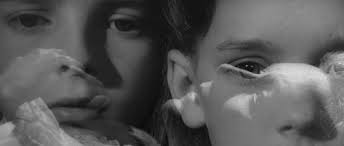
Over the credits, we get a quick glimpse of what we will later learn is the movie’s climax–a clasp of Kerr’s praying hands, over which she breathlessly trembles and sweats, almost in erotic fervor. “I want to save the children, not destroy them,” she confesses in a whisper that flutters amongst twittering night birds. “More than anything, I love children. They need affection, love–someone who’ll belong to them, and to whom they would belong.”

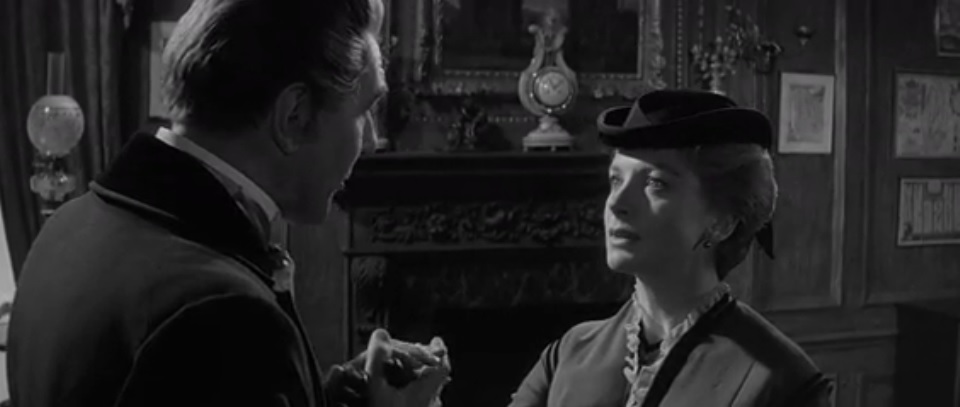
We then eavesdrop on a moderate prologue in which we’re introduced to Michael Redgrave’s coldly profligate uncle as he hires Kerr’s Miss Giddens to take charge of the young rascals foisted upon him (he echoes–or precursors–Miss Giddens’ sentiments about providing them “someone who’ll belong to them, and to whom they would belong”). But he’s upfront about it: he has no time for them, and he’s looking to pay her to love the children for him (tellingly, his first interview question is: “Do you have an imagination?” and we will find Miss Giddens indeed has a fruitful one, of which she’s later a victim). The sheltered daughter of a radically religious country parson, she strikes us as someone of ulterior motives, because as much as she professes to love children, she’s only too willing to let her prospective employer off the hook for leaving his niece and nephew in the lurch as he gallivants carefree, spreading his influence around London. (Of course, she wants the job, so who is she to object?) Giddens clearly develops a crush on this cad, and throughout the rest of the movie, she’s adamant to do his bidding, even if he never appears before her (or us) again. He’s wealthy, but not someone worthy of love, yet she’s been shuttered away for so long, and so past her prime (Kerr is at once too old for the role, and altogether the perfect age for it) that the soulless uncle seems like some kind of perverse hero to her. Maybe, we’re left to conclude, he resembles her own father, who clearly had no room for his own children “mentally or emotionally.”
innocents 14

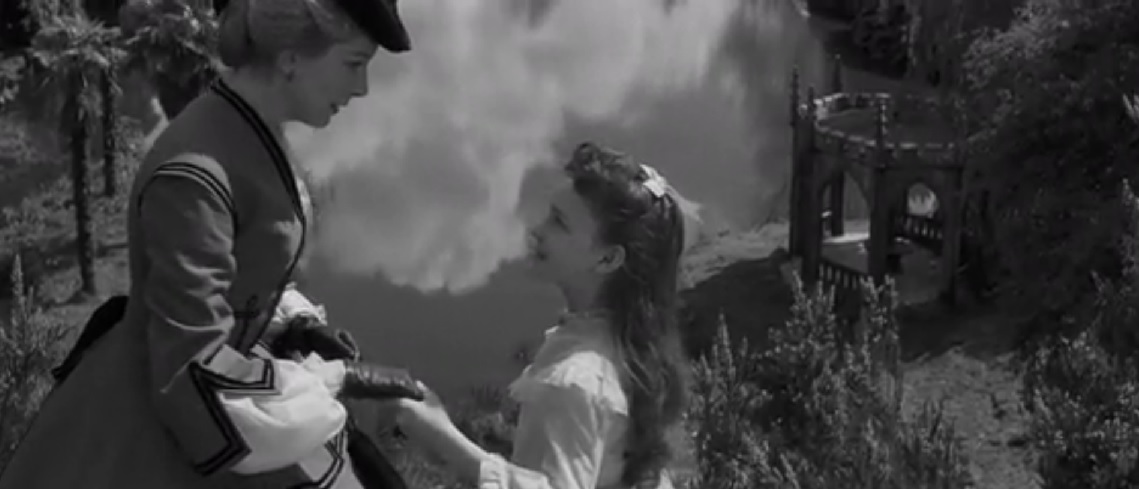
After being regaled of previous governess's appalling fate (and of its secretive quality–she’s told to never to speak of it, ever), Miss Giddens arrives at the cloistered Bligh estate glorified and fully embraced by Franklin’s Flora, who’s positively giddy at having a new person in her orbit. As if her own name were a call to action, Flora responds most powerfully to the blooming countryside engulfing the mansion (often, the movie’s environment, with its croaking frogs and flittering butterflies, feels like it's pulling us headfirst into its dizzying effulgence). As Miss Giddens first wanders beside the landscape’s mirrored pond, she can hear a far off voice calling “Flora! Flora!” When she's finally faced with the young girl, Miss Giddens is confused–to whom did that distant voice belong? She knows that Miles, the nephew, is off at boarding school. However, her faith in the innocence of children quickly brushes such uncertainty aside. She is caught up with meeting the ebullient Flora (whom we first see as a rippling mirror image in the pond–itself mirroring a later disturbing apparition). She’s immediately introduced into Flora’s vivid inner world, which Miss Giddens first sees as being entirely playful. She’s somewhat shocked when Flora introduces her reptilian best friend Rupert (a hapless tortoise), but otherwise, this feels like easy going.
innocents 16

The lively script, largely written by Truman Capote who adapted William Archibald’s play (Archibald had little to do with the screenplay, though he gets co-writing credit) then introduces us to the only adult character who has even a slippery grasp on what has befallen the children in their isolation. Mrs. Grose (Meg Jenkins) is an affable though ultimately simple-minded presence who at once puts Miss Giddens at ease and then, gradually, sets her upon a course to madness. Prone to superstition and secrets (“Stuff and nonsense,” she repeatedly says), she’s an unreliable voice, and the closer we seem to come to the truth via her accounts, the further the truth seems to drift away. Also drifting away are the niceties that first greet Miss Giddens, who first steps into the house overwhelmed by its opulence, and is quickly taken aback when she reaches out to touch some white roses and finds their leaves shedding away in decay. The young girl’s charms and wandering curiosity are discussed, and then Miss Giddens gets startled anew: It wasn’t Mrs. Grose calling Flora’s name earlier. And Flora, then, seems to know of Miles’ impending return to the estate, even though nothing has been mentioned of it. “Promise you won’t go away,” Flora pleads, and Miss Giddens assures her “I expect to be here a very long time.” And then when she and Mrs. Grose talk about the uncle, and the now-dead governess Miss Jessel, Grose lets it slip: “He had the devil’s own eye.”


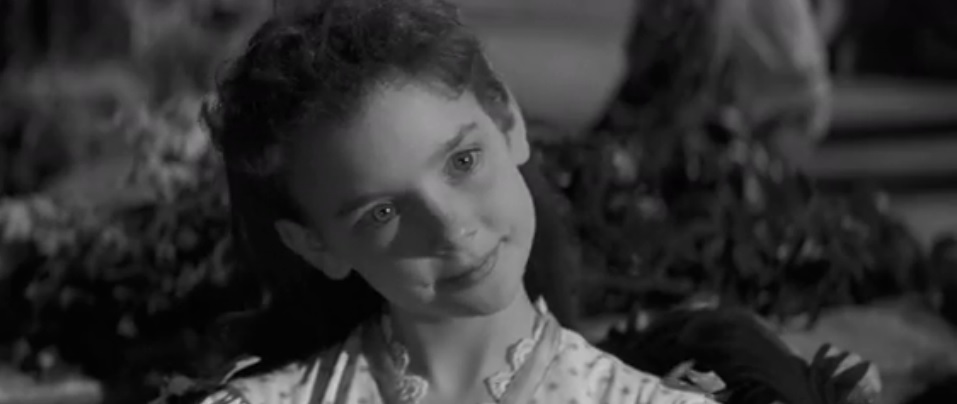
As we take our first of many eerie candlelit tours through the labyrinthine house (shot with uncommonly well-choreographed lighting and creative lens choices--this stuff was really executed  with proper detail), the film continually ratchets up our unease in subtle ways. Flora continually takes joy in the darkest things, whether it be the notion of being in two places at once, or waking before she dies (she misspeaks in delivering her nightly prayers), or being a soul who walks around after expiring (“Isn’t that what happens to some people?”) or ignoring those screeching, predatory sounds of nature that disturb her governess (“We must pretend we don’t hear it…then we won’t imagine things,” Flora instructs). Continually, we find this world rather billowy and beautiful, and at the same time certainly threatening. And Pamela Franklin’s eyes pierce our soul with their odd combination of knowing and purity, particularly when we find her predictions of Miles’ return come true via a letter informing of his dismissal from school (for a reason that’s never fully spelled out). It’s an unsettling moment but, as with many in the film, we can’t quite put our finger on why it is so (though Franklin’s subsequent line “Oh, look–it’s a lovely spider…and it’s eating a butterfly” place the viewer firmly in ghoulish territory).
innocents 17

Miles is played by Martin Stephens, a young actor who’d reached an apex of creepiness in British cinema only the year before when he appeared as the agile and otherworldly leader of the transfixing, blonde-headed children commanding Wolf Rilla’s Village of the Damned. His showing here surpasses that role in many ways, though it also recalls it: as in Rilla’s film, his Miles is “miles” beyond his years, and seems to know more about the cruel universe than either the viewer or the adults in the film have any ken. Like Flora, he first appears as an adorably rambunctious child, full of vigor. His masculine energy instantly captivates his governess, and she gladly reverts back to her preferred role upon meeting him. But Miss Giddens is then quickly suspicious of his ability to dirty up innocence, and this is the feeling that defines their odd relationship throughout the film (Mrs. Grose cackles at the governess’ distrust: “Are you afraid he’ll corrupt you?”). This notion becomes ever more alarming when we see that Miles resembles his uncle so, with his cravat and pompadoured hair, that he strikes the viewer (wholly subliminally) as a bonafide Mini-Me. The can’t be good for Miss Giddens, we know right from the outset, when he boldly hands her some flowers as introduction (“Charm must run in the family,” she cheerfully says to Mrs. Grose).


As Clayton’s masterfully directed piece progresses, Miles’ peculiarity becomes more disconcerting, and its causes become clearer (though the film, in keeping with the times it was made, is unable to articulate any details beyond furtive suggestion). The Innocents was mildly appreciated upon its first release (it won Best Director from the National Board of Review, but otherwise was ignored by critical voices, unjustifiably so). But it’s recently re-entered the conversation when discussing the most deeply layered of horror films, and as such, it’s received a much vaunted 2014 release as part of the Criterion Collection, so we can fully soak up Francis’ complex lighting schemes and deep focus framing. The cinematographer’s work shines brilliantly, particularly during the stunning dream sequences–complicated, lap-dissolving mosaics that have rarely seen equal (this would be a tremendously satisfying movie to see on the big screen). Director Clayton, as well, seductively applies sound and music to his creation, with moments of chatter and then thudding silences that will freeze your soul. Without revealing too much (lest I spoil its surprises), the film reaches only one of its many peaks when the ominous Miles, after a vigorous game of hide-and-seek, colludes with Flora to put on a show for the governess and Mrs. Grose. By candlelight, with a chintzy crown atop his head, he recites a morbid love poem to the departed–one that feels utterly like something out of Edgar Allen Poe, but which was directly written for the film as a kind of counterpart to Flora’s song (this must be a creation of Truman Capote, a poet of the first order):

What shall I sing to my lord from my window?
What shall I sing, for my lord will not stay?
What shall I sing, for my lord will not listen?
Where shall I go when my lord is away?
Whom shall I love when the moon is arisen?
Gone is my lord, and the grave is his prison.
What shall I say when my lord comes a-calling?
What shall I say when he knocks on my door?
What shall I say when his feet enter softly
Leaving the marks of his grave on my floor?
Enter my lord!
Come from your prison!
Come from your grave, for the moon is arisen
Welcome, my lord…

innocents 1

This provokes only one of many alarmed jolts from Kerr’s jittery, unstable governess, who indeed may not be as crazy as she seems (this is the movie's perfect height). Her bedside conversations with Miles become increasingly anxious, and one such encounter leads to a totally wrong-feeling moment between the two–one that couldn’t be shot nowadays without a uproar from concerned parents. Amidst spectral walks through deserted hallways, dusty attics, bug-ridden gardens, and wind-blown bedrooms, Clayton elegantly builds tension, to the point you think you mightn’t be able to stand another minute. The swirling, chaotic climax is the final punch to the gut, a shocking coda to all the dread that’s come before.

As a work about children, this might be the chanciest cinema has to offer, particularly given the time in which it was produced. If it were filmed today, the story might be spelled out too baldly, if it could be filmed at all. As it is, you can feel Clayton and screenwriter Capote dancing so close to the edge that the waltz becomes ridiculously perilous. There are innumerable regal and scuzzy scares in The Innocents. What remains in our consciousness, after the fear is shaken away, is the demarcation of that line between chastity and depravity. That’s exactly what’s so alarming about this movie’s splendid, gorgeously horrifying ambivalence. In the end, it’s concerned with what scurrilous details children might cull from seen and unseen adult sexuality. What can be more disquieting, or less innocent, than that? Yet, I think kids can watch this film and understand it fully.

NOTE: this review originally appeared in 2015 as part of WONDERS IN THE DARK's genre overview called THE CINEMA OF CHILDHOOD. Check the whole lineup out here: 

the-end-the-innocents

Tuesday, September 7, 2010

My Answers to the Good Professor.

Geez, I just haven't been able to sleep all night. Not after reading PROFESSOR DAVID HUXLEY’S LABORIOUS, LICENTIOUS SPOTTED-LEOPARD LABOR DAY FILM QUIZ on Dennis Cozzalio's consistently terrific Sergio Leone and the Infield Fly Rule. The questions were just too surprising, thought-squeezing, and weird to get out of my head. So I had to reply to them here. You can read the rules over at SLATIFR, and leave any contributions you may have there, or here. I hafta say: This was a helluva lotta fun!


1) Classic film you most want to experience that has so far eluded you.
Jerzy Skolimowski's Deep End or Paul Williams' Out of It.


2) Greatest Criterion DVD/Blu-Ray release ever
I would have to say Fanny and Alexander, just because it's my second favorite movie of all time and I waited two decades to see it in its full version. But their dazzling collection of Brakhage films comes real close to besting it, for much the same reason. Seeing each of these on Blu-Ray might blow my eyes out.

3) The Big Sleep or The Maltese Falcon?
The Maltese Falcon, of course. Much more precisely directed, obviously more intelligible, and the supporting cast--Mary Astor, Peter Lorre, Sydney Greenstreet, and Elisha Cook Jr.--seals the deal.

4) Jason Bateman or Paul Rudd?
Paul Rudd, definitely, if only for that one amazing scene in Wet Hot American Summer where, at Janeane Garafalo's insistence, he phony-laboriously cleans up the plate of food he just sent sailing onto the cafeteria floor. Brilliant stuff.


5) Best mother/child (male or female) movie star combo
It's hard to argue with Ingrid Bergman and Isabella Rossellini, now, isn't it?

6) Who are the Robert Mitchums and Ida Lupinos among working movie actors? Do modern parallels to such masculine and no-nonsense feminine stars even exist? If not, why not?
There could be some modern Robert Mitchums and Ida Lupinos out there, but present-day ideals of what's considered "movie star" good-looking have changed from that period. For instance, most male stars these days were initially cast in breakthrough roles because of their boyish good looks. Problem is, they STILL look like boys (Cruise, DiCaprio, and the like). They don't look like they could stick someone in the gut with a bayonett like Mitchum and, say, Lee Marvin (really) did. And, likewise, most female stars look like little girls and are shunted away from great parts once they STOP looking like girls (and, anyway, screenwriters are not crafting tough parts for women like they did in the 40s and 50s). The most dangerous-looking, square-jawed men out there are Jon Hamm, Jason Statham, and Tom Hardy, I think. And it seems like Charlize Theron, Rose McGowan or January Jones could do a tough moll like Lupino, but they don't have her quirky mouth.

7) Favorite Preston Sturges movie
For the movie itself, I'd say Sullivan's Travels. But for pure laughs, I'd go with The Palm Beach Story.

8) Odette Yustman or Mary Elizabeth Winstead?
Odette Yustman? Wait, lemme IMDB her...okay. Odette is a little bit prettier but, man, she's been in a lotta movies I refuse to see. At least I've seen Grindhouse and Live Free or Die Hard (both of which I enjoyed). And I plan on seeing Final Destination 3 and Scott Pilgrim, so I give Winstead the win.


9) Is there a movie that if you found out a partner or love interest loved (or didn't love) would qualify as a Relationship Deal Breaker
I once broke up with a woman after I took her to see A.I Artificial Intelligence. She hated it, because she was a school teacher and couldn't brook all the cruelty being heaped on the boy. I kept telling her "But he wasn't a boy...he was a robot." I thought this was an essential starting point to a deeper conversation. No go. Her refusal to even discuss the movie made me see red, so I stopped calling her. I was no more beset with viable female alternatives then than I am now (which is to say: none). So, these days, the deal-breaker movie would have to point to some larger issues underneath by which I could not abide. Say, for instance, if she cheered at Michael Moore Hates America. Get my drift?

10) Favorite DVD commentary
I have to list three: (1) the hysterical fake commentary delivered by "Kenneth Loring," artistic director of "Forever Young Films," on the 2001 DVD release of Blood Simple; (2) Martin Scorsese's adoring remarks on the 2004 DVD release of Robert Wise's The Set-Up, and (3) Ronald Neame's honest and complete accounting of the making of The Poseidon Adventure on the special 2-disc edition.

11) Movies most recently seen on DVD, Blu-Ray and theatrically
DVD: Player Hating, Maggie Hadleigh-West's deeply moving bio-doc of Brooklyn hip-hop artist Half-Mil. Theatrically: The Kids Are All Right, Winter's Bone and Inception--on the same day, in the same theater. VHS: The Great Santini. Never seen a Blu-Ray.

12) Dirk Bogarde or Alan Bates?
Hmmm...this requires a refresher course. With Alan Bates, I've seen and liked Whistle Down The Wind, Georgy Girl, Zorba The Greek, Far From The Madding Crowd, The Fixer, Women in Love, The Go-Between, An Unmarried Woman, The Shout, The Rose, Britannia Hospital and Gosford Park. With Dirk Bogarde, I've seen and liked Victim, The Servant, Darling, Accident, The Fixer, Oh! What A Lovely War, Death in Venice, The Night Porter, A Bridge Too Far and The Patricia Neal Story. Though I think Bogarde's performance in The Servant is the best out of the two bunches, I'll give the edge to Alan Bates for his slightly more powerhouse resume.

13) Favorite DVD extra
The 70 minute audio-only interview with Stanley Kubrick on the 2001: A Space Odyssey two-disc special edition DVD/Blu-Ray. I waited my whole life to hear the man speak at length; until this disc's release, he was a visage without a voice. Hearing his dignified Bronx accent was, at last, a mystery revealed.

(What an incredible photo here, by the way: Kubrick, on NYC's 42nd Street, with the words "THE MIRACLE" on his left and "BELIEVE IT OR NOT" on his right!)

14) Brian De Palma’s Scarface—yes or no?
I'm embarrassed to say that, when I first saw Scarface in the winter of 1983, my 17-year-old self considered it the movie of the year. I went back two weeks later and wondered what the hell I was thinking. Never before or maybe since had a movie fallen from my good graces so quickly. It's a cultural touchstone, yes, and it should be seen. But, although Pacino is often amusing in it, it's a shithole movie.

15) Best comic moment from a horror film that is not a horror comedy (Young Frankenstein, Love At First Bite, et al.)
"We're gonna need a bigger boat." Jaws. The audiences in 1976 invariably screamed with laughter, because it was the perfect line to hear after jumping out of our skins upon seeing Bruce for the first time.

16) Jane Birkin or Edwige Fenech?
I haven't seen one Edwige Fenech movie; her corner of the filmmaking world is not my deal. Jane Birkin, then, if only for Blow-Up, Evil Under the Sun, A Soldier's Daughter Never Cries, and Charlotte Gainsbourg.

17) Favorite Wong Kar-wai movie
In The Mood for Love.

18) Best horrific moment from a comedy that is not a horror comedy
Malcolm McDowell pulls a sheet back and discovers what sort of medical experiments he's submitted himself for in Lindsay Anderson's O Lucky Man!


19) From 2010, a specific example of what movies are doing right…
Looking at Mad Men, Louie, and Breaking Bad (and certainly the upcoming Boardwalk Empire), the real talent is shifting over to long-form storytelling on TV. It seems like a great move, too, because TV is bravely telling the tales we long to get from movies, and in finer points. Only the much-contested Inception has astonished me in cinemas this year. I'm certain that will change next week when I begin reporting on the New York Film Festival's offerings.

20) Ryan Reynolds or Chris Evans?
Ugh. What a choice. I guess Ryan Reynolds, though I still hate looking at his meatball mug. He was okay in Adventureland, though, and I'm hoping Buried will be good. (POST NOTE: Buried WAS good. Reynolds has a bonafide notch on his belt.)

21) Speculate about the future of online film writing. What’s next?
I concur with Tony Dayoub's answer to this question. I have a hard time writing for no money, and can easily see myself reducing my input on this blog down greatly once work comes my way. That said, and again, speaking for myself, when that day comes, I might just settle down to do a weekly podcast rather than spending hours on writing. I could then transmit just as much passion for the subject in a fraction of the time, though admittedly not as eloquently. (Or am I fooling myself? Is my writing as good as I hope it is? I can't tell...no one leaves comments on my site. I often feel I'm writing for no one but myself.)

22) Roger Livesey or David Farrar?
Roger Livesay. His performance in A Matter of Life or Death is astonishing.

23) Best father/child (male or female) movie star combo
Ryan O'Neal and Tatum O'Neal, forever together in Paper Moon.

24) Favorite Freddie Francis movie (as a director)
As director, I'll easily go with his version of EC's Tales From The Crypt (though I was one of the few who liked his adaptation of Dylan Thomas' The Doctor and the Devils). But he's really had more impact on cinema as a photographer. There, the contest is close, but I'll go with his work on Jack Clayton's The Innocents over his also-perfect lensing of David Lynch's The Elephant Man.


25) Bringing Up Baby or The Awful Truth?
The Awful Truth. Not even a second thought about that.

26) Tina Fey or Kristen Wiig?
Tina Fey. She seems smarter, and I like that little scar on her mouth (she still has that, right?)

27) Name a stylistically important director and the best film that would have never been made without his/her influence.
How could Bob Fosse have made All That Jazz without Federico Fellini showing him the way?

28) Movie you’d most enjoy seeing remade and transplanted to a different culture (i.e. Yimou Zhang’s A Woman, a Gun and a Noodle Shop.)
How about a Bollywood version of Pennies From Heaven?

29) Link to a picture/frame grab of a movie image that for you best illustrates bliss. Elaborate.
If I may cannibalize a previous blog entry, for my Cinema Gallery collection:

First love's pure bliss in A Little Romance. (George Roy Hill, 79; PHOTOG: Pierre-William Glenn). The absolute soaring of my heart--really, it was beating out of my chest--upon first experiencing this moment when I was 12 years old will never, ever, ever leave me. The feeling returns every time I see the film again.

30) With a tip of that hat to Glenn Kenny, think of a just-slightly-inadequate alternate title for a famous movie. (Examples from GK: Fan Fiction; Boudu Relieved From Cramping; The Mild Imprecation of the Cat People)
I have been chomping at the bit to contribute to this always-hilarious meme (thanks, Glenn), so I'll give it a try with five titles:
A Few Prefer It Rather Warm
Das Sub
To Mock A Killingbird
The Gospel According to St. Ides
Outhouse Five


Did I pass?

Wednesday, July 21, 2010

A Cinema Gallery: 200 Images, Part 3

Now, for part 3 of my six-part series following 200 landmark film images, we go all monochrome. Black-and-white is all the rage here with these 35 images (this makes 104 of the guaranteed 200, and no directors will be mentioned more than once):

Is this real??? Duck Soup (Leo McCarey, 33; PHOTOG: Henry Sharp)

Our man amongst his treasured swings in Ikiru (Akira Kurosawa, 52; PHOTOG: Asakazu Nakai)


The mail is thrust out of a moving train on a fateful Kansas day. In Cold Blood. (Richard Brooks, 67; PHOTOG: Conrad Hall)

Jackboots in line for the Oscar-winning short Hitler Lives (Don Siegel (uncredited); producer: Gordon Hollingshead, 45)

A child killer pleads his case, his strangling fingers straightened in the underrated remake of M (Joseph Losey, 51; PHOTOG: Ernest Laszlo)


"Eddie, I'm so sorry." Ed Wood. (Tim Burton, 94; PHOTOG: Stephan Czapsky)

For the very first time, a lawyer must make a choice between eastern justice and western survival in The Man Who Shot Liberty Valance (John Ford, 62; PHOTOG: William H. Clothier)


A newlywed understands her doom in The Honeymoon Killers (Leonard Kastle, 69; PHOTOG: Oliver Wood)

The getaway, and a culmination to a groundbreaking long shot filmed on location, in Gun Crazy (Joseph H. Lewis, 50; PHOTOG: Russell Harlan)


Dreamscape. Last Year at Marienbad. (Alain Renais, 61; PHOTOG: Sacha Vierny)

Bones rattle about in The Skeleton Dance (Walt Disney, 29)

The mad title image--a shock for me at an early age--for The Snake Pit (Anatole Litvak, 48; PHOTOG: Leo Tover)

Another title image, this time for Woman in the Dunes (Hiroshi Teshigahara, 64; PHOTOG: Hiroshi Segawa)

Waifs wait to be educated in the bedroom. The Knack …And How To Get It (Richard Lester, 65; PHOTOG: David Watkin)

The ladies' auxillary's talk on the cultivation of hydrangeas moves on in The Manchurian Candidate (John Frankenheimer, 62; PHOTOG: Lionel Lindon)

"Your future's all used up." Orson Welles in Touch of Evil. (Orson Welles, 58; PHOTOG: Russell Metty)

A sunset drive in Hud (Martin Ritt, 63; PHOTOG: James Wong Howe)

"I am, George. I am." Who’s Afraid of Virginia Woolf? (Mike Nichols, 66; PHOTOG Haskell Wexler)


Leon Theremin demonstrates his musical invention in Theremin: An Electronic Odyssey (Steven M. Martin, 94)


A sleepless night alone in L’Atalante (Jean Vigo, 34; PHOTOG: Louis Berger, Boris Kaufman, Jean-Paul Aphen)

A movie star's beloved is laid to rest in Sunset Blvd. (Billy Wilder, 50; PHOTOG: John F. Seitz)


Joe is so much more charismatic and sweet than that other big ape. Mighty Joe Young. (Ernest B. Schoedsack, 49; PHOTOG: J. Roy Hunt, Bert and Herb Willis)


A snowy rush to safety in The Tale of the Fox. (Wladyslaw and Irene Starewicz, 30; PHOTOG: Wladyslaw Starewicz)

The trial is afoot, with all of the afterlife's humanity as excited audience, in A Matter of Life and Death / Stairway to Heaven (Michael Powell and Emeric Pressberger, 46; PHOTOG: Jack Cardiff)

Humorist and Alcgonquin Round Table staple Robert Benchley details The Sex Life of the Polyp. (Thomas Chalmers, 28; PHOTOG: Thomas Chalmers)

A door breathes, and a house is alive, in The Haunting (Robert Wise, 63; PHOTOG: Davis Boulton )

What shall I sing to my lord from my window? What shall I sing for my lord will not stay? What shall I sing for my lord will not listen? Where shall I go when my lord is away? Whom shall I love when the moon is arisen? Gone is my lord and the grave is his prison. What shall I say when my lord comes a-calling? What shall I say when he knocks on my door? What shall I say when his feet enter softly? Leaving the marks of his grave on my floor. Enter my lord! Come from your prison! Come from your grave, for the moon is a-risen. Welcome, my lord... The Innocents. (Jack Clayton, 61; PHOTOG: Freddie Francis)

Two unforgettable faces: John Barrymore and Carole Lombard in Twentieth Century. (Howard Hawks, 34; PHOTOG: Joseph H. August)

"The little man who lives inside my brain." Crumb. (Terry Zwigoff, 94; PHOTOG: Maryse Alberti)

Scorpions entertwined at the outset of L'Age D'Or (Luis Buñuel, 30; PHOTOG: Albert Duvergier)

Not a storybook marriage in Tomorrow. (Joseph Anthony, 72; PHOTOG: Allan Green)

The gold's gone outta this town in Yellow Sky. (William A. Wellman, 48; PHOTOG: Joe McDonald)

One boulder makes hilarious contact in Seven Chances. (Buster Keaton, 25; PHOTOG: Byron Houck, Elgin Lessly (uncredited))

The sunny side of the street. Jammin’ The Blues. (Gjon Mili, 44; PHOTOG: Robert Burks)

Tomorrow: Color returns for 36 more times!

Part One of this six-part series is right here,
while Part Two is here.