Here I am as the Jury President for the 2014 Massachusetts Independent Film Festival, standing outside the legendary Brattle Cinema in Cambridge, MA. (Photo by Nolan Yee)
This is my first post on FILMICABILITY, and you should know I revisit this very post from time to time in order to update it. That said, I think it's only fair I introduce myself before you read my stuff. It's a complicated history, so bear with me. I can only hope you're interested. (Really, this is my attempt to write an autobiography in a simple blog post, but if I were to be truthful, this would require so much more space, because, even if I try to denigrate it, I have to admit, I've lived an eccentric and fascinating movie-centric life...)
My name is Dean Treadway and I have been studying movies literally from the crib (one of my first memories is crying for the movie section of the newspaper before my father departed for his job as an Atlanta police officer). Here, I feel moved to put things simply: Movies are the God's Eye View and that, in short, is why I love and am astonished by them.
I have lived in Atlanta, Georgia most of my life, but have also spent ten of my years in New York City, both in Manhattan and in Brooklyn. I am now, as of 2014, back down south in Atlanta, where, when I was a tyke in the 1970s, my wonderful parents Lynn and Buddy took me to then-numerous drive-ins to see two films a night at least twice a week throughout my childhood. They had been big drive-in moviegoers since they met as teenagers, so that's where I in turn got an education in both Z-grade stuff like
Wicked Wicked,
The Child, Eaten Alive, and
The Manson Massacres as well as ambitious fare like
Network,
Nashville, The Good The Bad and The Ugly, and
Butch Cassidy and the Sundance Kid. I was a with-it kid, so I was unusual amongst my peers (since I was generously allowed to see R-rated movies and such). I don't know what was going on with my parents, but they must have somehow realized that I could handle watching movies, even though they admonished me to cover my eyes during scenes they found inappropriate (ultimately, I have to see their trust as kismet, because I have followed this love of film, even to poverty, to this very present, as I update this post on 3/27/2018).

Going to the drive-in always has been and always will be a mystical experience for me. Being under the stars and feeling the summer breeze blow through your hair, with the stars and the planes up above, munching on concession stand pizza slices or corn dogs...it was just like nothing one can now imagine. Further...hearing 60s pop songs like "The Boxer" by Simon and Garfunkel or "Nights in White Satin" by the Moody Blues echo out into the ether over hundreds of drive-in speakers (which, with the advent of radio-transmitted sound, have now left the scene), or hearing the gruff dialogue from movies like
My Name Is Nobody or
Easy Rider bounce off the movie screen back at you in a Doppler effect; waiting for the rain to die down so you could stop watching the film through a sheet of water flowing over the windshield; getting the little handbills telling you what was coming up next week and the week after--my first taste of repertory programming ("Oooh!
The Bad News Bears! We gotta see that--and it's on with
Theater of Blood!"); having a second, and maybe better, maybe worse movie to look forward to after the first one had ended; before the movie, playing on the slightly rusted swing-sets in front of the screen as if you were on stage; wandering around to see if you could catch anyone doing it in the backseat of their car; the indescribably vivid taste of the popcorn, the soda and the candies (MMM...Chuckles!!) ...and the visage of the movies themselves, trashy or brilliant. Whoa. Sensory overload. The drive-in was and is a movie-going experience with which I wish more people were now more familiar.
My times at Atlanta drive-ins in the 1970s shaped me. I remember them all: the North-85, the Northeast Expressway (the torn ticket of which will eternally provide the "entry" into this website), the Southeast Expressway, the Bankhead, the Scott, the Gwinnett, the Moonlight,
and the Starlight (the only one that still exists there--six goldurn screens, and on holidays showing classic films!). This might give you an idea of what it was like--they were STILL showing this stuff in the 70s, and it gave you the chills.
Here are some photos of my favorite Atlanta theaters in their heyday.
The Starlight Six Drive-In Theater
(more popular than ever, thank God, with six screens still running 6 or
7 months out of the year (3 screens run in the winter months))
The Rhodes Theater
(the single greatest theater (in that it always played movies) in Atlanta history,
pointlessly closed and still lying on unused property!!! Here it is, in
its '50s salad days, way before I attended it in the '70s and '80s as a superb repertory theater.)

The Fox Theater (here, you can see that, even in the '50s, it had converted over to a live performance theater. But it was still playing movies almost exclusively up until the early 70s (I remember seeing TALES FROM THE CRYPT and SNOOPY COME HOME there during that period). Even though it was threatened with destruction in the '70s, the community rallied to its side, and so it's still operating and is STILL the best place in town to see a movie--when they play them in the summer, that is. In 2013, I saw LAWRENCE OF ARABIA there for only the third time on the big screen, and it was tremendous. Here is a good photo of the interior of this remarkable theater...and this doesn't even give you one scintilla of what the place is like:
The North-85 Twin Drive-In Theater (The best! A 70s childhood favorite! GONE! Wahhh!)
The Tara Theater...the place where I first saw GONE WITH THE WIND, STAR WARS, TAXI DRIVER, RESERVOIR DOGS and about a thousand more movies. Still the premiere theater in Atlanta, and still looking as '60s cool as it always has. I used to work here, and I still have my complaints, but the Tara remains one of the finest movie venues in Atlanta, in presentation and programming.
(Check out more old and new Georgia theaters by going to www.flicker.com and visiting Jack Coursey's excellent Cinema Georgia site. Thanks, Jack, for your dedication and your valuable photos!)
Anyway, after Friday and Saturday nights at the drive-ins, with our tacos and our popcorn with oregano sprinkled on it, we'd be wiped out on Sunday mornings. It was then that I'd settle down to watch
Academy Award Theater with
Bill Tush on what was then WTCG, but eventually became WTBS (and an infant version of TCM). Because of Tush's expert hosting of the show and his detailed information about all the awards, no matter how small, that the film they were playing were nominated for, I became obsessed with film history. Naturally, my principle mode of learning became the study of Oscar-nominated and -winning films. Now, I know this may be a major bone of contention for some Oscar-hating filmfans, but I should say that I look at those awards with equal parts passionate disgust and disassociated intellectual distance. I see them as a learning tool and a social/artistic barometer--nothing more.
Academy Award Theater, and also such channels as 80s-era HBO (an impossibly huge influence on me, in appreciating both features and shorts, including early music videos), Chicago's WGN, and New York's WOR...all of them taught me the value of the classics and I am forever grateful to Bill Tush, Ted Turner, and all of the rest of 'em for that (plus, in particular, with Turner and Tush for providing me with Tush's hysterical late-night comedy news show--which later made me love
SCTV, and later that love ping-ponged to TUSH, the first truly original show produced by this fledgling network--and then there's that endless succession of horror movies on that channel...oh gosh...I have so many influences, I cannot give them their due here. But I have to say Ted Turner and Bill Tush are amongst the strongest of them. And how lucky I was to meet both of them, each in the strangest of ways (you'll have to contact me personally to know how I met them each).
 Now that you have visual proof of Tush's connection with the world-shaking Turner, watch this:
As the drive-ins started dying out post
Star Wars, I started attending repertory houses in Atlanta around the late 70s (particularly the Rhodes and George Lafont's incredible Silver Screen). I repeatedly saw new movies at the dear departed Toco Hills Theater, the other adjunct to my movie education that also provided me with my first job. The years 1979-1983 were incredibly influential to me, and I still see this as the best time for movies so far in my lifetime (to be fair, EVERYBODY who loves movies adores the stuff they saw at the age I was at at this time (12-16)).
Once I graduated high school, I enrolled at Georgia State University, where I became involved in the school newspaper,
The Signal. I walked in wanting to review movies and before knew it, I was doing just that (my first review:
Repo Man). Quickly thereafter, I was turning in two articles a week, going on press junkets (I attended the
2010,
Top Gun and
Pretty in Pink premieres) and interviewing celebrities (Tom Cruise (for
Top Gun), Arnold Schwarzenegger (for
Predator), Julia Roberts (for
Mystic Pizza), Nicolas Cage (for
Moonstruck), Neil Patrick Harris (for
Clara's Heart), Emilio Estevez (for
That Was Then, This is Now), Edward James Olmos (for
Stand and Deliver), Molly Ringwald (for
Pretty in Pink, along with Andrew McCarthy, John Hughes, and Jon Cryer), Anthony Michael Hall (for
Out of Control), and Matthew Broderick (for
Ferris Bueller's Day Off) as well as John Sayles (for
Brother from Another Planet), Stephen King (for
Maximum Overdrive), Spike Lee (for
School Daze), Robert Zemeckis (for
Back to the Future), Richard Donner (for
Ladyhawke), and comic artists Peter Bagge and Harvey Pekar (around 1988, way before the film
American Splendor arrived)). As a result of all this effort I was putting into the paper, I soon rose in rank to editor of its features section, before rising to Managing Editor of the whole magilla. During this time, I happily netted four college journalism awards for my work.
In 1986, I attended New York University's Tisch School of the Arts for one semester before bowing out due to financial difficulties. But I made some lifelong friends. My first film crew consisted of Brian Matson, Paul Zerner, and Steve Wicks. All of us appeared in Zerner's final film, a spoof of Wolfgang Petersen's DAS BOOT, filmed in a dorm-hall cafeteria after hours. Deemed DAS MILK, it's my favorite of all of our films (though I haven't even seen my own 16mm films since they showed in class circa 1986/87; this is the first to be posted to You Tube, and I feel rightfully so, since Wicks (the very Aryan blonde), Matson (the bespectacled mechanic) and I (the fat "cook") all appear in it (with each of us dubbing the other's voice).
My other great friend from this period
Gary Sherwood--screenwriter, James Bond expert, and radio DJ for
KOWS-FM in California (where he hosts the weekly show THE TRIP, focused in solely on music from the 1960s)--later invited me to room with him in New York for a couple of years. There, from 1989 to 1992, I worked in the publishing industry as well as at a delivery video store on 84th and 3rd called VideoRoom, where I learned to think and speak quickly about movies, since we were charged with helping customer--over the phone--with making their film choices. VideoRoom was one of the first video stores in the nation (established in 1979), and it was one of only two video stores that I ever worked at in which a detailed, multi-page rundown of your film knowledge was necessary as part of the application process. I adored every moment working there; I got to recommend movies to such club members as Bill Cosby, Dick Cavett, Diane Venora, and who knows who else (I could write a whole book about my experiences working there--it's really where I learned to talk about movies off the top of my head, since it was a requirement of the job).


I left New York in 1992 and bombed around back in Atlanta for a few years, toiling away at Atlanta's oldest full-time movie theater,
The Plaza (est. 1939), for a few glorious and very fun years. There, I worked closely with friends like projectionist extraordinaire Robert Schneider (one of my favorite people of all time: Here he is,
below, pictured in the projection room of the Starlight Drive-In, where he worked for a few years before his untimely death). Let me tell you, this man loved movies and worked hard to make sure we all saw them properly (he never left the projection booth until the title appeared on screen and he could focus the film). Plus he was one of the funniest and most unusual and knowledgeable personalities I've ever had the privilege to encounter--and that doesn't even cover half of his genius.

In addition, at the Plaza, I was thrilled to work alongside box office guy/rock star Clay Reed of the Subsonics, the late and brilliant Patrick Flynn, Mark Krell, Pete Steckel, Floyd the Warlock, Laurie G-Force, Red Suzie, Matt Earnest, Mary Sease, Heidi Kirsch, Josh Newcom, Karen, Bill, Kris Monroe, Mary Price and her movie-maven husband Kevin (manager of George Lefont's now-defunct Garden Hills Theater and an unsung movie expert). All were tremendously influential in my life. Somehow, I don't think I'll ever have a job as great as the Plaza, no matter how much it might fulfill me in financial or creative ways. But I hope I do! (By the way, now the Plaza is a non-profit film outlet run by Michael Furlinger and he needs your
support).
The majesty of neon and florescents....wow! The box office has moved inside, but the Plaza looks very much like this now, except to say it isn't showing porn.
The Plaza Theater's main auditorium, still looking the way it did 50 years ago (though the seats have now been replaced with stronger and more comfortable ones...)
And here's the Plaza's brand new lobby, updated from the seedy way it looked in even the 1990s. I personally contributed six one-sheets to the theater's astounding wall of fame.
The Plaza Theater, the home of my heart, in full flower. One of the finest movie houses in the world. Phot by Josh Meister, for ATLANTA magazine.
I was temporarily saved from minimum-wage slavery when another NYU friend, the great singer/songwriter/TV producer
Brian Matson--who, by the 1990s, was also living in Atlanta --told me of a job opening at Turner Network Television in their programming department. I ended up landing this exciting position; my bosses, Lisa Mateas and Phil Oppenheim, were the tippy tops and taught me a great deal about taste and the lack thereof (Lisa's excellent TV-centric website, for which I sometimes write for, is
flamingnose.blogspot.com). However, we were all witness to the changing of the Turner empire from one wholly-owned by the man himself to one subsidized by Time-Warner, then by AOL. I left the job after four years, but not before amassing an additional cache of film and television reviews I wrote for the then-new TNT website (I was one of the first people that told the TNT management that they needed to get this new thing CALLED a website). I was there as a key player in the hiring of Joe Bob Briggs as the host of
Monstervision. And I was even in a TNT commercial for
In the Heat of the Night, which was a big ratings getter for TNT in the mid-90s. I'm the shorter, fatter guy with the bass here (and I helped storyboard this piece, too). The star is, of course, the show's head deputy Bubba, played by Alan Autry (formerly Carlos Brown, if you remember, in both 1980's
Popeye and in 1981's
Southern Comfort).
After this little bit, I teamed up with some fellow Turnerites, including Brian (the official director of "Hubba Bubba") on what would become one of my life's most rewarding experiences: being a charter member of the super-duper neo-lounge band UberEasy!!
 UberEasy, pictured above in our usual performance garb, from left to right: Dean Treadway (percussion and vocals), Brian Matson (bass and vocals), Dejie Johnson (vocals and show hostess), and Barry Koch (guitar and band leader).

From here, I started working at one of Atlanta's only independent video stores,
Videodrome (a terrific outlet that's still in existence, as of 2014), while simultaneously co-hosting a live movie review show on public access. For four years I worked with the able Aron Siegel--now a sound designer for films like the recent horror epic
The Signal, John Sayles'
Honeydripper, The Walking Dead, and
Necessary Roughness--on
Film Forum. Aron and I extemporaneously expounded on current film and film history for the live television audience. It was an incredibly enriching experience (thanks, Aron AND directors Allen Williams and Phredd Allen). Here, I more primarily received a rapport with the camera and the confidence in knowing that I could talk endlessly about anything connected with movies. I also began, during this time, hosting my own show on film history, called
Film Geek. And I started writing film reviews for the local alternative newspaper
Creative Loafing. (In one issue of CL, there was an article about
Film Forum, an ad for UberEasy's latest show, and a movie article written by me--triple hat trick!!)

Then, I was handed the opportunity of a lifetime: I was asked by Executive Director Barry Norman to be Programming Director for a film festival that was being launched in the lovely north Georgia town of
Dahlonega (the site of the first gold rush in US history, predating Alaska and California). It was a big job, but I jumped at it without giving it a second thought. For two-and-a-half years, I evaluated thousands of movies from all around the world (about 35 different countries), all in service of a four-day fest with five venues. I hosted the films, wrote the program, and had my hand in about every imaginable aspect of the project. There is a lot--an insane amount--to say about this experience. But, save to say that it changed my life and my view on filmmaking, I'll save it for another post...

Anyway, I eventually left the position and began working as a post-production film and event consultant in 2006 before deciding to move back to New York--this time to Brooklyn--in 2007. I worked at the legendary Kim's Video on St. Mark's and Third for the two years before it closed (Kim eventually sent its amazing collection to a little town in Sicily!). This was another of the most amazing jobs I ever had. I walked in one day, not knowing if they needed any workers, filled out the application (which required me to list my favorite films, and I ended up with a handwritten list of 150 movies off the top of my head). I was hired on the spot, and was then part of an unforgettable crew. It was possibly the most well-known video store on the East Coast of that time, and so I now have memories of helping out people like Ryan Gosling, Michel Gondry, Chloe Sevigny, Chuck Workman, Phyllis Somerville, Gaby Hoffman, Kelly Reichardt, and David O. Russell with their rentals.

I later worked for a while at World of Video in the West Village (Greenwich and Perry St., one of the last video stores in the city, now sadly closed). But I then, because of crippling economics, had to retreat to my hometown of Atlanta, Georgia, where I am still living as of June 2015.
One of the greatest things that happened to me while I was up in New York was the beginning of my involvement with
MOVIE GEEKS UNITED, the #1 rated all-movie-related podcast on the web (which has easily surpassed 4,000,000 downloads on Itunes while gathering a competitive number on You Tube). Hosts Jamey Duvall and Jerry Dennis began the show in 2006, and they have since gathered over 700 interviews with such actors as Robert Duvall, Matthew Broderick, Jeff Goldblum, Patricia
Clarkson, Ellen Burstyn, Pierce Brosnan, Andy Garcia, Demian Bechir, Antonio Banderas, Crispin
Glover, Peter Dinkledge, Jim Broadbent, Malcolm McDowell, Dennis Quaid,
Alan Rickman, Jon Voight, Karen Allen, Leslie Caron, Robert Forster,
Philip Baker Hall, Toby Jones, Nancy Allen, Leslie Manville, Olivia
Williams, Peter Weller, Joan Rivers, Zoe Bell, Jeremy Piven, Kevin
Pollack, Jeremy Renner and Matthew Modine. The directors that have been on the show include Francis Ford Coppola, David Cronenberg, James Cameron, Jonathan Demme, Brian De Palma, Bruce Beresford, Joe Dante, Charles Ferguson, Joel
Schumacher, John Sayles, Shari Springer Berman, Robert Pulcini, Lloyd Kaufman, Rod Lurie, Bobcat
Goldthwait, Brett Ratner, Keith Gordon, James Gray,
Eduardo Sanchez, Lee Unkrich, and Armando Ianucci. The show's immersion into cinematography has included interviews with Robert Richardson, William Fraker, Ric Waite, Larry Smith, Allan
Daviau, Vilmos Zsigmond, Maryse Alberti, Steven Poster, and Matthew Libatique. Equally so,
MOVIE GEEKS UNITED has paid close attention to film composers like Alexandre Desplat, Terrence Blanchard,
Marvin Hamlisch, Ira Newborn, Howard Shore, Mark Isham, Mychael Danna,
and John Debney. The show has taken a look into the artforms of writing, editing, art direction, and costume design as well.
So, of course, my involvement with Movie Geeks United has been a tremendous source of pride for me. Yet, somehow, incredibly, I started out merely as a caller. But Jamey and Jerry quickly saw that I was able to talk extemporaneously about movies (that skill I learned at all my other jobs), and so they welcomed me on the show again and again. Over the past four years, I have risen from that position to being one of the co-hosts of the show (something I could have never imagined happening), and I have to say, I'm incredibly proud to be so. I consider Jamey Duvall to be an unmatchable talent, both in his hosting and interviewing skills, and Jerry Dennis is very much his brother in his knowledge of both film and literature. I have now represented the show at the New York Film Festival (for three years now) and at the Atlanta Film Festival (for two years), and have now even graduated up to conducting some of the interviews on the show including my favorite actor
Greta Gerwig, co-writer and star of
Frances Ha and lauded writer/director of
Lady Bird; my most treasured movie star hero of the '70s and '80s,
Mr. Burt Reynolds currently, my favorite living filmmaker
Mike Leigh (director of
Naked, Topsy Turvy, Life is Sweet, Mr. Turner);
Lalo Schifrin, the lauded composer of scores for
Dirty Harry, Mission Impossible, Bullitt, Enter the Dragon and
Cool Hand Luke);
John Heard, star of
Cutter's Way, Big, Home Alone, Between the Lines and
Chilly Scenes of Winter);
David Lowry (director of
Ain't Them Bodies Saints);
Jeff Garlin (star of
Curb Your Enthusiasm and director of a number of films, including
Dealin' With Idiots);
James Ponsoldt (director of
The Spectactular Now and
Smashed);
Ann Dowd (the remarkable actress and lead of Craig Zobel's
Compliance);
Raiders of the Lost Ark and
Starman lead
Karen Allen;
Tom Donahue (director of the excellent HBO doc
Casting By);
Carter Burwell (the composer of many brilliant scores for the Coen Brothers and Spike Jonze, among many others);
George S. Clinton (composer of scores for the Austin Powers series,
The Apple, Bury My Heart at Wounded Knee, and
Cheech and Chong's Still Smokin'); and likely the final interview with master cinematographer
Haskell Wexler (
Who's Afraid of Virginia Woolf, Days of Heaven, One Flew Over the Cuckoo's Nest, Bound for Glory, and so many more landmark films).
Me with one of my heroes, Martin Short, after seeing him perform in Paul Thomas Anderson's INHERENT VICE, and after vociferously professing my love for him at the press conference. I'm not one for geeky moments like this, but I could not let it go by without a photo, generously taken by my great friend Tony Dayoub.
Here I am with my favorite working filmmaker, the irrepressible Mike Leigh, a while after the NYFF premiere of his 2014 film MR. TURNER. I consider myself a student of his--few artists can produce movies as incisively and dedicated to basking in the flaws and assets of humanity as he does.
These days, I am also occasionally called upon to be a jurist at film festivals like the
Massachusetts Independent Film Festival, a relatively new but enthusiastic event out of Cambridge and Somerville MA, right outside of Boston. Having done this for two years, I can tell you that it really give me the taste to be a film festival programmer once again (as has my most recent work as a special press correspondent with the
Atlanta Film Festival). There's really nothing better than watching the sometimes terrible, sometimes overwhelmingly great work being done by emerging and established artists, and being able to craft, in one way or another, a program of films that will delight audiences and give filmmakers a chance to get a deeper perspective into the quality of their work and, hopefully, a little love from an industry that can sometimes make them feel as if they're working in a vacuum. I simply adore the festival circuit...to me, it's pure spiritual uplift.
And now, this website, called FILMICABILITY, has passed 1.5 million hits as of December 2017.
Whew!
That said, I'm doing this site in order to talk about movies of all types. Hardly a new thing for the internet, but then again, there's nothing like having ME talk about them (I've seen over 25,000 films--including shorts and features, and many of them more than once; in fact, as of 2015, I've gotten to the point where I can;t watch films I've seen before because I actually have them memorized, so I'm constantly looking for new things--from all eras--to adore).
I should note here that I'll largely only be covering movies that I like or love or simply can't live without. Few bad reviews will pop up here on FILMICABILITY
(a word that I coined, the definition of which I like to say is: the ability to make or love film). Truthfully, I'd rather treat the bad movies as if they don't exist. That's my philosophy. I'm more of an enthusiastic film
appreciator than a film critic. Screw all the voluminous trash out there. I've had tremendous experience trying to give it the time of day, but I will no longer give it my energy. These days, there's just too much obvious crap being sold to moviegoers, and I won't let myself be a part of it. I've already had enough of that.
So, I think the first movie I'm going to write about here, Joan Micklin Silver's
Chilly Scenes of Winter, is one that I've been a massive fan of for a long time, but which, despite a once sizable cult following, has only been recently released on DVD (bundled together, via Amazon, with another great John Heard-lead movie from the era, Ivan Passer's excellent modern noir film
Cutter's Way, with Jeff Bridges and an insanely sorrowful Lisa Eichorn; this double feature, by the way,
is the best way any real movie lover can spend 15 bucks, though I have to say, don't expect any extras, though there DEFINITELY should be some; in fact, I would posit both
Chilly Scenes of Winter and
Cutter's Way as two American films that should be taken on by the Criterion cabal).
Chilly Scenes of Winter has a complicated production history. Adapted from Ann Beattie's novel of '70s romantic malaise, it was originally filmed as
Head Over Heels in 1979 and barely released by a very sick United Artists (who was busy pumping money into the film that eventually drove a stake into its own heart, the underrated
Heaven's Gate). After
Head Over Heels' financial failure, UA and writer/director Silver pulled the film from release, altered its ending, and re-released it in 1981 with the original title of Ann Beattie's novel. I still can't really understand why they bothered, since the film didn't do any better at the box office as a result. (I can only surmise that UA was a supremely confused collective at that moment.)
The unusual thing about this (and I should warn you that there's a SPOILER ALERT here) is that Silver took the happy ending to this troubled love story--mind you, the
same happy ending that's in the original novel--and replaced it with a
crushing yet realistic finale. Of course, this is the sort of thing no focus group today would ever go for, addicted to happy endings as they are. But, in the cynical 1970s, it seemed as if every movie out there had a downbeat ending, so I suppose this is what Silver had in mind. Or maybe she just saw it as unlikely that the troubled protagonists of this story would ever enjoy a lasting relationship together. (End SPOILER ALERT).
In the film, John Heard plays Charles, a go-nowhere Salt Lake City civil servant living in the gloomy house his grandmother left him. As the film begins, he's in a deep state of depression over his breakup with Laura (Mary Beth Hurt), the sweet but deeply damaged file manager he met on the job a while ago. But this is only one of the things bringing him down. Almost everyone else in Charles' life takes a bit of energy away from him: his best friend, Sam (Peter Riegert), a similarly unambitious but romantically successful jacket salesman; his annoying boss (Jerry Hardin), always asking for silly advice for his sexually addled son; a very-available but very-bland female co-worker (Nora Heflin) who has the hots for Charles; an suicidal mother with a tenuous grasp on reality (Gloria Grahame, superb in one of her last films); a sardonic sister (Tarah Nutter) who seems to have everything together; and a somehow rosy stepfather (Kenneth McMillan) with a major my-kids-don't-love-me issue.
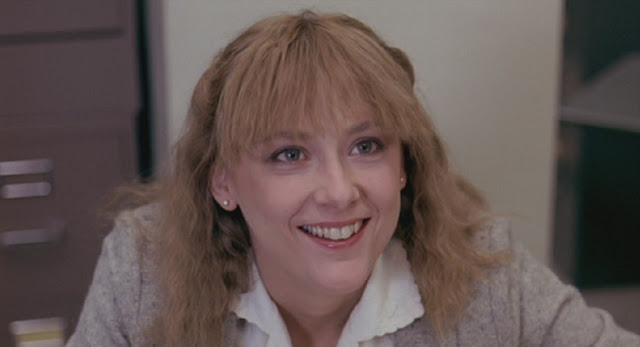
About the only moments of joy in Charles' life come from his memories of his moments with Laura, which the film documents with a deft ease that gives similar time-juggling films like
Pulp Fiction or
The Killing a run for their money. The viewer is completely convinced that this is a linear structure, and is only aware later that the film is told almost entirely in flashbacks. Heard's narration weaves in and out, and Silver even has him address the camera at times in a maybe
Annie Hall-influenced move (though
Chilly Scenes of Winter is its own animal, it also owes much to Woody Allen's masterpiece).

Anyway, the moments with Charles and Laura together, in happiness and anger, are some of the most electrifying romantic scenes in movie history. In particular, their first meeting has a sexual tension that pops like no other scene of its type. Their banter, their body language, their flirtatious looks and barest confessions--it's all like nothing else I've ever witnessed on film (I cannot stress this strongly enough). It's on the strength of moments like this--another is their charged slow-dance to Bette Midler's version of "Skylark," with Charles' voice-over admission: "Say what you will--it was perfect"--that we're able to understand our lead's unwavering devotion to this woman, and this relationship. But it's in the argumentative scenes--like the one they have after exiting a porno movie, and Charles says that Laura was prettier than the girl getting boffed on screen--that we realize that Laura has no room in her soul for this much love. There's something both in her present (her lifeless marriage to A-frame house salesman, played by co-producer Mark Metcalf) and way in her unmentioned past that won't allow her to enjoy it. And Charles is often too smothering anyway, putting up, for instance, an unnatural objection to Laura visiting her gynecologist by herself (and culminating in a disturbing promise of violence that shakes both Laura and the viewer to the core).

One of the things that makes this movie work so well is the decision to deviate from the push me/pull you dynamics of the love story by peppering the movie with lots of offbeat characters, all nicely-played. Peter Riegert, then fresh off his success as one of the leads in
National Lampoon's Animal House, adds a game brand of wildness to Sam, his laconic tone mixing humorously with a determined physicality. And Grahame is also quite fine, demented and sad, as a woman whose lust for life has been whittled down by the empty-nest syndrome and a desire for a man--Charles' long-dead father--whom she never got to love as fully as she would have liked (now, as I type this, I wonder if this is the sort of thing that set Charles up for the kind of poisoned relationship he'd experience with Laura). Also, finally, I should favorably point out McMillan--a great character actor of the 70s and 80s--as the rotund, boisterous stepfather, always eager to please, promising olives to Charles for their Sunday dinner and boosting both Turtle Wax and dancing lessons with equal zeal to his stepson. And, lest it not be forgotten that
Chilly Scenes of Winter is steered largely by the gifts of its two leads; with this and
Cutter's Way, John Heard cemented his place in film history as one of his era's most likable, world-hardened actors, while Mary Beth Hurt hit a career high with her charming neurotics (I especially love the scene where she asks Charles for a birdfeeder and does her little tweety sounds for him--I wait for that moment every time I see the film).
Joan Micklin Silver has long been one of my favorite unsung film directors (
Hester Street, Between The Lines, and
Crossing Delancey are some of her other very accomplished works). But this is the most complete of her films. She builds a brilliantly blah look to the film (I love how the art direction and photography achieves this sort of beige look to everyday life, and then punctuates it with individual shots that mirror those moments that, in our own lives, seem movie-lit brilliant). Moreover, I marvel at how she knows so well Silver knows how to write this man Charles (with all due credit going to the novel's author Beattie who, by the way, cameos in the film as a harried waitress). So often I'm astonished at how so many men know so little of how to write women that they don't even try, reducing some female roles down to cliche and sex. But here is a lady that truly knows how to portray men, at least men of this era (perhaps it's easier for women to pen men's roles because they listen so much more intently). Silver also captures the stench of disappointment in the late 70s air as the hopeful Woodstock generation plods towards Reagan's inevitable New Dawn (Tarah Nutter, as Charles' sister, has a great dismissive line: "All Woodstock was was a bunch of people walking around in the mud looking for a place to pee"). Charles fight to keep Laura is, in a way, a last-ditch effort laced with 60s-era idealism. He knows this relationship has its problems but somehow, somehow, he's gonna try and make it work because
something in him tells him it's worth it. Until it isn't anymore.

As suggested by the bleak title and Ken Lauber's brilliantly plaintive musical score (performed partially by jazz harmonica great Toots Thielemans, who also provides the score's athletic whistling),
Chilly Scenes of Winter chronicles one man's descent into time-jangling depression, and into a whirlwind wistfulness about the past. But it does so with a light air and about as entertainingly as any film could, and there's just something particularly timeless about the film that I attribute to Micklin's expert direction. There are very big laughs in it (just wait for the part about yogurt), but it'll also leave you with a deep sort of nostalgia for any lost love you may have experienced...and this goes for both men AND women. Because, let's face it--as much as I love Woody Allen's films, most of us aren't part of the New York intellegentsia. We're largely all poor, working-class schlubs like Charles and Laura.
POST NOTE (AND SPOILER ALERT): OH MY GOD! Some angel on You Tube posted the original ending to this story. Remember, this is how Ann Beattie ORIGINALLY wrote it (it still seems so strange to note that the filmmakers and the studio actually opted for a more downbeat ending). I still think the redo is great and the way the story should be told, but this other ending makes my heart soar strangely with hope (maybe because it's the ending I WISHED had happened, and not the one I know was most likely). At any rate...what a truly fantastic history the film has. Criterion is foolish to ignore it. There are definitely some mysteries here to be explored.
Nice to meet you, and come back to FILMICABILITY soon. Keep watchin' movies.
--Dean Treadway
After the 2013 Massachusetts Independent Film Festival closing night awards ceremony. (Photo by Nolan Yee)