Showing posts with label Leni Riefenstahl. Show all posts

Sunday, May 3, 2015

1935--The Year in Review

Easily the most entertaining film of a nondescript year, Hitchcock's The 39 Steps is a constant surprise. It begins and ends in stunning fashion, and even though Riefenstahl's Triumph of the Will is clearly the most influential movie of its time, Hitchcock's finest British production is obviously the narrative movie of the year--it's just as exciting now as it was when it was made. But James Whale's The Bride of Frankenstein came close to eclipsing it with the sheer force of its performances and design (it's at the top as one of the greatest sequels produced). With animation, Disney continues to contribute beautiful work with The Band Concert, which would prove to be among Mickey Mouse's finest moments. Still, in the end, it is Riefenstahl's images that will live forever, even if they live in infamy. NOTE: These are MY choices for each category, and they are in no way reflective of the choices made by the Oscars.

PICTURE: THE 39 STEPS (US, Alfred Hitchcock)
(2nd: The Bride of Frankenstein (US, James Whale), followed by: 
Triumph of the Will (Germany, Leni Refenstahl)
Top Hat (US, Mark Sandrich)
Captain Blood (US, Michael Curtiz)
Mutiny on the Bounty (US, Frank Lloyd)
A Night at the Opera (US, Sam Wood)
Ruggles of Red Gap (US, Leo McCarey)
Sylvia Scarlett (US, George Cukor)
David Copperfield (US, George Cukor)
The Man on the Flying Trapeze (US, Clyde Bruckman)
A Midsummer Night’s Dream (US, William Dieterle and Max Reinhardt)
A Tale of Two Cities (US, Jack Conway))

ACTOR: Charles Laughton, RUGGLES OF RED GAP (2nd: Ronald Colman, A Tale of Two Cities, followed by: Boris Karloff, The Bride of Frankenstein; Peter Lorre, Mad Love; Victor McLaglen,  The Informer; W.C. Fields, The Man on the Flying Trapeze; Groucho Marx, A Night at the Opera; Clark Gable, Mutiny on the Bounty; Charles Laughton, Mutiny on the Bounty; Paul Muni, The Story of Louis Pasteur; Will Rogers, Steamboat Round the Bend)


ACTRESS: Katharine Hepburn, SYLVIA SCARLETT (2nd: Jean Arthur, The Whole Town‘s Talking, followed by: Bette Davis, Dangerous; Ginger Rogers, Top Hat; Katharine Hepburn, Alice Adams; Greta Garbo, Anna Karenina; Miriam Hopkins, Becky Sharp)


SUPPORTING ACTOR: Ernest Thesiger, THE BRIDE OF FRANKENSTEIN (2nd: Mickey Rooney, A Midsummer Night’s Dream, followed by: W.C. Fields, David Copperfield; Franchot Tone, Mutiny on the Bounty; Basil Rathbone, Captain Blood; Edward Everett Horton, Top Hat)


SUPPORTING ACTRESS: Elsa Lanchester. THE BRIDE OF FRANKENSTEIN (2nd: Edna May Oliver, David Copperfield, followed by: Mary Boland, Ruggles of Red Gap; Florence Eldridge, Les Misérables; Zasu Pitts, Ruggles of Red Gap; Jessie Ralph, David Copperfield)

DIRECTOR: Leni Riefenstahl, TRIUMPH OF THE WILL (2nd: James Whale, The Bride of Frankenstein, followed by: Alfred Hitchcock, The 39 Steps; Michael Curtiz, Captain Blood; George Cukor, Sylvia Scarlett; John Ford, The Informer)

SCREENPLAY: Charles Bennett and Ian Hay, THE 39 STEPS (2nd: William Hurlbut and John L. Balderson, The Bride of Frankenstein; W.P. Lipscomb and S.N. Behrman, A Tale of Two Cities; George S. Kaufman, Morrie Ryskind, James Kevin McGuinness, A Night at the Opera; Dudley Nichols, The Informer; Gladys Unger, John Collier, and Mortimer Offner, Sylvia Scarlett)


LIVE ACTION SHORT FILM: CAB CALLOWAY'S JITTERBUG PARTY (Fred Waller) (2nd: Tit for Tat (Laurel and Hardy; Charles Rogers); Uncivil Warriors (Three Stooges; Del Lord); Three Little Beers (Three Stooges; Del Lord)


ANIMATED SHORT FILM: THE BAND CONCERT (Wilfred Jackson and Walt Disney) (2nd:  Colour Box (Lenny Lye), followed by: Three Orphan Kittens (David Hand and Walt Disney)


CINEMATOGRAPHY: Hal Mohr, A MIDSUMMER'S NIGHT DREAM (2nd: Sepp Allinger, Triumph of the Will, followed by Bernard Knowles, The 39 Steps)


ART DIRECTION: TOP HAT, The Dark Angel, Anna Karenina, A Midsummer Night's Dream, The Bride of Frankenstein


COSTUME DESIGN: CAPTAIN BLOOD, Top Hat, A Midsummer Night's Dream, Anna Karenina, David Copperfield

Saturday, March 22, 2008

Film #17: The Wonderful, Horrible Life of Leni Riefenstahl


If you've ever seen Triumph of the Will or Olympia, you've probably wondered about their mysterious, reclusive maker. Leni Riefenstahl rose to prominence in pre-Nazi Germany with her strapping, sexy starring roles in Arnold Fanck's heroic "mountain" movies. Having given up acting in 1933, she resolved to turn her energies to directing films. Her reading of Adolf H.'s prison memoir Mein Kamph was a revelation. "I became a confirmed National Socialist after reading the first page," she wrote in her memoirs. "I felt a man who could write such a book would undoubtedly lead Germany. I felt very happy that such a man had come."


Her film of Hitler's 1933 Nuremberg Nazi rally, Victory of Faith remains little-seen. But, turns out, it was just a trial run for yet another go at recording a gathering of jackboots. In 1934, she shot Triumph of the Will with discernible passion. Even though it was obviously documenting the beginnings of worldwide calamity, this true believer made Hitler's arrival on the world stage look as welcome as the Second Coming, and few Germans at the time would have objected to this view. Check out how Hitler's plane comes zooming out of the dramatic grey-white clouds, or the epic craning of the camera over the throngs, or the impossibly uniformed lines of soldiers and swastikas. She adored this Hitler dude, and helped make him the monster he became.

She went on to record her reeling ode to Aryan physical beauty and athleticism, Olympia at the 1936 Berlin Olympics, thus sealing her international reputation, even among disgusted Nazi-haters, as the first notable female film director (watch the Olympics today and you will still see shooting techniques that she pioneered). She continued to support Hitler all through the war, and he returned the favor by bankrolling her increasingly lavish productions.


Once the war had ended, Riefelstahl found herself imprisoned in a French detainment camp. Upon her release, she continued to try and make films, but her support of the Nazi carnage shot her chances for funding, so she concentrated on still photography, and thereby sank into a notorious obscurity. That is, until she agreed to sit with director Uli Wertzel for 1994's The Wonderful, Horrible Life of Leni Riefenstahl. Wertzel is a lucky beneficiary of the 90-year-old's misused talent and undeniable charisma. Regarding the Holocaust, Wertzel catches her parroting that tired old "we didn't know anything about it" excuse guilty Germans handed the world. Her onscreen contention that artists cannot be political is a jaw-dropper, but is also bizarrely understandable given the abstracted virtuosity displayed in Triumph and Olympia.


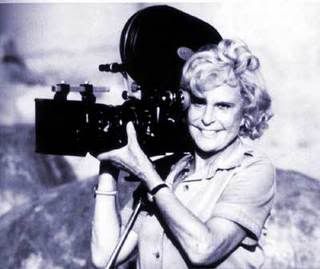
Clips from her small but significant body of work serve as centerpieces to this long, grand documentary, though the footage of the middle-aged Riefenstahl filming native tribes in Africa and, then at 88, shooting underwater films of marine life are easily as intriguing. In particular, I loved the hilariously arrogant scenes where she directs the director, decrying his shot set-ups and, while talking and walking, complaining that she can't talk while walking. Wertzel's controversial celebration of this notable but terribly misled filmmaker is a supremely satisfying look at the life in art and the art of a life.