Showing posts with label Brad Pitt. Show all posts

Saturday, January 14, 2017

2011--The Year in Review

As usual per the year in movies in the current era, I started off thinking this was the worst time ever to be a movie lover. But, by the fall, I began to see an extraordinary collection of largely contemplative films that were, in one way or another, pining for the past. Nostalgia is the dominant theme in 2011's movies: one could lump Midnight in Paris, The Artist, War Horse, Hugo, The Tree of Life, General Orders No. 9, and George Harrison: Living in the Material World all into a category wanting for the comforts and justice of bygone eras, presumably because the present is so trying. Also, the prevalence of end-of-the-world scenarios in films like Melancholia, Rise of the Planet of the Apes, Another Earth, Contagion, Take Shelter and 4:44: Last Day on Earth is related to worldwide discord being felt by many. But I also found 2011's films also to be filled with a shining love of life, nature and humanity. It was a resolutely extraordinary period for film, and many of these in my top 25 will deserve to be studied again and again in the future.

Chief among these subjects will certainly be Terrence Malick's resolute masterpiece The Tree of Life, his radically unique take on a family drama centered in on a Texas clan led by a stern father (Brad Pitt) and a dreamy mother (Jessica Chastain, an actress who had a superb year with breakthrough roles in this, The Help, Coriolanus, and Take Shelter). The Tree of Life, with its dazzling tour through the world's biggest and smallest events, certainly deserves to be the third Best Picture spot I have awarded to this one-of-a-kind director. My thoughts on the film are best expressed in my review, which you can see here. But, from that review, I offer this: "Malick's filmic thoughts are resolutely unlike anything mainstream audiences of narrative cinematic storytelling have been treated to since Kubrick's 1968 film 2001: A Space Odyssey. I guarantee 99% of the audience watching the film with you when you see The Tree of Life have never experienced anything like it. That includes you, and me, too, really. Most viewers will be angry at the ultimate conclusion to Malick's film, because it doesn't conform to a paying customer's plotline/revelation payoff. But those who are disappointed will be regretful, or perhaps angry with their own reactions to the film itself 20 years down the line, where it will be commonly seen as one of cinema's most unparalleled visions. So comparisons to the similarly singular, divisive, fantastic 2001 are just. This is a movie for the ages. It's rare to see such a work, but here it is, in front of our eyes."

It hurts, though, to have to ignore other great movies from this year in this process. I had to find room for Nuri Birge Ceylan's stunning Turkish crime drama Once Upon a Time in Anatolia, a gorgeous and emotionally draining yarn that grabbed me from its very first well-constructed minutes and never let go (it contains my favorite shot of the year--an apple's slow motion tumble from the tree to a brook filled with rotting fruit). Asghar Farhedi's tense Iranian divorce drama A Separation likewise had me ensnared in its complex machinations early on, as its screenplay and cast were just too brilliant to ignore (Sareh Bayat, as the fractured family's caregiver who finds her family caught up in another's drama, had to emerge as my top Supporting Actress). The best mainstream Hollywood movie of the year was Bennett Miller's Moneyball, a highly entertaining account of a failing baseball team's winning foray into a controversially exacting brand of sports analysis; the movie was commanded by two fantastic performances--one from Brad Pitt, in his finest hour here as victory-hungry Oakland A's manager Billy Beane, and another from Jonah Hill, a comedic performer who achieved instant character actor status as Beane's apprehensive lead statistician.

Meanwhile, the Best Actress race was led by Kirsten Dunst as the heavily depressed bride in Lars Von Trier's apocalyptic Melancholia, Tilda Swinton as the overwhelmed mother of a psychopathic child in Lynne Ramsay's We Need to Talk About Kevin, and Anna Paquin as a manic teenager seeking justice for a fatal accident she had a hand in causing in Kenneth Lonergan's Margaret, an unfortunately troubled production that really wouldn't get widely seen for a couple of years. It was a tough race, there, but I eventually found for the actress that I though dug deepest into her own soul than any other (and this was not an easy decision). I should also point out my adoration for perhaps the most little-known movie in my top ten, a decade-in-the-making labor of love by Georgia filmmaker Robert Persons dealing with the changing face of the Southern United States and, indeed, the ecological transformation affecting the world entire, in his poetic, beautifully photographed documentary General Orders No. 9; if you are a fan of Malick's The Tree of Life, then you definitely must make time for this work that could stand as its wholly in-step companion piece. With other superb films like Oslo, 31st August, Footnote, Take This Waltz, Paradise Lost 3: Purgatory, The Kid with a Bike, Goodbye First Love, Damsels in Distress, Silent Souls, Bridesmaids, George Harrison: Living in the Material World, Pina, Buck, Contagion and Martha Marcy May Marlene, we can see now this was a shining year for world cinema. Even though I would've chosen differently, I don't even have a serious issue with Michel Hazanavicius' lovely ode to silent cinema The Artist as a Best Picture choice. In its own lighthearted fashion, it, too, was a film totally in keeping with the high quality of film work completed in 2011. NOTE: These are MY choices for each category, and are only occasionally reflective of the selections made by the Academy of Motion Picture Arts and Sciences (aka The Oscars). When available, the nominee that actually won the Oscar will be highlighted in bold.

PICTURE: THE TREE OF LIFE (US, Terrence Malick) (2nd: Once Upon a Time in Anatolia (Turkey, Nuri Bilge Ceylan), followed by: A Separation (Iran, Asghar Farhadi); Melancholia (Denmark, Lars Von Trier); Moneyball (US, Bennett Miller); Margaret (US, Kenneth Lonergan); General Orders No. 9 (US, Robert Persons); The Artist (France, Michel Hazanavicius); Oslo, 31st August (Norway, Joachim Trier); Footnote (Israel, Joseph Cedar); We Need to Talk About Kevin (UK/US, Lynne Ramsay); Take This Waltz (Canada, Sarah Polley); Paradise Lost 3: Purgatory (US, Joe Berlinger and Bruce Sinofsky); The Kid with a Bike (France, Jean-Pierre Dardenne and Luc Dardenne); Goodbye, First Love (France, Mia Hansen-Love); Damsels in Distress (US, Whit Stillman); Silent Souls (Russia, Aleksey Fedorchenko); Bridesmaids (US, Paul Feig); George Harrison: Living in the Material World (US, Martin Scorsese); Pina (Germany, Wim Wenders); Contagion (US, Steven Soderburgh); 5 Broken Cameras (Palestine, Emad Burnat and Guy Davidi); Martha Marcy May Marlene (US, Sean Durkin); A Little Help (US, Michael J. Weithorn); Buck (US, Cindy Meehl); Win Win (US, Thomas McCarthy); There's Something Wrong with Aunt Diane (US, Liz Garbus); The Deep Blue Sea (UK, Terence Davies); The Autobiography of Nicholas Ceausescu (Romania/Germany, Andrei Ujica); Killer Joe (US, William Friedkin); A Dangerous Method (Canada, David Cronenberg); Tyrannosaur (UK, Paddy Considine); Play (Sweden, Rüben Ostlund); Hanna (US/UK, Joe Wright); The Inturrupters (US, Steve James); Into The Abyss (US/Germany, Werner Herzog); Winnie The Pooh (US, Stephen J. Anderson and Don Hall); Pariah (US, Dee Rees); The Descendants (US, Alexander Payne); Warrior (US, Gavin O’Connor); The Future (US, Miranda July); The Devil’s Double (Belgium/Netherlands, Lee Tamahori); Tinker, Tailor, Soldier, Spy (UK, Tomas Alfredson); War Horse (US, Steven Spielberg); Source Code (US, Duncan Jones); Project Nim (US, James Marsh); Meek's Cutoff (US, Kelly Reichardt); Habemus Papam (Italy, Nanni Moretti); The Guard (Ireland, Michael McDonagh); The Raid (Indonesia, Gareth Evans); 50/50 (US, Jonathan Levine); Young Adult (US, Jason Reitman); The Help (US, Tate Taylor); Margin Call (US, J.C. Chandor); The Beaver (US, Jodie Foster); The Skin I Live In (Spain, Pedro Almodóvar); In Darkness (Germany/Poland, Agnieszka Holland); Jane Eyre (UK, Cary Fukunaga); Disabled but Able to Rock (US, Blake Myers); Elena (Russia, Andrei Zvyagintsev); 4:44: Last Day on Earth (US, Abel Ferrara); Violet and Daisy (US, Geoffrey Fletcher); Red State (US, Kevin Smith); Mission Impossible: Ghost Protocol (US, Brad Bird); My Week With Marilyn (UK/US, Simon Curtis), Crazy Stupid Love (US, Glenn Ficarra and John Requa); Take Shelter (US, Jeff Nichols); Paul (US, Greg Mottola); The Muppets (US, James Bobin); Hugo (US/UK, Martin Scorsese); Rango (US, Gore Verbinski); The Girl with the Dragon Tattoo (US, David Fincher); Carnage (US/France, Roman Polanski); Puss in Boots (US, Chris Miller); Coriolanus (UK/US, Ralph Fiennes); The Ides of March (US, George Clooney); Midnight in Paris (US, Woody Allen); Sleeping Sickness (Germany, Ulrich Köhler); Beginners (US, Mike Mills); Attack the Block (UK, Joe Cornish); The Mill and the Cross (Sweden/Poland/UK, Lech Majewski); Drive (US, Nicolas Winding Refn); Shame (UK, Steve McQueen); Rise of the Planet of the Apes (US, Rupert Wyatt); Super 8 (US, J.J. Abrams); Extremely Loud and Incredibly Close (US, Stephen Daldry); Sucker Punch (US, Zack Snyder); The Iron Lady (US, Phyllida Lloyd); J. Edgar (US, Clint Eastwood); Restless (US, Gus Van Sant))


ACTOR: Brad Pitt, MONEYBALL (2nd: Jean Dujardin, The Artist, followed by: Anders Danielsen Lie, Oslo August 31st; Peyman Moaadi, A Separation; Peter Mullan, Tyrannosaur; Dominic Cooper, The Devil’s Double; Mel Gibson, The Beaver; Matthew McConaughey, Killer Joe)


ACTRESS: Kirsten Dunst, MELANCHOLIA (2nd: Tilda Swinton, We Need To Talk About Kevin, followed by: Anna Paquin, Margaret; Michelle Williams, Take This Waltz; Michelle Williams, My Week with Marilyn; Elizabeth Olsen, Martha Marcy Mae Marlene; Leila Hatami, A Separation; Kristen Wiig, Bridesmaids)


SUPPORTING ACTOR: Jonah Hill, MONEYBALL (2nd: Lior Ashkenazi, Footnote, followed by: Viggo Mortensen, A Dangerous Method; Max Von Sydow, Extremely Loud and Incredibly Close;  Albert Brooks, Drive; Nick Nolte, Warrior; Taner Birsel, Once Upon a Time in Anatolia; Christopher Plummer, Beginners)


SUPPORTING ACTRESS: Sareh Bayat, A SEPARATION (2nd: Charlotte Gainsbourg, Melancholia, followed by: J. Smith Cameron, Margaret; Jeannie Berlin, Margaret; Melissa McCarthy, Bridesmaids; Carey Mulligan, Shame; Octavia Spencer, The Help; Jennifer Ehle, Contagion)


DIRECTOR: Terrence Malick, THE TREE OF LIFE (2nd: Nuri Bilge Ceylan, Once Upon a Time in Anatolia, followed by: Lars Von Trier, Melancholia; Asghar Farhedi, A Separation; Bennett Miller, Moneyball; Michel Hazanavicius, The Artist; Robert Persons, General Orders No. 9; Kenneth Lonergan, Margaret)


NON-ENGLISH LANGUAGE FILM: ONCE UPON A TIME IN ANATOLIA (Turkey, Nuri Bilge Ceylan) (2nd: A Separation (Iran, Asghar Farhedi), followed by: Oslo 31st August (Norway, Joachim Trier); Footnote (Israel, Joseph Cedar); The Kid with a Bike (France, Jean-Pierre Dardenne and Luc Dardenne); Silent Souls (Russia, Aleksey Fedorchenko); Goodbye, First Love (France, Mia Hansen-Love); Pina (Germany, Wim Wenders); Play (Sweden, Rüben Ostlund); Habemus Papam (Italy, Nanni Moretti); The Raid (Indonesia, Gareth Evans); The Skin I Live In (Spain, Pedro Almodóvar); In Darkness (Germany/Poland, Agnieszka Holland); Elena (Russia, Andrei Zvyagintsev); Sleeping Sickness (Germany, Ulrich Köhler); The Mill and the Cross (Sweden/ Poland/UK, Lech Majewski))


DOCUMENTARY FEATURE: GENERAL ORDERS NO. 9 (US, Robert Persons) (2nd: Paradise Lost 3: Purgatory (US, Joe Berlinger and Bruce Sinofsky), followed by: George Harrison: Living in the Material World (US, Martin Scorsese); Pina (Germany/France/UK, Wim Wenders); 5 Broken Cameras (Palestine, Emad Burnat and Guy Davidi); There's Something Wrong with Aunt Diane (US, Liz Garbus); The Autobiography of Nicholas Ceausescu (Romania/Germany, Andrei Ujica); Buck (US, Cindy Meehl); The Inturrupters (US, Steve James); Into The Abyss (US/Germany, Werner Herzog); Project Nim (US, James Marsh); Disabled but Able to Rock (US, Blake Myers))


ANIMATED FEATURE: WINNIE THE POOH (US, Stephen J. Anderson and Don Hall) (2nd: Rango (US, Gore Verbinski), followed by: Puss in Boots (US, Chris Miller))


ANIMATED SHORT: THE THOMAS BEALE CIPHER (US, Andrew S. Allen) (2nd: The Fantastic Flying Books of Mr. Morris Lessmore (US, William Joyce and Brandon Oldenburgh), followed by: La Luna (US, Enrico Casarosa); These Hammers Don’t Hurt Us (US, Michael Robinson))


LIVE ACTION SHORT: THE SHORE (Ireland, Terry George) (2nd: Time Freak (US, Andrew Bowler), followed by: Bear (US, Nash Edgerton); Sati Shaves Her Head (US, Tejal Shah))


ORIGINAL SCREENPLAY: Asghar Farhedi, A SEPARATION (2nd: Kenneth Lonergan, Margaret, followed by: Ebru Ceylan, Nuri Bilge Ceylan and Ercan Kesal, Once Upon A Time in Anatolia; Sarah Polley, Take This Waltz; Annie Mumolo and Kristen Wiig, Bridesmaids)


ADAPTED SCREENPLAY: Steve Zaillian, Aaron Sorkin, and Stan Chervin, MONEYBALL (2nd: Joachim Trier and Eskil Vogt, Olso 31st August, followed by: Lynne Ramsay and Rory Kinnear, We Need to Talk About Kevin; Alexander Payne, Nat Faxon and Jim Rash, The Descendants; Christopher Hampton, A Dangerous Method)

CINEMATOGRAPHY: Emmanuel Lubezki, THE TREE OF LIFE (2nd: Gohkan Tiraki, Once Upon A Time in Anatolia, followed by: Robert Persons, General Orders No. 9; Manuel Alberto Claro, Melancholia; Guillaume Schiffman, The Artist)


ART DIRECTION: HUGO, The Tree of Life, Tinker Tailor Soldier Spy, The Artist, Anonymous

COSTUME DESIGN: THE ARTIST, The Skin I Live In, The Mill and The Cross, Anonymous, Immortals


FILM EDITING: MONEYBALL, The Artist, Paradise Lost 3: Purgatory, Contagion, The Tree of Life


SOUND: THE TREE OF LIFE, The Girl With the Dragon Tattoo, War Horse, Hugo, Moneyball


SOUND EFFECTS: WAR HORSE, Super 8, Mission Impossible: Ghost Protocol, The Girl with the Dragon Tattoo, Hugo


ORIGINAL SCORE: Ludovic Bource, THE ARTIST (2nd: Amit Poznansky, Footnote, followed by: Alberto Iglesias, The Skin I Live In; Alberto Iglesias, Tinker Tailor Soldier Spy; Tom Rowland and Ed Simons, Hanna)


ORIGINAL SONG: “So Long” from WINNIE THE POOH (Music and lyrics by Zooey Deschanel) (2nd: “Man or Muppet” from The Muppets (Music and lyrics by Bret McKenzie), followed by: "The Sambola! International Dance Craze" from Damsels in Distress (Music and lyrics by Lou Christie, Michael A. Levine and Mark Suozzo); "Coeur Volant" from Hugo (Music by Howard Shore, lyrics by Elizabeth Cotnoir and Isabelle Geffroy); “Sparkling Day” from One Day (Music and lyrics by Elvis Costello); "Life's A Happy Song" from The Muppets (Music and lyrics by Bret McKenzie); "Masterpiece" from W.E. (Music and lyrics by Madonna, Julie Frost and Jimmy Harry); “Shelter” from Take Shelter (Music and lyrics by Ben Nichols))


SPECIAL EFFECTS: THE TREE OF LIFE, Rise of the Planet of the Apes, Melancholia, Hugo, Real Steel

MAKEUP: THE IRON LADY, My Week With Marilyn, Gainsbourg: A Heroic Life

Tuesday, December 17, 2013

Film #159: The Assassination of Jesse James by the Coward Robert Ford


jesse 8

The passage of time, and of eras, overwhelms the film's first frames as cinematographer Roger Deakins aims his camera into the ether, capturing time-lapsed storm clouds speeding through the Missouri skies, with Nick Cave and Warren Ellis’ tick-tocky score sounding out like mournful timepieces ringing out the end of one hour and the beginning of another. We first see Brad Pitt’s Jesse James as a pensive, well-loved 34-year-old family man fervently contemplating his humanity and his concomitant mortality. The eloquent narration–some of the best ever written for a film–begins by illustrating Jesse’s foibles, normalcies, lies, physical flaws, and almost superhuman charisma. Actor/filmmaker Hugh Ross is the unseen narrator, who speaks in third-person as if he were dissecting this tale’s movements with scientific fervor; his serious, folksy voice is perhaps the most important in the movie, because it’s the authoritative reresentative of human history–the same history that will ensnare and mangle the lives of our two title characters, and of all others who near them.

Writer/director Andrew Dominik, working from Ron Hansen’s novel, laboriously crafts the language of this narration, making it feel like it was cribbed from an 1882 St. Louis newspaper. Even the film’s title–The Assassination of Jesse James by the Coward Robert Ford–reads like a bold headline over a story one might’ve consumed the day following Ford’s notorious bullet. This use of antiquated speech, inspired by Hansen’s work, is one of many tricks that the determined Dominik employs as a time-travel devise in this masterful period piece. Often, experiencing this picture’s sights and sounds feels like being hypnotized and transported directly into the heel of the 19th Century.


Having let us know, immediately, that this is going to be no ordinary shoot-’em-up (something that must’ve been a disappointment to Warner Brothers, who treated this complex film with shoddy bewilderment upon its 2007 release; it was a notorious and heartbreaking box office flop), Dominik quickly makes a tonal shift into the first dialogue scene, with king-of-the-court Jesse in good humor and communing with his still Confederate-loyal gang hours before what will be their final train robbery. It’s here, via boyish joviality, that we immediately get familiar with many of the story’s main players: the affable Charley Ford (Sam Rockwell); big talkin’ lover-man bandit Dick Liddil (Paul Schneider); poor and simple Ed Miller (Garret Dillahunt); and Jesse’s cousin, the quietly proud but hair-trigger Wood Hite (Jeremy Renner). Things are kept light…and then Robert Ford shows up. In a dark coat and a tattered, stunted stovepipe hat, Casey Affleck immediately captures our attention with his low-self-esteem shambling (Affleck’s idiosyncratic performance seems slightly influenced by Timothy Carey–something about those lidded eyes and that slightly slurred speech). Sucking the air out of the very forest, Ford puts on an uncertain smile and kneels down to join the boys, but–as it seems to have been for his entire life–the timing is all wrong. Just as he takes a seat, chowtime is called and the James gang goes running, leaving him by lonesome once again. This cloudy outsider desperately wants in.

jesse 11

Bob Ford decides to escape this scene and approach Frank James (Sam Shepard) for some validation. Bad idea. Here, we get more fully introduced to the way Ford carries himself. As he does throughout the film, in a performance of immense grace and empathy, Affleck employs a dazzling array of facial pyrotechnics–toothy smiles, tired and begging eyes, a nearly trembling chin, contrite glances downwards, humiliated glances sideways–in his first unsure attempt to sell himself (and Ford is ALWAYS trying to sell himself in this movie–that’s something that makes this story contemporary, since most of us are trying to sell ourselves to someone these days). This first monologue is key (we should remember: it’s given to Frank James, whom Bob respects but doesn’t hold in high regard as he does Jesse):

Bob: I was lyin’ when I said I just happened down here. I been lookin’ for you. I feel lousy I didn’t say so at the outset. (pause) Folks sometimes take me for a nincompoop on account of the shabby first impression I make, whereas I’ve always thought of myself as being just a rung down from the James Brothers. And I was hoping if I ran into you aside from those peckerwoods, I could show you how truly special I am. (no response from Frank, who lights a cigar). I honestly believe I’m destined for great things, Mr. James. I’ve got qualities that don’t come shinin' through right at the outset, but give me a chance and I’ll get the job done. I can guarantee you that. 

Frank James is, however, way past this manner of life, and is in no mood to hear talk of further exploits, and so he shuffles Bob Ford off with an assertive flash of his gun. But here we see that Bob Ford–who with his first line admits he’s a liar–is the much more unstable person. Through Affleck’s performance and Dominik’s authentic dialogue, we can sense Ford’s foot-stamping rage as he tries to be polite and brush off this rejection from someone he feels stole some of Jesse’s limelight. And, as we will see, Bob Ford is VERY protective over his OWN gilded image of Jesse James.

Dominik intercuts this intense scene with a revisit with the rest of the gang, whose characters become more defined as they talk about their exploits with women (and women are rarely seen in this film, although they do have a fleeting presence, not surprisingly as busy housewives or wide-eyed ingenues). Here, we sense the power of a couple more performances–the sad sugar of Dillahunt’s Miller, and the boss sassiness of Schneider’s Dick Liddil, who schools these guys on what words will and will not work on women. Obviously a devotee of poetry, Liddil understands the power of words, and this is among his weapons–it sets him a level above his ill-educated compatriots, at the very least. This scene provides the transition into Robert Ford’s first meeting with his idol. But Jesse’s see-through-you friendliness puts the flakey Bob off-guard, and leaves him feeling disappointed in Jesse’s lack of seriousness over what Bob sees as a valuable opportunity for him to buy into Bob’s sharp-shooting loyalty.

jesse 4

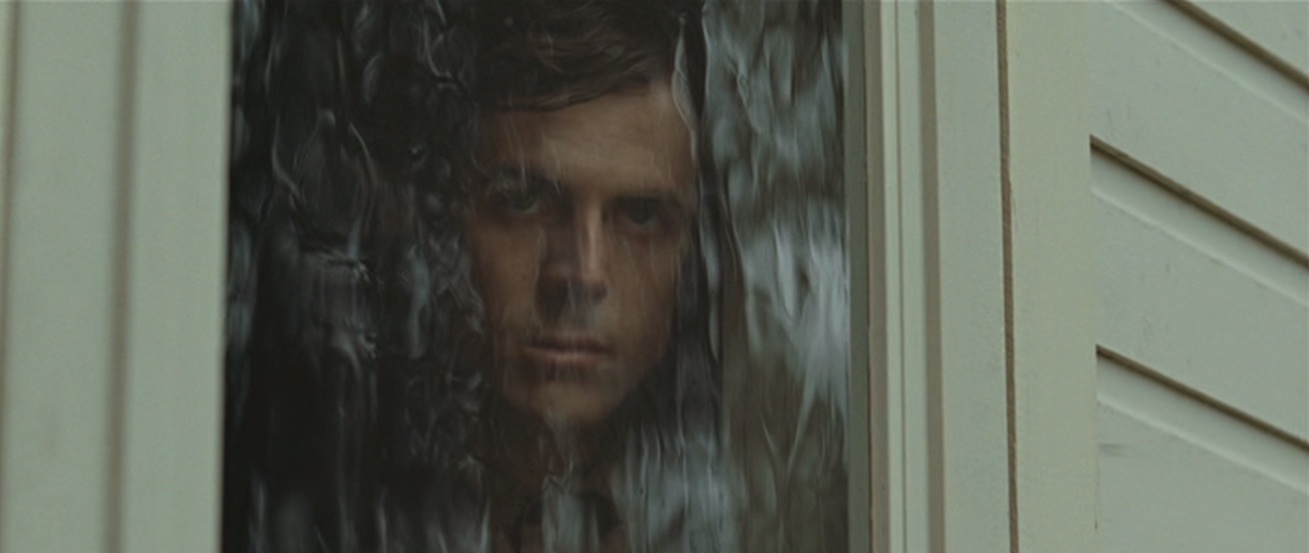
The robbery at Blue Cut is a showpiece for Deakins’ cinematography (and that’s saying something for a movie shot as impeccably as this one; this is certainly some of Deakins’ most notable work, in a career filled with masterstrokes). Here, as the narrator chimes in again, we get a fuller blush at the film’s visual splendor. We start to take more notice of the camera’s radically blurred lenses, superbly ground to create the feel of looking through hand-blown glass or, maybe, a crystal ball. We see Jesse, tinted by yellowed lantern light, listening to the tracks for activity, and–in an unusual camera move which results in such darkness as to require the viewer to momentarily lean on sound alone–we eventually catch the train emerging out of that inky blackness, its passing headlight refracting psychedelically through the reedy trees amongst which the James Gang lie in wait. Then we catch a towering glimpse of Frank James as the stone through which this steam-spitting locomotive cannot pass. The raiding of the train is memorable not for its brutality, but for its lack of it; while gathering what little loot they can, Ed Miller nervously warns Jesse against killing a meek clerk standing guard over the train’s questionable riches. Here, we get the first glimpse into Jesse’s murderous eyes, and into the notion that maybe something is afoul in this group–something beyond Robert Ford’s vampiric energy. As time further encroaches on the film through its memorably needling score, Jesse and Frank don’t even have to have words after the robbery. They know it’s all over.

But then there is Bob Ford, who shows up to energize Jesse again. For him, at this moment, and often throughout the movie, Bob is a window into the strange fame and adulation he’s achieved, and so Jesse is glad to have him around, for he has not much amusement to hang his hat on at this stage. It’s at this moment, too, that Bob Ford begins to recognize Jesse as someone who might spot his worth. I love the scene where Jesse and Bob smoke cigars on a porch, and Bob lets Jesse in on his fandom. This is where some of the movie’s present-day relevancy comes into play, as it feels like Brad Pitt is now playing a version of himself, having to listen to a slightly scary acolyte’s rapturous praise while trying to hold onto a self-image he can recognize. Meanwhile, Affleck has Bob come across as a kid who takes a wobbly joy in this opportunity, and then quickly realizes he’s playing at a risky game of barely comprehensible hugeness. It’s great how this scene begins, with Bob in little-child mode, bouncing between nervous near-tears and breathless adulation, regaling Jesse with how bad his day began and how well it’s ended, and Jesse calmly remarking “Yeah, it’s a wonderful world.” Just as brilliant is how the scene ends, with Ford revealing his disdain for Frank (a “nothing,” he slips); Jesse is obviously wounded by this, and here the air goes out of Bob Ford’s performance, especially when Jesse tells him those dime novels he takes such stock in are all lies. At this moment, which he typically tries to shrug off, Ford seems to take up residence on another, even more melancholy planet. This is a movie about the perils hidden in being famous, and in adoring the famous too much.

jesse 5

It doesn’t get much better for Bob the next morning, when Jesse chooses him as his footman while demonstrating his willingness to kill enemies by beheading a pair of snakes. Here we get the sense that Ford finally knows he’s been idolizing an unforgiving killer. Even so, all this “sounds like an adventure” to him, and taking the job is definitely a transient way for him to look better than the rest of the gang (even though Wood and Charley end up mocking Bob, as always; this movie, in another display of present-day relevance, touches on those revenge fantasies that many of the bullied have often, and still do now, turn into realities). The narration that follows keys us into another of the film’s themes: the intermingling of the hunter and the hunted:

Narrator: They moved to 1017 Troost Avenue at night so that the neighborhood couldn’t get a good look at them or their belongings. And then Bob thought Jesse would give him eight hours of sleep and a daydreaming goodbye. But with a second day in the Thomas Howard house, Bob thought he might never go, but might be brought in as a good-natured cousin to the boy and a gentleman helper to Zee. He went everywhere with Jesse. They made trips to the Topeka Exchange Saloon, where Jesse could spend nearly sixty minutes sipping one glass of beer and still complain about feeling tipsy. Bob would rarely vouchsafe his opinions as they talked. If spoken to, he would fidget and grin. If Jesse palavered with another person, Bob secretaried their dialogue, getting every gesture, reading every inflection and tic, as if he wanted to compose a biography of the outlaw, or as if he were preparing an impersonation. 

 
After Bob is sent away by an increasingly creeped-out Jesse, we get into the film’s mesmerizing second act, detailing the machinations that set the barely-regarded Robert Ford swirling into a tornado of destined events that’ll send him crashing into the “Thomas Howard house” almost seven months later, with Jesse at the end of his gun. Dick Liddil’s copious feel for female flesh–at first a plot element that seems superfluous–ends up being the lit match that melts the tar holding Jesse’s gang together. It spurs Wood Hite to seek revenge against Liddil (for diddling his elderly father’s young wife, played with a saucy impertinence by Alison Elliott). This sets Bob Ford against Hite, whom he dispatches in a steady but lucky shot (probably more inspired by Hite‘s mockery of Ford, and his closeness to Jesse, than by Liddil’s well-being); and this sets Bob and Charley finally in the same camp, bound by blood to protect each other, despite all the years Charley has spent ribbing Bob for his gaga droolings over the James itinerary.

All this intrigue comes amidst rumors that Liddel and Ed Miller are planning to backstab Jesse (this leads to an excellent scene with Bob Ford taking a bath out in a meadow, and Liddil threatening him with a pistol shot if he ever lets on anything he knows; Schneider, a veteran of David Gordon Green’s All The Real Girls and, later, Jane Campion’s Bright Star, is really splendid here with his honeyed phraseology and sly vocals). Jesse, however, seems to know all that’s going to happen before it does and so it’s no surprise he’s onto the virtually translucent Ed Miller, whom he visits in an extremely tense scene that highlights Dillahunt’s stammering yokel as a grim figure submerged over his head. Dillahunt had an extremely good year in 2007, appearing in both this and Joel and Ethan Coen’s No Country for Old Men. Unlike that film appearance, he brilliantly cuts a pale and underfed profile here–one painfully blue, unloved and discarded.

jesse 6

Eventually, Jesse is compelled to visit the Ford brothers, ostensibly to ask them to help him case another bank, but really to see if there are any fissures in their loyalty. This leads to another of the film’s most quietly explosive scenes, with Sam Rockwell’s boisterous Charley at the family dinner table, trying mightily to distract Jesse’s sense of something amiss by making Bob the butt of jokes. But Bob turns things around for himself, and for the on-edge family: through this exchange, he both reignites Jesse’s inexplicably prescient fascination with him and, with a subsequent tantrum, underscores his own strong scent of disloyalty:

Jesse: Give me some more conversations, Bob.
Charley: I got one. (laughing hard) This one’s ’bout as crackerjack as the one–
Jesse: Let Bob tell it.
Bob: (long pause) I don’t even know what you’re talking about.
Charley: About how much you and Jesse have soooo much in common.
Jesse: Go on, Bob.
Charley: Yeah, come on, Bob. Tell us a story.
Bob: Nope. Nope.
Charley: C’mon, entertain Jesse. He’s here…c’mon
Bob: (long pause as his hems and then smiles) Well, if you’ll pardon my saying so, I guess it is interesting, the many ways you and I overlap and what not. I mean, you begin with our daddies. Your daddy was a pastor of the New Hope Baptist Church; my daddy was a pastor of a church at Excelsior Springs. Um. You’re the youngest of the three James boys; I’m the youngest of the five Ford boys. Between Charley and me, is another brother, Wilbur here, with six letters in his name; and between Frank and is another brother, Robert, also with six letters. And my Christian name is Robert, of course. You have blue eyes; I have blue eyes. You’re five feet eight inches tall. I’m five feet eight inches tall…Oh me, I must’ve had a list as long as your nightshirt when I was twelve, but I’ve seem to have lost some curiosities over the years. (the camera remains on Bob longer than it should; the smile drifts off his face).
Jesse: (after staring at Bob for a while, grinning) Ain’t he somethin’?

jessie 15

By the time the government gets wind of Dick Liddil’s whereabouts, Robert Ford has enough animosity built up against Jesse that something has to give. Searching for any way he can finally become as notorious as his hero, Bob Ford–like many modern assassins–finally turns against his idol. With the collusion of some Missouri lawmen (Ted Levine and Tarantino favorite Michael Parks) and under the direction of Governor Crittenden (played by former Bill Clinton advisor James Carville, in a sharp, surprising cameo), he gets caught up in a false sense of importance. Even the government, who’s depending on Bob’s commitment to this manhunt, seem to belittle his abilities. They know they’re well past the scrapings and into the barrel. But they’re trying everything they can–even putting their trust in someone who may frankly be a madman. And Bob is extra willing to play along, especially if it can fill the hole inside himself, if only for a short while (“I’ve been a nobody all my life,” Ford tells Levine’s Sheriff Timberlake. “I was the baby–I was the one they made promises to they never kept. And ever since I can remember, Jesse James has been big as a tree.”)

Jesse, meanwhile, comes to a new appreciation of the Ford brothers, having forged a bond with Charley after asking him for and tentatively believing Charley’s version of the truth regarding Dick Liddil and Wood Hite. It’s Charley who seals his own and his brother’s fates, with the final selling of Robert Ford. And as Jesse has no other associates whom he can even remotely count on (none that are alive, at least), he relents in letting Bob back in the gang. But he does so because he’s already seen death approaching; while stalking fish under the ice of a frozen lake, he tells Charley “…one thing that’s for certain: you don’t mind dyin’ once you’ve peeked over the other side. You’d no more wanna go back to your body than you’d wanna spoon up your own puke.”

jesse 14

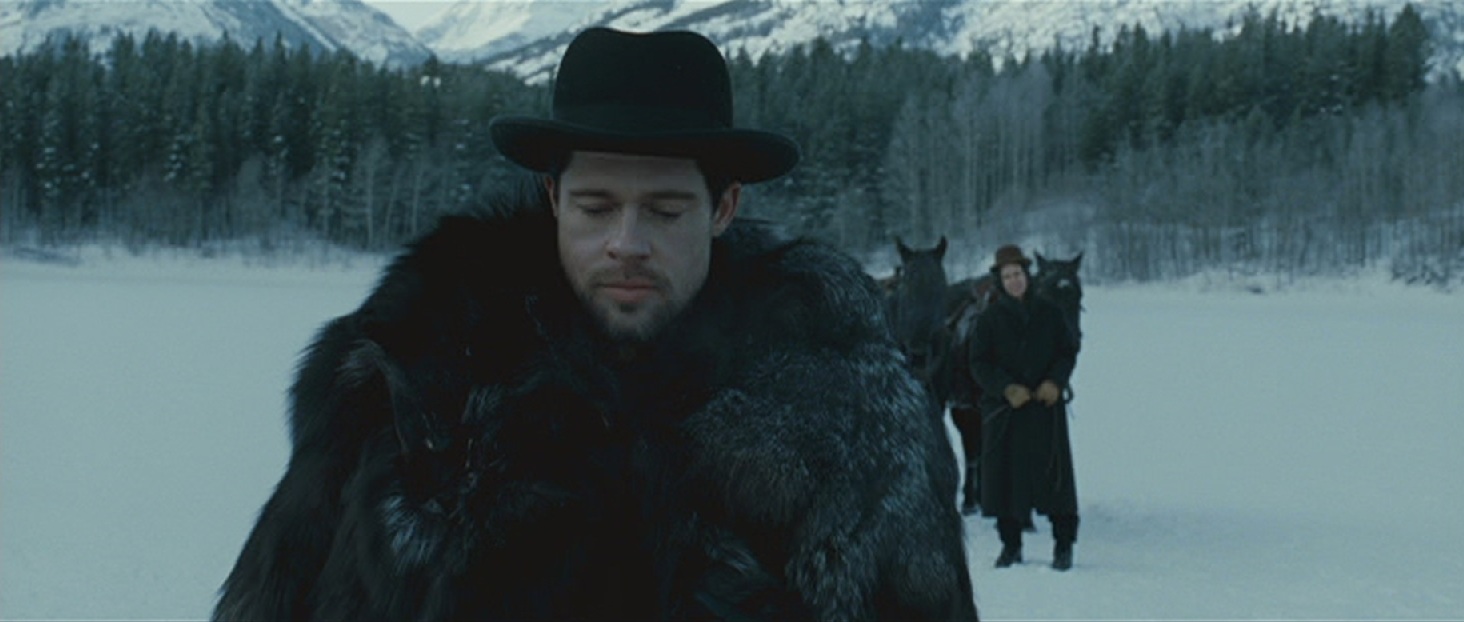
True to its title, the film’s final act dramatizes James’ death, with a sweaty Robert Ford nervously ramping up to his deed, and Charley over in the corner, gut-sick with guilt and fear. But we get the most unguarded insight into Robert Ford’s persona after Jesse’s death–after we as an audience feel the loss of Brad Pitt’s glamour from the film (Pitt’s terrific throughout, especially when being menacing or playful, or both at the same time). Ironically, it’s while he’s making his living as a stage star, in hideous makeup and with wooden line readings, recreating his murder of a superstar criminal and folk hero night after night (with Charley portentously standing in as Jesse), that we are finally clued in to Bob’s secret feelings of shame and confusion (particularly in the scene where he bares his feelings to his understanding paramour, played gently and all too briefly by Zooey Deschanel). It’s in this section that Affleck’s Robert Ford becomes truly tragic–not just simply an accidental monster or a wayward goof, but a frightened, neglected man-child with delusions of glory and ill-gotten fame, a man who still respects Jesse James’ code of loyalty and who ultimately joins the rest of the world in seeing himself as a Judas enriched with only a few mollifying pieces of silver.

As director, Andrew Dominik showed promise with his debut film Chopper. But nothing he displayed there prepared me for seeing The Assassination of Jesse James on the big screen upon its release. The film’s glorious visage swallowed me up whole–it felt so monumental and yet so intimate. It’s a film that screams to be seen in clarity and enormity, even though Dominik is fond of using the 2:35 frame to box his characters in behind windows, through doorways, reflected in picture frames or mirrors, or simply in claustrophobic settings. Scenes in the Missouri countryside can be expansive, but mostly in transitional moments. Often, we feel somewhat trapped even when the camera’s under open skies. Deakins’ design of the color palette is realistic without being overly sepia, as many period pieces make the mistake of being these days; his blacks are particularly striking in both the robbery scene and also especially in Jesse’s ride with Ed Miller (where Jesse almost–but not quite–disappears into the darkness). But I’ll really never forget first drinking in all those shots filmed through altered lenses and blown glass; they add the eeriest feel, like we’re peering through a prism into another world. Dominick is doubly wise to have a costume designer (Patricia Norris) that doesn’t overdress an actor, and production designers (Ms. Norris and Richard Hoover) that don’t overdress a set–everything seems authentically spare when needed, and ornate when needed otherwise (as in the final half, which toys with the upper crust).

jesse 9

The natural and layered sound work (with that insanely great Cave/Ellis score) adds a further note of detail, and the editing, by Dylan Tichenor and Curtis Clayton, is measured and well-timed (some might consider Assassination slow, but I don’t). This 160 minute film went through some trying episodes in post-production, and Dominik says there’s still about 10 minutes he’d like to add back in, including a late-film sequence he calls “The Garden” which the director maintains is the film’s best scene (he was asked by Warner Brothers to trim Assassination after he delivered an even longer initial cut; we should consider ourselves lucky, though, because Warners was proposing a 102-minute massacre that would’ve gutted the movie).

As it is, with the last confident salvo of Hugh Ross’ narration (which is truly ravishing--some of film history's most stunning final words), the viewer is sent stumbling away, stultified, jolted by the film’s meticulous design, with Robert Ford’s dead stare frozen as a reminder that notoriety received without integrity is really best refused. And with that, Andrew Dominik’s The Assassination of Jesse James by the Coward Robert Ford makes its way into the top pantheon of western epics. Perhaps more accurately than any genre entries that preceded it, this movie sets us right square into that age where a certain violent strain of honor gulped its final, inextricable taste of air. It tells a yarn with as much resonance today as it had in 1882, and it does so with one of the finest film performances ever–Casey Affleck’s sorry, sorrowful, pitiful Robert Ford–working in tandem with Dominik’s uncommonly lyrical vision and fate-filled language. It's a movie unlike any other. 

The Assassination of Jesse James by the Coward Robert Ford is now enjoying a huge revival, spearheaded by superfan Jamieson McGonigle. His efforts to reignite passion for this neglected masterpiece resulted in sold-out two screenings at The Museum of the Moving Image in Queens, New York City (attended by director Dominick and author Hansen).  Happily, though, and with the director’s approval, McGonigle–who owns his own personal 35mm print of the film–is looking for other venues, in other cities, in which to bring this masterful movie to life on the big screen once again. If you’re interested in contacting him, here is the Facebook page for this devoted revival.  

NOTE: This article originally appeared as entry #12 in Wonders in the Dark's overview of cinema's 60 greatest westerns.  

jesse 10

Sunday, November 3, 2013

Film #155: 12 Years a Slave


I saw Steve McQueen's 12 YEARS A SLAVE yesterday, and lemme tell ya, this is the film of the year--historically invaluable (outside of maybe the 12-hour TV miniseries ROOTS, the best filmed work ever produced on its subject), beautifully crafted and overwhelmingly emotional. I want to encourage--plead with, even--all to see it. However, I would be wrong not to mention that it's a difficult movie to view, for anyone. It's a gut punch that leaves you winded, as well it should--and it does so not with unending violence, but with needling misery punctuated by great grace. It illustrates a terrible set of crimes we must recognize and face up to in order to finally begin to vanquish its stink--and this "we" is not only America, but the "we" in all countries with slavery in their past or present, which basically includes the world entire. Like Steven Spielberg's SCHINDLER'S LIST, another brutally relentless picture to which it's been most readily compared (though not exactly accurately), this is a detailed telling of painful truths which we each have a collective responsibility to experience in all their abysmal power. 

In a scant 133 minutes, McQueen makes us feel every longing moment of Solomon Northup's kidnapping from his New York home, where he was once a successful musician and family man, and his seemingly endless imprisonment in a state of constant threat, frustration, back-breaking labor, and spirit-breaking hopelessness. The very title of the film let's us know that the protagonist (an excellent Chewitel Ejiofor) finally escapes his dour fate, and for that mercy, we're grateful. But the movie more importantly makes you also feel a bottomless anguish for those souls who share in his experience--those who had to wait for more blood to be shed, across a divided nation, before they could sample freedom, if they survived the journey at all. 

A major factor in the movie's success is the completely wrenching performance by Lupita Nyong'o as Patsey, a female slave caught between the sexual assaults of her psychopathic "master" (a hissable Michael Fassbender, continuing his long collaboration with McQueen) and his jealous, icy wife (the equally hateful Sarah Paulson). Nyong'o is incredibly talented and is, like the movie as a whole, instantly the frontrunner this awards season for her supporting performance that, in some of 12 YEARS A SLAVE's most compelling sequences, brands itself onto our brains. Fearless, she makes her character's physical and spiritual depletion utterly, unerringly palpable. 


This film's remaining cast is tremendous as well. Paul Giamatti is especially memorable in his brief showing as an unspeakably heartless slave trader (the scene where he separates a female slave from her children is torturous, and is easily the most nefarious screen moment ever for this usually likable actor); the typically unwashed Paul Dano is well positioned as an scary field boss; Alfre Woodard has a superb key sequence as a former slave who's somewhat cynically--and shrewdly--forged a path to survival by marrying into master status; and Brad Pitt, as a journeyman carpenter from Canada, is a gentle presence as the film's one pale-skinned voice of reason and compassion (Benedict Cumberbatch, as a blindly and ironically religious former "owner" of Northup's, is at least slightly giving, though still monsterous). Beyond the performances, Sean Bobbit's sumptuous widescreen photography reminds us that this violence and oppression occurred in places of dichotomous beauty (McQueen gently illustrates the passage of time without irritating title cards but instead with brilliantly melancholy views of the Louisiana countryside), Hans Zimmer's dischordant score provides a unsettling note throughout, Joe Walker's editing is perfectly timed, and John Ridley's screenplay is beyond reproach in dialogue, insight, and pace. 

Steve McQueen, whose British nationality adds a valuable outsider's perspective, is apparently fascinated and moved by imprisoned characters; his previous films, the Irish prison-set Bobby Sands biopic HUNGER and the sexual addiction drama SHAME--a movie I didn't care for, because of its distancing chilliness--prove this. Here, McQueen forsakes only a bit of the slick, long-taked gaze he displayed in those works but, without jettisoning his measured and unflinching style, he's traded up for a more valuable and effective emotional impact (12 YEARS A SLAVE is the only 2013 film that has moved me to tears). Amongst a massive number of unshakable images, I find I really can't shake the one shot of Ejiofor's Northup that most stunningly illustrates the high quality of both the director and the actor's unique efforts: a lengthy close-up of Northup silently considering his place in the world, and then looking directly into the camera as if to plead for the audience's help, and perhaps to recognize our complicity (also extremely unforgettable: a very long take of Northup on the end of a lynching rope, with his feet barely touching the ground and his body just on the verge of being choked lifeless, with no one--not even other slaves--coming to his assistance). 

Ejiofor is forced into giving a somewhat reigned-in performance, since the only emotions Northup can safely display are ones tinged with suffering. But this doesn't make his showing here any less detailed and disciplined. Steve McQueen's 12 YEARS A SLAVE will definitely have you wincing and weeping, and will also certainly stun you into a long, contemplative reverie as you consider, and are overwhelmed by, the cruelties the very concept of slavery inflicts upon its irredeemable perpetrators, who live dark lives of despicable heartlessness, and its hapless victims, who've experienced unimaginably gratuitous despair and, yet, somehow, retain a superhuman iron will to press on past the hell. This movie's own bravery is, in a similar light, heroic. 

Wednesday, June 8, 2011

Film #144: The Tree of Life


The most special special effect in Terrence Malick's ultimate, unrelenting, devoutly cinematic achievement occurs at its outset: a valuable jewel-like dalliance of light and dark, color and blackness. It lingers, morphs, disappears and then returns to us at key moments.

I cannot help but open this piece by considering these apparitions. They happen so importantly. Why are they there? Why do these extremely experimental seconds, in an EXTREMELY experimental film, impose themselves on us so insistently? 


These ghostly apparitions of Malick's are, in my opinion, what we see when we close our eyes: the sparks of memory first and imagination second. Malick's new film, The Tree of Life, concerns itself partially with these twin subjects. What is memory? How true is it? Is it something we've fashioned out of wholecloth? And, regardless of where it comes from, what does it do to us? How does it affect us, forever and ever? How do those who help us create these images in our brains face up to their responsibilities? Where to we come from? Where are we going? What do we wonder life was like before we got here? And what do we imagine it'll be like after we're gone?  (This is, possibly, the subject of The Tree of Life's last, longing, beachside moments, though I think, really, those scenes are the portrayal of our peacemaking with the past.)  How do we deal with our brains'--our hearts'--own imperfections? Or are they imperfections at all? Malick continually asks questions like these. He is cinema's premier, bald-faced philosopher--not a new moniker, for him--and his freshest movie, with its 30-year conception, is the proof.


The picture is told in insistent whispers--in the utterings of its main character's mother (Jessica Chastain, who wisely imparts "Unless you love, your life will flash by"). They are also told with the murmurs of her first son, Jack (Hunter McCracken), who confesses "Father, Mother. Always you wrestle inside me. Always you will." And The Tree of Life reaches fruition in the recollections of that son's grown self, played in a brief appearance by Sean Penn, who concedes to a higher power with "Brother. Mother. It was they that lead me to your door" (and I think the door here belongs to the father).  Unlike Malick's previous two works, the inestimable The Thin Red Line and The New World, the narration is almost wholly limited to these three characters. The main dramatic character, Mr. O'Brien (played impeccably by Brad Pitt), is given few narrative points. He says what he thinks, when he thinks it. He suffers because of this. Whispers, and confessions, are rarely his style (though if you listen closely enough--the film rewards extra attention--you'll find he does have something secret to divulge); still, confrontation and aggression are primarily his trade. And, in this life, he's not going to own up to anyone about any sort of shortcomings he might have, except in one special instance (the film's TRUE, shattering climax, which comes equipped with one of the most moving hugs in cinematic history).


I hear many things being bandied about regarding The Tree of Life's resemblance to Kubrick's 2001: A Space Odyssey. I'm sure this comes from the stellar sequence, 30 minutes into the film, that maps out the entire history of life on this globe we inhabit, backed mostly by only a low rumble (one way in which this film diverges from 2001 is that, in these scenes, the constructs of man, musical or otherwise, are vague). These are unspeakably extravagant segments, sampled more from Godfrey Reggio's Koyaanisqatsi than anything else, though still solely the product of Malick's inquiring brain. His filmic thoughts are, however, resolutely unlike anything mainstream audiences of narrative cinematic storytelling have been treated to since Kubrick's 1968 film. I'd guarantee 99% of the audience watching the film with you when you see The Tree of Life have never experienced anything like it. That includes you, and me, too, really. Most viewers will be angry at the ultimate conclusion to Malick's film, because it doesn't conform to a paying customer's plotline/revelation payoff. But these disappointed ones will be regretful, or perhaps doubly angry, with their reactions or with the film itself 20 years down the line. So the comparisons to the similarly singular, divisive, fantastic 2001 are just. This is a movie for the ages. It's rare to see such a work, but here it is, in front of our eyes, and I'm sorry if you cannot see it.


The Tree of Life's much-talked-about dinosaurs do indeed make an appearance ("The movie has DINOSAURS in it?" the internet collectively queried). It's brief, but a lot of genuinely human emotion is punched into this mirage. One lizard's careful, empathetic gestures has an integral impact on another, whose life depends upon this fellow creature's next move. The scene takes place at a riverside that certainly, with higher waters flowing over once polished rocks, matches a riverside we see millions of years later, as McCracken delivers a stolen piece of female nightware down a rushing river tide. The scene--one that shakes Jack to his center--delineates how small our most significant concerns are to the universe at large. By the way, the scene with the dinosaurs is later mirrored in a scene with the two brothers, where the elder takes pity on the younger.


In fact, the film is also partially about our smallness as a species. To reduce The Tree of Life to a pat thesis statement seems rather conservative, but the film certainly still dallies with how insignificant we all are in the scheme of things; the stunning shots of 50s-era children playfully romping amongst the clouds of poisonous DDT are tremendously ebullient, even though we now know those chemicals are lethal. But so what? This, too, shall pass. There's a moment in the film's first hour in which I could feel it breaking me--breaking my addiction to plot and dialogue. It'll break you, too, unless you're too addicted to give it all up. Still, there's such a monumental lack of direct discourse in The Tree of Life's first hour that it makes us happy--when the exchanges finally come between Pitt's father and his sons--that humans have any impact at all on the Earth. Or that the Earth has any impact at all on humans.

There are more joyful moments in Malick's movie...like the scene where the toddler Jack first meets his baby brother, R.L. The boy's startled, fascinated reaction to his new sibling rings resolutely truthful, as does his angry outburst at being his mother's new second best (there's a third brother that barely gets noticed, as third children often do). The closest I ever came to weeping in absolute ecstasy like I did at the Wagner-scored end (and beginning) of The New World--something I cannot expect EVERY film to achieve--came when a beautiful piece by Bedřich Smetana (Má Vlast Moldau (Vltava)) swells and the kids finally get to run about in wild abandon while their father is away on business. This rapturous scene made me realize acutely what joy these boys felt they'd been missing out on all along (though I suspect Jack still desired to see his father--with that determined, lip-pursed look on his face--playing Bach's "Toccata and Fugue in D Minor" on a gorgeously wooden-keyed pipe organ). I also like how the young Jack makes amends after constantly testing and besting his younger brother (Laramie Eppler, who looks remarkably like a baby Brad Pitt). Eppler's uncanny resemblance to his screen father transmits an important, gentle signal as to what Jack imagines their pop must have been like as a boy, and this has a powerful effect on how he decides to treat him from then on.


But I have to wonder: not seeing what happened to the third child, and knowing what happened to the second (he dies early in the film, at age 19, possibly as a result of the Vietnam War, though nothing is ever mentioned of this; likewise, very little is mentioned of the "yes, sir" father's military-peppered past)...given all of this, I wonder: did the father's strict upbringing insure Jack's success in a solidly cold, impermeable, steel-and-glass world? Did it likewise insure an even gentler R.L.s death by his own or by another person's hand? (The early telegram that devastates the mother clues me in that R.L.s death occurred in combat; the military informed families of combat deaths by letter or telegram up until the first years of the Vietnam conflict.) Or is it the mother's forgiving, nature-loving freedom that led to her children's inability to deal with the planet's harshness? Regardless of who's responsible, is it Jack's very success among the unfeeling skyscrapers that chaperones him into reveries about the origins of the world, and to thereby question what kind of man he's become? A sign that Jack's turning into his father: He's clearly incommunicable with his wife/girlfriend, who's briefly seen bedside, early in the picture, wondering what the hell's going on with him. (I find it moving that this woman bears a strong resemblance to a girl the young Jack is seen following home from school in the wake of his first romantic feelings; this lass stares into the camera at one point, way into the film's running time, as if to say "Remember me?")


I cannot, now, deconstruct the film's unreliable maze of memory, the impossible fragmenting of Earth life, the searing splats of emotion, and the kaleidoscopic sparks of hazy inspiration. And then there's all the water and window imagery (this seems to connote a flow of feeling and thought--and the final shot of the film is of a bridge OVER water, which tells us much).  At any rate, these are features that should be left for future conjecture, after the movie can be seen again and again as it deserves to be (I have seen it three times now, and have noticed many fascinating details that weren't evident the first time around). It should be enough to say that, while this is a difficult picture to ponder for an audience who cannot possibly be expecting anything like it, The Tree of Life is necessary viewing for all those who love movies at a soul level. And isn't it absolutely divine, in a summer filled with films that can't nearly compete with such subject matter, that more thoughtful moviegoers can be left with something on screen that challenges us so? The mere thought of The Tree of Life's magnanimous grandeur makes me glad I still live on such a friendly but unsympathetic planet. Personally, the struggle to live drives me crazy, more often than not. But this film makes life itself easier to bear. I hope, but do not expect, that you will feel the same upon seeing it.

Saturday, March 7, 2009

Yes, INGLOURIOUS BASTERDS excites me very much.

Am I wrong, or am I sensing a massive Tarantino backlash afoot? I've seen some very dismissive things written about his upcoming release Inglourious Basterds, and I have to say: I don't get it (could it be leftover hate from the not-well-received Grindhouse?). Sorry, naysayers, but Tarantino is one of our greatest, most vivacious filmmakers. I mean, every Tarantino movie is an absolute must-see. This one, with Brad Pitt, Eli Roth, B.J. Novak, Samm Levine, Til Schwieger, Diane Kruger, Michael Fassbender, Cloris Leachman, Maggie Cheung and Mike Myers, looks to me like what should be a hit. But, since it looks good, and since Tarantino hasn't had a smash hit since Pulp Fiction in 1994--and since it's a World War II movie--I fear that it'll probably bomb at the box office. I've never seen the original Italian-made 70s film The Inglorious Bastards (directed by Enzo Castellari and starring Bo Svenson, Fred Williamson and Ian Bannen) but I'm sure I'll catch that correctly-spelled title soon. But with this little bit of typically snazzy Tarantino talk, I'm sold on this being one of the most tantalizing 2009 offerings out there:

My name is Lt. Aldo Raine and I need me eight soldiers. We're gonna be dropped into France, dressed as civilians. We're gonna be doing one thing and one thing only... killing Nazis. Members of the national socialist party conquered Europe with murder, torture, intimation, and terror. And that's exactly what we're gonna do to them. We will be cruel to the Germans and through our cruelty they will know who we are. They will find the evidence of our cruelty in the disemboweled, dismembered, disfigured bodies of their brothers that we leave behind us. The Germans will not be able to help themselves from imagining the cruelty their brothers endured at our hands, at our boot heels, and the edge of our knives. And the Germans will be sickened by us. The Germans will talk about us and the Germans will fear us. Nazis ain't got no humanity! They need to be destroyed! Each and every man under my command owns me one hundred Nazi scalps... and I want my scalps!