With a plaintive, desert-baked guitar acting as soundtrack, Richard C. Sarafian's existential action epic
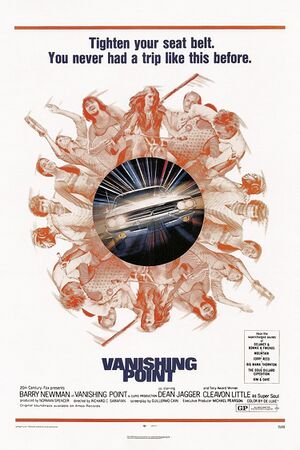
Vanishing Point begins at its end, with rust-speckled bulldozers rumbling through the morning light of a funereal California town apparently populated only by doddering old men with ancient hats. As helicopters dot the air, these earth-movers situate themselves imposingly in Main Street's middle as a makeshift roadblock. They're the law's last stab at halting a determined, enigmatic force named Kowalski (Barry Newman), who's about to spend the rest of this melancholy, pepped-up movie muscling towards San Francisco in high-speed flashback.
From the outset,
Vanishing Point's then-retro framing and locale is a devoted tip of the brim to the western. After Peckinpah and Leone blew the genre up in the late 1960s, it had nowhere to go but here. Spotted palaminos were replicated by similarly-named cars--in this case, the key one being a blindingly white 1970 Dodge Challenger, piloted by a nearly empty-hearted, tow-headed Colorado cowboy who must deliver it to the California coastline in record time (as in Peckinpah's
The Wild Bunch--a welcome influence--wide-eyed children are constantly documented as witnesses to the action). Jazzed by handfuls of Bennies, Kowalski is unshakingly single-minded and, like all great cowboys, has little to say about his task except through unfettered dash. His crotchety old boss admonishes him early on: "You're gonna kill yourself one day, do ya know?" "Yeah, I know" is Kowalski's tired reply.
 Vanishing Point
was one of the cinema's prime offerings to the drive-in gods in the 1970s. I must have sat in the back seat, with my parents up front, watching this adrenaline-pumper (often as a second feature) at least ten times that decade. I vividly remember it being paired often with another searching 1971 car movie, Monte Hellman's
Two Lane Blacktop, and also in re-release as part of a much-touted 1974 20th-Century Fox-powered double bill with another key drive-in car-chase classic,
Dirty Mary, Crazy Larry, starring Peter Fonda and Susan George (I can also recall its appearing with Floyd Mutrix's like-minded auto-centric romance
Aloha Bobby and Rose). Watching
Vanishing Point recently, I realized its immutable impact on me when, ten minutes in, Kowalski's speeding car is at once stopped in freeze-frame, and then disappears from the screen. Even as a kid, I thought: "What is THIS?!" In its own way, it's as indelible a moment as Truffaut's freeze-frame climax to
The 400 Blows.
Kowalski's not a bad guy. He may be a bifurcated speed addict through and through, but he has a job to do and he does it well. Stodgy badge-wearers retreat to radios, roads and sky to keep the man from doing his chore, but they amount to little more than housefly-scaled irritants. Even with his lawlessness, Kowalski's careful to ensure the safety of the civilian and non-civilian drivers he deftly runs off the dusty western byways. Differently from the heroes of a host of 1970s films, this vigorous man--an unappreciated Vietnam vet and former racetrack loser--is always thoughtful regarding those he's bested. In return, the fates hand him the victory/homecoming he always desired. This character, in his most dire moment, gets assistance from Dean Jagger (the Supporting Actor Oscar-winnner for 1949's WWII saga
Twelve O'Clock High, portrays a desert-wisened snake charmer who teaches Kowalski how to truly become invisible). Amidst this movie's screeching, dust-cloud bedlam--as with the whole of the clip-clopping western genre--one of the glitziest adornments to
Vanishing Point is its portraiture of the rocky, brush-covered countryside, though here the boonies are slashed not by towering buttes, but by the horizontally-angular intrusion of asphalt and white lines.
Sarafian's studied camera is captained by cinematographer John A. Alonzo, who'd later extend his grainy, rarely-showy talent to classics like
Harold and Maude, Sounder, Chinatown, The Bad News Bears, Norma Rae, Scarface and George Clooney's black-and-white live-TV remake of
Fail Safe (2000). Alonzo broke through to the A-list with
Vanishing Point and it's no mystery why: his agile camera keeps up with that raging Dodge Challenger like a battle-scarred trooper. It zooms in slightly, seemingly desirous to become one with the automobile's metallic body, spotting the white demon in long shot through the astral prism of the wavy desert heat, and then capturing it in disorienting, motion-filled close-ups as the sandy sunshine reflecting off Kowalski's windshield blinds us to this dude's actual motivations (the worst scene in the movie, which should have hit the post-production floor, mawkishly refers to Kowalski's seaside past with a long-haired blonde, who's mirrored often amongst the movie's few women; as it's inferred, she disappears in a surfing mishap). This thankfully brief moment--along with one involving an adoring, nude lady hog rider--confuses and bores the viewer, since we already know Kowalski's uber-practical aims. We don't need ladles of sentiment to satify here.

One who hasn't seen this jaunty, stunt-laden movie jewel might think that the intense, sparse lead performance by Newman is
Vanishing Point's only relation to humanity. But throughout the film, we also follow Cleavon Little (more well known for his later role as the snide, self-confident lead in Mel Brooks' western spoof
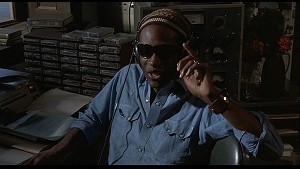
Blazing Saddles). He's dedicates much energy to the charismatic, out-of-place Super Soul, who uses his airwaves to comfort, forcibly deceive, and ultimately cheerlead Kowalski towards his soul destination. Little's introduction in the film is another of its treasures. Sighted, yet wearing a blind man's sunglasses--he sees nothing but he sees it all--Super Soul trails behind a German Sheperd through a small town's weedy crossroads (the pissed-off townsmen keep their mouths shut tight as he passes--he's a bizarre fixture there, but he's already given them what for, and besides, he's "handicapped," so hands off, bub). Super Soul arrives at the KOW(alski) studios--"the noisiest, bounciest, fanciest radio station in the faaaaaarrr west"--as an undisputed superstar (his first broadcasting salvo is absolutely electric). Even considering Wolfman Jack in
American Graffiti, Jeff Bridges in
The Fisher King, Eric Bogosian in
Talk Radio, and Lynne Thigpen in
The Warriors, this is surely the best performance ever by someone playing a radio DJ. Along with Wolfman Jack's performance, it's certainly the purest, since the music and not the talk seems to be his point. I do love it when Super Soul advises Kowalski that the desert will beat him; Kowalski tells him to go to hell, and switches off the radio. Later, after Super Soul and his producer (John Amos) are brutalized by the cops, Little and Newman--both equallly put-upon--seem to have an impossible conversation with each other through the ether.
Gifted with a diverse soundtrack that includes gospel, soul, hard rock, bluegrass, honky tonk and elevator music from Delaney and Bonnie Bramlett, Mountain, a way-pre "Bette Davis Eyes" Kim Carnes, Jerry Reed, and others,
Vanishing Point sounds as good as it looks (it also knows how to employ silence and sound effects). The accomplished Sarafian shoots his lean story with confident aplumb. In an era where viewers were just getting over the often goony use of rear-screen projection to convince them L.A.-bound actors were completely ensconced in other places and times, Sarafian historically, bravely chose to shoot everything in
Vanishing Point as if it were happening presently

(now, CGI has taken the place of rear-projection, as the extra-lame remake of
Gone in 60 Seconds and, conversely, Tarantino's "reality"-loving
Death Proof have shown). Sarafian sternly locks the camera down upon the hoods of that Dodge Charger, and on the hoods of rival sedans, with Kowalski-like determination. The repeatedly dizzying shots of the rushing road, with white dots speeding by, and the searching, driver's-side-window close-ups of the concentrated Kowalski are waggishly exhilarating. Sarafian later delivered underrated B-product like the southern passion play
Lolly Madonna XXX (with Robert Ryan, Season Hubley, and Jeff Bridges) and the compassionate Burt Reynolds western
The Man Who Loved Cat Dancing. And the director would also pen a valuable production primer called
The Film Director. Sarafian would nevertheless cruelly sink into obscurity (though, as an actor, he'd get a few juicy roles in films like Barry Levinson's
Bugsy). However, with his unrelenting
Vanishing Point, he definitely caught one moment where the rubber met the road.