Tuesday, January 13, 2015

Film #166: A Matter of Life or Death (AKA Stairway to Heaven)


matter-of-life-death-bfi-00o-6ct

Out of the seventeen movies Michael Powell and Emeric Pressberger made together, A Matter of Life and Death was their sixth, sandwiched in between two other humanistic yet fantastical tales, 1945’s “I Know Where I’m Going!” and Black Narcissus (47). This team was, at the time, used to dazzling audiences with their idea-dense, often passionate and visually rich flights of imagination (thanks to their collaboration with legendary cinematographer Jack Cardiff). Yet A Matter of Life and Death feels somehow different, maybe because it’s such a glorious mix of so many genres. It first feels almost like science-fiction, with that quick, witty tour of the galaxy at the film’s outset (this is the first glimpse of the subtle but often brilliant special effects featured throughout the movie). Then it most certainly feels like a war picture in the spectacular opening scene between David Niven’s presumably doomed RAF pilot Peter Greene and Kim Hunter’s June, the “Yank girl” he radios as his plane is going down (few movies, if any have had the temerity to begin with such florid and unbound emotions—I mean, what gorgeous close-ups we have here–and yet with the two main characters at the edge of being separated not only by space but by life itself).


For a while, the film becomes a fantasy, as we are taken into another world…a world that may be Heaven (though Powell and Pressberger purportedly wanted to avoid inferring anything such; they balked at the American retitling Stairway to Heaven) or it may be simply another dimension that exists only in a dusty corner of Peter Greene’s brain. It does feel like if the directors truly wished to erase the concept of Heaven from the film, they wouldn’t have had new arrivals in the black-and-white world picking up their made-to-measure wings at the sign-in desk, nor would they have given the young Richard Attenborough—as a breathless newbie–his only line is “It is Heaven, isn’t it?” Either way, the film works in the possibility that all Peter Greene is experiencing--including a ghostly visitation by an erring French “conductor” (Marius Goring)–is a hallucination suffered as a result of something nasty pressing down on his brain. In this way, with the introduction of Roger Lievsay’s Dr. Frank Reeves (who's magnificent here), the film also becomes a tense medical drama.
Goring’s foppish conductor is sent down to the Technicolor “real” world in order to bring Greene back where he belongs—in the afterlife, where the numbers aren’t adding up for the first time in a thousand years. Greene, indeed, was supposed to die after bailing out of his crippled aircraft. But the conductor lost him in the British fog, and instead Greene survives, washing up on the shores of Devon (there’s an unusual scene with a nude shepherd boy that was cut out of American prints). In short order, Peter finally meets June, who’s bicycling desperately along the shoreline. With the tiny sound of her bicycle bell, the two profess their instant love for one another, and this complicates matters greatly. Upon his visitation, the conductor apologizes for the mistake, but Peter refuses to go along with him, reasoning that this new romance has saddled him with a fresh responsibility that he must own up to. That it comes as the result of a mistake by the powers-that-be, he argues, is not his fault and certainly not a reason to punish he and June with a prolonged separation.


This disagreement necessitates an appeal to the authorities of this other world, and so a trial date is set, with Abraham Farlan (Raymond Massey), the first casualty of the American Revolutionary War, set as the prosecuting attorney. Peter is told to choose anyone he wants—from Socrates to Abraham Lincoln—as his defense attorney. But it takes an unexpected accident for him to get the representation he truly desires. In its final third, A Matter of Life and Death becomes a dizzying celestial courtroom drama, complete with a white-wigged judge (Abraham Sofaer), a stoic jury (at first composed of members with a certain anti-British bias), and a vast audience of the world’s members, all separated out into their separate cheering sections. It’s fascinating that, in this sequence, the film takes on the subject of rancor between the British and the Americans (this was a big subject in the UK during WWII, with the Americans’ often unwelcome arrival on British shores). Farlan—who naturally despises the British whom he fought against and who killed him–is constantly trying to use Greenes’ nationality against him, while Peter’s defense is just as constantly trying to steer the arguments back to the facts (that June is an American girl, born in Boston, infuriates Farlan even further).


The film ultimately comes to a stalemate on the issue, settling on the equitable notion that there are good and bad things both about those on each side of the pond (this is amusingly done with each of the attorneys sampling bits of radio broadcasts from each country, with Britain’s a burbling, pretentious Churchill-like commentator pontificating endlessly, and America’s a snippet of a goopy Sinatra-like pop song, complete with swooning girls screaming in the background).

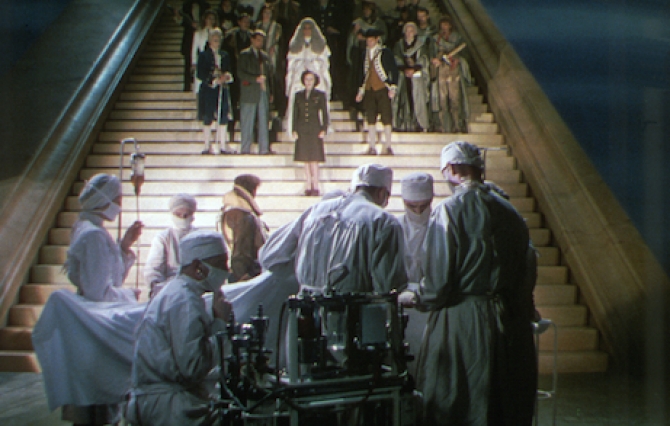
Ultimately, though, A Matter of Life and Death is primarily a sublime love story. That very unusual first scene sets it up so perfectly (I adore it when Niven tells the unforgettably red-lipped Hunter, who’s just confessed she could love a man like Peter, “I love you, June. You’re life and I’m leaving you.”). They enjoy a passionate connection, clawing at life, that feels palpably real despite its unusual pedigree. Powell and Pressberger wisely upend the Wizard of Oz color separation, making the Earthly world vibrantly hued with the possibilities of romance, and the other world coldly reasonable in the starkness of black-and-white (what miracles photographer Cardiff performs all throughout). The unforgettable climax is set against the massive stairway (built at huge cost to the filmmakers) that stands as perhaps the film’s most provocative or at least memorable image. While Peter is on the operating table in the real world, he finally also appears in the other world as a witness for the trial. June appears here, too, and it takes a supreme sacrifice on both their parts to prove that their love is substantial. “Be careful,” Farlan warns. “In the whole universe, nothing is stronger than the law.” But the defense counsel counters just as emphatically: “Yes, Mr. Farlan. Nothing is stronger than the law in the Universe. But on Earth, nothing is stronger than love.” Very few movies convince us of this as vigorously, and with such agile intelligence, as does A Matter of Life and Death. 


NOTE: This piece first posted as a part of WONDERS IN THE DARK's overview of the best romantic movies ever made. Take a look at the complete collection here.

Sunday, January 4, 2015

Film #165: Breaking The Waves

I first encountered Lars Von Trier’s brilliant Breaking the Waves very much like most American audiences did: in late 1996, a year dominated by indie-flavored movies like Fargo and The English Patient, it was nominated for a slew of Golden Globe awards (including the top three Drama awards, yet it would only garner one eventual and clearly unavoidable Oscar nod). When these nominations came down, I was dumbstruck, because Breaking the Waves had not yet played in my hometown of Atlanta, but had definitely made a splash in Cannes earlier that year. I wasn’t even able to make it out to the one theater showing it that year, it was so low on my priorities. I was a fool (as I still haven't ever seen it on the big screen).

When I finally did catch it on video in mid 1997, I was doubly dumbstruck--I found it to be a complete masterpiece, to the point where it still remains the most recent entrant into my personal top twenty films of all time. As overwhelming as it is, with Von Trier and cinematographer Robby Muller working at their absolute apex, it was Emily Watson that impressed me most. Her Bess, so loving and trustful, passionate about life, and completely devoted to so much she experiences, was unlike any fictional character I had ever encountered. She felt like a wide-eyed child, but yet she was very much an alluring woman, with a woman’s fullest desires, but perhaps without the wherewithal to understand those drives, except to say that she knew she totally had to follow them to what she saw as their natural end. She is like a strong but tiny bird one wants to help survive the cold outside. The fact that she had equal desires to be faithful to God and to her church complicated matters, especially since the church she follows (in early '70s Scotland, where the film is set) has a very dim view of women’s thoughts or contributions, except as earthly birth vessels.


Bess’ love of Jan, an oil rig worker toiling somewhere off the angry Scottish coast, is a force to behold. It’s seriously a love unlike any other I have witnessed in movies. It is complete and devoted, carnal and innocent, wild and reckless. Bess gives herself over completely to Jan (played also impeccably by Stellan Skarsgaard), to the point where the viewer even wonders if Jan is taking advantage of this simple minded girl (which is certainly something the late Katrin Cartlidge, exquisite as Bess’ widowed sister-in-law, wonders as well–her character is a nurse, so she’s deeply investing in Bess’ well-being all throughout, and even sternly yet gently warns Jan not to break her heart).  There is never really a moment where we suspect Jan is truly deceiving Bess, though. He obviously loves her innocence and her devotion to what she believes, and of course her revelry in their shared desire (just look at him as he looks over at Bess adoringly while they’re at the cinema together; her eyes are trained on the movie–she’s the perfect movie watcher, so ready to believe what she sees–and his eyes are trained so intently, deeply on her…it’s all just so ridiculously sweet).

The film begins with Bess confessing her love for Jan to God, to whom she talks–repeatedly throughout the film–in a empty church all by herself (presumably because none of the church father’s will truly listen to her without judgement). Early on, we have a sense that Bess is at least a creative type, if not a tad bit off, because she takes on the role of God in her confession. Her God voice is a deep, chiding one, impatient with her girlish selfishness…it seems like a voice that comes wholly outside of her personality and intelligence quotient, so we sense that maybe there’s a psychosis happening here. But I don’t think she is insane (though I do think she is driven to do insane things, by her own misunderstandings). In the end, Bess is simply trying to reconcile the love of a God who thinks her silly (as she portrays him, or as she has been taught to think of him) with the love of a flawed man who thinks she’s absolutely wonderful. Breaking the Waves chronicles a woman who follows God, but not as devoutly as she does the vital man who loves her, and whom she takes as her husband.

As this is a Lars Von Trier film, Watson’s character is certainly run through the wringer (Bjork, Charlotte Gainsbourg, and Kirsten Dunst would also assay tortured females in later Von Trier efforts). Bess begins the film completely lovestruck, dancing with abandon at her low-key down-home wedding and losing her virginity to Jan in the bathroom before the reception is even over (you can sense her complete devotion to sex from the outset; yet intimacy, even without sex, is also a fascination for her, as we see in a brilliant moment where she lies awake, listening and giggling as Jan snores away, asleep). There’s not much time for a honeymoon, as Jan is due back on the oil rig in mere days, and when he has to leave for work (for which he will be away for many weeks), Bess’ rage is unleashed. Now that she’s given herself over to a new “God”–one who has a personality which she cannot provide herself–she is left completely without half of her new self.

Jan, too, is torn asunder by his responsibility to work, which takes precedence over his new marriage. One wonders is Jan, too, is taking on perhaps more than he can handle by marrying Bess–he is genuinely shocked by her anger, but there is clearly part of him that finds it charming and romantic (which it is). But he doesn’t quite see the danger in it. However, honestly, who could predict such a future as this?

Tortured by his absence, Bess begs God to provide her for a way to be with Jan once again, and God does indeed provide that chance, but in a dark, perhaps mischievous and even punishing manner. On the oil rig, Jan is stricken with a serious injury after his probably drunken co-workers mishandle a piece of equipment that crashes into his head, knocking him into a coma. Quickly, he is rushed to the coast, where he is interred in the hospital where Cartlidge’s Dodo works as a nurse (there is nothing in cinema like the scene where Bess gets the word that Jan is seriously wounded: she disappears from the moment in a faint that is painfully, palpably real, especially as photographed in that grainy, handheld sheen by cinematographer Muller).

Bess takes Jan’s new arrival by her side as a sign that God is testing her, and so she takes on the full responsibility for his injury. So, when Jan finally comes to and is presumably paralyzed for life, we can feel his pain too. Here he is, a new husband who abdicated his love for a paycheck, and HE’S responsible for that. The guilt he feels is crushing, especially as he realizes that Bess is worth all the love that he can give to her. But he also realizes that he can never give her the full physical intimacy that she deserves, and so a psychosis enters into his own plate of problems. He asks her–for purely selfish reasons–to go out and experience sex with other men, and then come back and tell him all about it. This is his way of achieving consort with her body, yes, but he doesn’t take into account how this will affect her fragile personality–he seems to do it as a perhaps doped-up, bed-bound lark. But, as he is her new “God,” she follows his instructions, to her own eventual fate.

Breaking the Waves is a steamroller, an emotional workout of immense proportions. It is a story of sacrifice and faith, almost to the nth degree. It is not just Bess’s tale–it is Jan’s as well. It’s a journey to enlightenment that they take together, and by the film’s end–and it surely sports a soaring, surprising ending that one would never EVER forget upon seeing it–you are sure that you have witnessed one of the great love stories ever, even if it’s one that does not take the trajectory that any screen romance, before or since, has taken. With Von Trier’s superb direction, Muller’s unusual and groundbreaking photography, the brilliantly curated British pop music soundtrack (featuring Jethro Tull, Elton John, and Deep Purple, among many others), those unforgettably idyllic chapter stops by Per Kirkeby (done in a color-steeped style very different from Muller’s more grungy, documentary-influenced work throughout), and especially the deeply committed performances by Skarsgaard, Cartlidge, Jean Marc-Barr (as Jan’s best friend), and especially by Emily Watson. She gives an astounding performance that takes it place alongside Maria Falconetti in The Passion of Joan D’arc as arguably the greatest ever put on film.

It’s incredibly easy–for me, at least–to see Breaking the Waves as a film that staunchly proves its thesis. On its movie poster, the tagline reads “Love is a mighty power.” After seeing it, you truly stumble away, dazed, saying to yourself “Yeah. It goddamn well is.”

NOTE: This piece first posted as a part of WONDERS IN THE DARK's overview of the best romantic movies ever made. Take a look at the complete collection here.

Monday, December 29, 2014

Memo to the Academy 2015: Please pay attention!

My choices for the films, performances and achievements that should not be forgotten in the 2015 Oscar nomination game. These are all my outside the box choices (as much as their outsider stances often surprise me), and so I have left out what I consider to be the usual suspects at this point. My #1 choice, in each category, is both the first mentioned and the film pictured.

BEST PICTURE
The Congress (Ari Folman)
Inherent Vice (Paul Thomas Anderson)
Mr. Turner (Mike Leigh)
Whiplash (Damian Chazelle)
Force Majeure (Ruben Ostlund)
Nightcrawler (Dan Gilroy) 
Gone Girl (David Fincher) 

BEST DIRECTOR
Jonathan Glazer, Under the Skin
Paul Thomas Anderson, Inherent Vice
Damien Chazelle, Whiplash
Ari Folman, The Congress
Ruben Ostlund, Force Majeure
Mike Leigh, Mr. Turner
David Fincher, Gone Girl 
Dan Gilroy, Nightcrawler

BEST ACTRESS
Marion Cotillard, Two Days, One Night
Robin Wright, The Congress
Lisa Loven Kongsli, Force Majeure 
Lisa Haas, The Foxy Merkins
Jackie Monahan, The Foxy Merkins
Scarlet Johansson, Under the Skin
Essie Davis, The Babadook
Shailene Woodley, The Fault in Our Stars
Thora Bjorg Helga, Metalhead
Charlotte Gainsbourg, Nymphomania
Hillary Swank, The Homesman

BEST ACTOR
Timothy Spall, Mr. Turner
Joaquin Phoenix, Inherent Vice
Ralph Fiennes, The Grand Budapest Hotel
Chadwick Boseman, Get On Up
Ben Affleck, Gone Girl
Miles Teller, Whiplash
Johannes Bah Kuhnke, Force Majeure
Tommy Lee Jones, The Homesman

BEST SUPPORTING ACTRESS
Katherine Waterston, Inherent Vice
Tilda Swinton, Snowpiecer
Lorelei Linklater, Boyhood
Kim Dickens, Gone Girl
Rene Russo, Nightcrawler 
Dorothy Atkinson, Mr. Turner
Marion Bailey, Mr. Turner
Carrie Coons, Gone Girl

BEST SUPPORTING ACTOR
Gary Poulter, Joe
Josh Brolin, Inherent Vice
Martin Savage, Mr. Turner
Martin Short, Inherent Vice
Danny Huston, The Congress
Tyler Perry, Gone Girl
Riz Ahmed, Nightcrawler

BEST ANIMATED FEATURE
Cheatin’ (Bill Plympton)
The Tale of Princess Kayuga (Isao Takahata) 
The Congress (Ari Folman) (If THE LEGO MOVIE, with its extremely lame live action climax, can be considered the frontrunner for this award, then why can't THE CONGRESS, with its supremely moving live action component frontloaded so, compete in this category?)

BEST DOCUMENTARY FEATURE
NOTE: What a ridiculously rich genre this is now! Whether or not these films have fulfilled the requirements of the Academy, these are the best documentaries I saw this year which are not on the shortlist of those in the running for the award, and in all cases I mourn this fact. By the way: the body count doesn't make for a better documentary. Increasingly, I love the docs that make way for the adoration, and not the decimation of, humanity, and so: 
A Chair Fit for an Angel (Raymond St. Jean)
National Gallery (Frederick Wiseman)
Red Army (Gabe Polsky)
Stray Dog (Debra Granik)
The Oracles of Pennsylvania Avenue (Tim Wilkerson) 
Sunshine Superman (Marah Strauch) 
Levitated Mass (Doug Pray)
Iris (Albert Maysles)
The Great Chicken Wing Hunt (Matt Reynolds)
Kids for Cash (Robert May) 
Out of Print (Julia Marchese)
Limo Ride (Gideon Kennedy and Marcus Rosentrater)
120 Days (Ted Roach)


BEST ORIGINAL SCREENPLAY
Dan Gilroy, Nightcrawler
Ruben Ostlund, Force Majeure 
Mike Leigh, Mr. Turner
Justin Simien, Dear White People
Jean-Pierre and Luc Dardenne, Two Days, One Night
Jonathan Raymond and Kelly Reichardt, Night Moves

BEST ADAPTED SCREENPLAY
Paul Thomas Anderson, Inherent Vice
James Gunn and Nicole Perlman, Guardians of the Galaxy
Gary Hawkins, Joe
Bong Joon-ho and Kelly Masterston, Snowpiecer
Marion Nelson, Tracks

BEST CINEMATOGRAPHY
Sharone Mair, Whiplash
Robert Elswit, Inherent Vice
Robert Elswit, Nightcrawler
Mandy Walker, Tracks
Fredric Wentzel, Force Majeure 
Robert Yeoman, The Grand Budapest Hotel
Jean-Francois Lord, A Chair Fit for an Angel
Kyun-pyo Hong, Snowpiercer

BEST ART DIRECTION
Snowpiercer
Foxcatcher 
Saint Laurent
Gone Girl
Inherent Vice 
The Babadook

BEST COSTUME DESIGN
Saint Laurent
Belle
Jersey Boys
Get On Up

BEST ORIGINAL SCORE
Marco Beltrami, The Homesman
Mica Levi, Under The Skin
Garth Stevenson, Tracks
Antonio Sanchez, Birdman, or: The Unexpected Virtue of Ignorance
Gary Yershon, Mr. Turner

BEST SOUND MIXING
Edge of Tomorrow
Force Majeure
Whiplash
Dawn of the Planet of the Apes

BEST SOUND EFFECTS EDITING
Dawn of the Planet of the Apes
Captain America: The Winter Soldier
Snowpiercer
Edge of Tomorrow

BEST EDITING
Whiplash
Nightcrawler
Gone Girl
Dawn of the Planet of the Apes
Edge of Tomorrow 
Under The Skin

BEST VISUAL EFFECTS
Under The Skin
Edge of Tomorrow
Snowpiercer
Birdman, or: The Unexpected Virtue of Ignorance

BEST MAKEUP
Mr. Turner
Snowpiercer
Get On Up