Showing posts with label Britain. Show all posts

Sunday, April 1, 2018

Film #175: Witchfinder General (aka The Conqueror Worm)

Among the horror genre’s most criminally overlooked classics, 1968’s The Conqueror Worm, which was US distributor American International's Corman-esque way of linking the film to the classic, long dead horror writer Edgar Allen Poe, in a bid for US box office success. Poe was then a big movie ticket seller and the inspiration of many Hammer horror and Corman-led vehicles like The Pit and the Pendulum, House of Usher, The Raven, and The Tomb of Ligeia, among many more (though the author's connection to this film is tenuous at best; his words are present only as some snatches of opening and closing poetry). Better known in the U.K. as Witchfinder General (the title under which it was eventually released on an MGM Blu-Ray box set including the Poe-connected anthology film Tales of Terror, the raucous two-film Dr. Phibes series, and the superb, Shakespeare-tinged horror black comedy Theater of Blood).

Reeves' version of this extraordinarily downbeat tale is a jaw-dropper. Despite its inobviously low budget, it succeeds in placing viewer right in this ornate but life-cheapening era. In it, Vincent Price leads as Matthew Hopkins, the real-life henchman for Cromwell's war-torn 17th century Britain who's assigned to locate and prosecute witches hidden within the country’s tiny townships. He’s an intriguing character because, with his obvious intelligence, he should be equipped to mitigate his dark side with common decency. Yet Hopkins is so consumed with lust and power that he can’t help but take advantage of the vulnerable, especially in a time where almost everyone was mad with fear and ignorance.

Rest assured, Price plays all this to the hilt in one of his very finest non-tongue-in-cheek horror performances. Without even the briefest moment of relief from the terror gripping the UK in this period of its history, the film is smartly helmed by long-depressed director/co-writer Reeves who, before accidentally overdosing in 1969, spearheaded two more dire, similarly-flavored pictures (The She-Beast with Barbara Steele, and The Sorcerers horror legend Boris Karloff). In keeping with those unsparing works, Witchfinder General is disturbingly set in a Hell where all moral boundaries have been violently erased, and all its subjugated inhabitants are capable of atrocities against even their closest confidants. No walk in the park, it is seriously distressing--the utter definition of horror.


Friday, October 15, 2010

NYFF Review #6: Another Year

I'm convinced. Actually, I've long been convinced. There is not a better filmmaker walking the earth right now than Mike Leigh.

Why else do movies, or any other art form, exist but to make the viewer feel something? So if you want to see movies that make you emote joy or discomfort or anger followed by joy again, then see a Mike Leigh movie. I defy any attentive person to witness Life is Sweet without giggling manically throughout and then breaking into sudden tears when jolly mother Allison Steadman confronts hard-hearted daughter Jane Horrocks about her disenchantment with the world. Why wouldn't one blanch at and then agree with David Thewlis' hope-murdering rants against existence in Naked? How could you not be moved by smirking Philip Davis and nurturing Ruth Sheen looking out for while making fun of the departing, clueless Jason Watkins in High Hopes? What jerk could fail to marvel at Jim Broadbent, as W.S. Gilbert, giving precise notes to his cast while building upThe Mikado in Topsy Turvy? What human can't understand the pain of husband Tim Stern as he suffers the sharp words of Allison Steadman's callous wife Beverly during Abigail's Party? And when Imelda Staunton's Vera Drake gets visited by the police, whose heart isn't thrust throatward? I must now offer some scenes:


David Thewlis and Peter Wight in 1993's NAKED


Allison Steadman, Janine Duvitsky, Tim Stearn and John Salthouse in 1977's ABIGAIL'S PARTY


Timothy Spall and Leslie Manville in 2002's ALL OR NOTHING


Jane Horrocks and Claire Skinner in 1990's LIFE IS SWEET


Sally Hawkins and Eddie Marsan in 2008's HAPPY-GO-LUCKY


Shirley Henderson in 1999's TOPSY-TURVY


Imelda Staunton and cast in 2004's VERA DRAKE

Mike Leigh has been making all sorts of movies--from features to shorts to TV movies--since his incredible 1971 debut Bleak Moments. In that film, he pretty much set the stage for what we could expect from him: exacting examinations of the less fortunate, or less wise, or more gifted, among the rich and poor denizens of London. He's never deterred from his station, because he knows when he's found a good and wealthy thing. And the stance has not yet betrayed him, regardless of time period or personage.

His newest film, Another Year, doesn't disappoint. In a way, it's kind of a Mike Leigh fan film, in that it includes a cast that he's well familiar with. Jim Broadbent, as the patriarch, marks his fifth film with Leigh; Ruth Sheen, as the matriarch, notes her fifth film as well; and lead Leslie Manville notches her seventh time out with the deviser/director.

Note that I used the word "deviser." Just in case you're not aware, Mike Leigh's movies are not written like other movies are. This is what makes them so special. You can never tell where they're going because the maker, and the actors, never know where they're going, either. In short, in the beginning stages of a project, Leigh arrives at an idea for a film, then asks a set of actors to join him, and then they together organize a story based on Leigh's idea. After a series of improvisations, the director later solidifies the results into a stolid script. Leigh, who has a deep and ongoing involvement in the theater, has in this way kept his ardor of the stage's surprising qualities kicking and has transmogrified them into his passion for cinema, too. This, I submit, makes him the most original filmmaker working today.

He's never operated in any other way. He's the modern originator of this process, and you can tell that his actors love him for it. At least, I could tell this, having attended the Q&A with Broadbent, Sheen, Manville, Leigh and producer Georgina Lowe following the screening of Another Year at the 2010 New York Film Festival (Another Year is dedicated to Leigh's longtime producer, the recently passed Simon Channing Williams). I have to say, the ovation at the fest was the most fervent I'd experienced. The film got a minute of applause, and each of the participant's got 30 seconds applause a piece. That's almost five minutes of love there.

And so deserved it was. Another Year is yet another masterpiece from Leigh. It's a film about aging, yes, and it's consequently about the quickening of time (this is a very important element of the film, and one I fear might be overlooked by younger film writers). It's also a film about the limits of friendship, and how much well-adjusted mates can stand before their less well-adjusted friends drag them down. Broadbent and Sheen play a happily married couple named Tom and Gerri ("That's brilliant," says another character). He's an engineering geologist, and she's a counselor at a hospital, where she works with a troubled Mary, played by Manville. Tom and Gerri are cheery and upbeat, with only Mary's continual troubles causing them consternation. The year in question--quartered into seasons--puts their relationship to the test, as it begins with Mary's breakup with a bloke, and continues with her desperate fascination with Tom and Gerri's son Joe (Oliver Maltman). We know where this is going to go, but Mary has no idea, because she's sodden by alcohol. (Mike Leigh's movies have a lot to do with the downsides of alcohol, because they're so attuned with their U.K. place in the world.)

Manville is a marvel here. Given her seven appearances in Leigh films, you'd never recognize her as the person who played the eye-shadowed new wife in Grown Ups, the snooty next-door neighbor in High Hopes, Gilbert's powdered spouse in Topsy Turvy, or the sadly deluded, depressed mother in All or Nothing. In Another Year, she plays a recognizable Leigh type, but she makes the role absolutely her own. Mary is a lady who was once sure of herself, but who has let life pass her by. The largely lighthearted Another Year catches this character as she begins to realize the horror of the nest she's built for herself.

There are four characters who help her to this point. Imelda Staunton (an obvious Leigh veteran) is a depressed housewife appealing to Gerri, and informing Mary that marriage isn't necessarily the answer. Peter Wight, unforgettable as Tom and Gerri's hardy friend Ken, is a overweight alcoholic who's romantic advances clue Mary in about what she really desires, to her terror. Karina Fernandez, as Joe's lover Katie, gently accepts Mary's scorn as the woman Mary never could have been. And David Bradley, in the last fourth of the film, as Broadbent's newly-widowed brother Ronnie, looks perplexed as Mary asks, after his wife's funeral, whether or not he'd like a cuddle (these are among the best scenes in the film).

Does this sound complicated? It's not. Leigh's movies, save for their characters' thick brogues (not in evidence here), are never hard to understand. They might be hard to WITHSTAND, but that's a great thing. They make you feel, and feel deeply. Another Year does so not only with its terrific acting and direction, but with its gleaming widescreen photography (by valued Leigh regular Dick Pope) and its unusually gorgeous music by Gary Yershon (I always love the scores to Leigh's movies, but this one is especially emotional, and I blieve Leigh thinks so, too, according to his comments to the NYFF audience).

I couldn't believe my great fortune to be in the same big room with the makers of Another Year. After it was over, I waited patiently to see what would happen. Manville, Sheen and Broadbent hung out in the lobby of the Water Reade Theater, talking eagerly to the press. I could have asked them a million questions. But I was most interested in saying something personal to Mr. Leigh, so I had to pick my battles. I didn't want to ask Mr. Leigh for an autograph (though I had a VHS copy of Life is Sweet in my pocket). I merely wanted to tell him something.

So, I guess some would say I was stalking him. Maybe. I called to him as he opened the door to go out of the theater.

"Mr. Leigh?" I called. And he stopped, as I'd hoped, right in front of the Walter Reade.

"Hi. I just wanted to tell you something." I took my place in front of him, and looked into his impossibly blue eyes. They really struck me; they'd never seemed so blue in all the photos I'd seen.


"I just wanted to tell you. I'm so happy to talk to you, and tell you how much your movies mean to me. They make me feel so many things all at once, and that's what I go to movies for." I had to hold back tears here. "There's really nothing like them. And I just wanted to tell you how much I love them. And I wanted to thank you for them."

"Well, thank you," he softly said. "Thank you very much. What's your name?"

And I realized I didn't have my pass around my neck. "My name is Dean Treadway, and I help with a podcast called Movie Geeks United, and I do my own blog called filmicability. I know you're busy, but I have a couple of questions. I've read you've never been satisfied with the look of Abigail's Party, given that it's shot on video. Have you ever thought of remaking it on film?"

"Oh, no. It so much a piece of its time, there'd be no point in going back to it. It is exactly as it should be. It's done."

"It is very much at home in the 1970s. I can understand that. I was wondering, there's so much of your stage work that I haven't seen. Is there any chance I can see some of it here in New York?"

"Well, I'm looking to restage a play I did called Ecstacy. Are you familiar with that?"

"No, not really. I've seen the title, though."

"Well, that's in the works."

And then I couldn't resist. I pulled out my Life is Sweet VHS. "I gotta do this. Could you sign this, Mr. Leigh? I usually prefer to get people to sign one-sheets, but I couldn't find a one-sheet for this movie. It's my favorite of your works."

"Is it?" he asked, as he signed. "Oh, yeah," I said, "It makes me feel great every time I watch it."

"Well, thank you..."

"Thank you, Mr. Leigh, for everything."

"Good luck to you, Dean." We shook hands lightly, and then the best filmmaker on the planet walked away from me, looking me in the eye, and I remain, still, to this day, dumbstruck.

Monday, December 1, 2008

Film #93: Vera Drake

I’ve been a fan of the UK’s Mike Leigh ever since he delivered an incisive look at a working class love affair with High Hopes, back in the late 1980s. (I would consider that film his US breakthrough, even though he’d been making films in Britain since 1971’s Bleak Moments.) His is a unique voice on the world film scene, since he has almost exclusively focused his camera on Britain’s lower-economic echelons during his career.

No one makes movies like Leigh does. First, he starts with an idea, complete with a cast of characters. Then he casts the movie with his chosen actors. Once he has this element together, he fleshes out the script and the dialogue by holding long conferences/rehearsals with his actors. It’s there that he/they come up with the the film's dialogue. From there, Leigh retreats to his typewriter where, referring to his notes taken during these conference/rehearsal periods, he sets down everything that is to be said in each scene. And then it’s on to filming the scene itself. This is a process that repeats itself over and over again until the film is complete. No one in the world makes movies quite like this—or, at least, has been making them like this as long as Leigh has.

Mike Leigh has made lots of movies that have made waves here in America. One, Secrets and Lies, garnered Oscar nominations for Best Picture, Actress, Supporting Actress, Director and Original Screenplay in 1996. He’s also won a ton of awards at the Berlin, Venice, and Cannes film festivals. His past films include Life is Sweet (my personal favorite of his works), the shattering Naked (a Best Actor winner at Cannes, for David Thewlis), Topsy-Turvy (another Oscar winner, and an unusual period piece for Leigh), the incredibly downbeat All or Nothing, and this year’s Happy-Go-Lucky, a 2008 front-runner for Best Actress for Sally Hawkins’ lead performance.

But Vera Drake may be the most notable entry into his canon. It tells the story of a generous, giving housewife (played immaculately by Imelda Staunton, herself an Oscar nominee in 2004) who finds herself on the other side of the law when she's prosecuted by the 50s-era UK government for providing amateur abortions for women who couldn’t bear the birth of a child. The thing that’s amazing about this movie is that it fails to directly hit on the political ramifications of these actions. Vera Drake performs these services for very little money and, in her mind, they are actions of kindness. However, when one woman almost dies from her treatment, she is picked up by the authorities and prosecuted as if she were a murderer, even though she was not fully aware of the ramifications of what she was doing.Vera Drake, in a very stark and clever way, lets us revisit a time where unprofessional abortions resulted in the destruction of so many lives. In that way, it is a pro-choice movie. However, he movie's politics aren’t that clear-cut. It also shows Vera as a woman who truly loves the birth of wanted children, but who also realizes that some women might have their lives threatened by the prospect of childbirth. And, at the same time, it follows the lives of women who, say, have been raped (Sally Hawkins appears here as a rape victim), or who are otherwise without a voice as to whether they should have a child or not. It’s an immanently fair movie in regard to this thorny issue.

Imelda Staunton is incredible in the title role. In the first half, she is sweet, caring, and attentive. In the second half—which is brought on by her most memorable scene as the police come to her door while her family is celebrating the engagement of her daughter—she is a shattered woman, completely blindsided by her own unawareness of the depth of her actions. The performances of everyone in the supporting cast—as usual in a Mike Leigh film—are first rate. Richard Graham as her loving husband George, Alex Kelly as her shy daughter Ethel, Daniel Mays as her headstrong son Sid, Eddie Marsan as Ethel’s good-hearted husband-to-be Reg (he also delivers a memorable performance in Happy-Go-Lucky), Phil Davis as George’s loving brother Stan, Leslie Manville as Stan’s snooty wife Nellie, Ruth Sheen (from High Hopes) as Vera’s partner-in-“crime” Mrs. Wells, Peter Wight as Detective Inspector Webster, and Oscar-winner and Leigh-veteran Jim Broadbent as the case’s Judge---all are incredible.

Mike Leigh is one of the world’s most original filmmakers. And Vera Drake may be the most daring, riveting, and telling of all his films.

Thursday, March 27, 2008

Film #20: Repulsion


(The above poster design is an astounding unofficial graphic for Repulsion created by +Pemo+ who, at the time of its making, was a student at FADU-UBA in Buenos Aries. Check out more of his amazing collages: go to www.flickr.com and search for +Pemo+. And click on the above image for a clearer view of its perfect copy.)

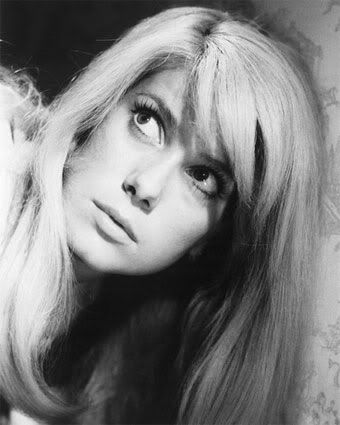
If I were powerful enough to go poof! and instantly make one movie on this blog valued by film fans as one of the greatest ever made, I would choose 1965's Repulsion. But, despite its being a most mortifying work, it appears as if hardly anyone has seen it. And it’s their loss. It's a harrowing, unmutable dark night of the soul that will scar you with its raw slashings. Director and co-writer Roman Polanski is at the apex of his considerable powers as his camera follows a pretty but sexually repressed manicurist named Carol (Catherine Deneuve) as she slowly dips into a lonely madness.


Using the nauseating device of a steadily rotting skinned rabbit to signify Carol’s worsening condition, Polanski trots her through nervous, sleepless nights listening to her bitchy sister (Yvonne Ferneaux) get schtupped in the next room, then in daylight has her literally being chased down by a horny, oft-rebuffed suitor (John Fraser). But when her sister and her married boyfriend (Ian Hendry) go off on holiday, things get REALLY awful. Isolated and tortured by her lack of intimacy or the desire for it, Carol absently stumbles through a series of wicked hallucinations that’ll have you questioning your own sanity (watch out for those walls, man!). Trust me, a few of these moments will make you jump so high, you'll spill your popcorn like a dang idiot. 'Nuff said.


The gorgeous Deneuve, in an understated outing that remains one of her best, was put through the psychological ringer by Polanski who insisted she abstain from sex or even see her boyfriend while the film was being shot. Often, he harshly insulted her into giving the performance he required (one shot has Deneuve swinging a candlestick holder at someone off-camera; she’s actually trying to bash Polanski, who’d taunted her once too often). With a bizarre score from jazz percussionist Chico Hamilton, chilling photography from Gilbert Taylor (Dr. Strangelove, Star Wars), and one of the most thought-provoking final shots in cinema history, Repulsion is certainly entitled to a reputation as the female Psycho, even if it isn’t nearly as well-known. See it immediately. And prepare yourself.

Saturday, March 22, 2008

Film #16: Tales From The Crypt (1972)

Most people know Tales From The Crypt as an 80s/90s cable TV show in the Twilight Zone / Creepshow vein -- sometimes scary, very jokey, with an animatronic near-skeleton as its host. Those more familiar with this version of the classic, famously-banned 1950s EC horror comics probably aren't even aware that it was previously filmed, ever so slightly more earnestly than maybe was needed, in 1972. This Tales from the Crypt was helmed by British director Freddie Francis and produced by Max J. Rosenberg and screenwriter Milton Subotsky, whose Amicus Films was the chief rival of the UK's more famous Hammer horrormeisters. Subotsky made a career out of making uneven anthology films like The House That Dripped Blood and The Vault of Horror, but this one stands strongest. The Crypt Keeper is here not played by a puppet, by a very game Ralph Richardson. Cloaked and enthroned in the British catacombs, he presides curiously over the ensnarement of five sin-soaked individuals and, in a delicious framing device, asks them each to tell the story of how they arrived there.


Joan Collins is a murderous housewife whose bloody Christmas Eve clean-up is interrupted by a maniac dressed as Santa (there's one moment here that ALWAYS startled theater audiences). In the one slightly drab segment, Ian Hendry is an adulterer caught in a confusing loop of nightmarish mayhem. Then, Richard Greene is a businessman who, in a Monkey’s Paw, variation, discovers an idol granting him three wishes (let’s just say he and his wife make all the wrong choices). The most inventively written episode has Robin Phillips playing an upper-class snob who taunts his unwanted neighbor, a poor old widower (the gentle Peter Cushing), into the grave (love those nasty little greeting cards in this episode).

And, in the best all-around section--as always, saved for last--Nigel Patrick is the greedy headmaster at a blind person's home where his charges, headed by Patrick Magee, plot vengeance for the steak-eating, wine-swilling pig’s continual skimping on their food and heat. You'll NEVER forget how this one turns out!! There's loads of veddy-dry humor and ominous atmosphere, complete with a memorably firey finale scored with a booming organ rendition of Bach’s spooky "Toccata and Fugue in D Minor." Like the best anthology movies, it leaves you wanting to take in even more episodes. This touchstone of British horror remains one of the best, or at least one of my most loved childhood favorites. Guess I was a pretty twisted kid.

Friday, February 22, 2008

Film #5: The Conqueror Worm a.k.a. Witchfinder General


Among the horror genre’s most criminally overlooked classics, 1968’s The Conqueror Worm, which was US distributor American International's Corman-esque way of linking the film to the classic, long dead horror writer Edgar Allen Poe. Poe was then a big box office draw, the inspiration of many Hammer horror vehicles like The Pit and the Pendulum, House of Usher, The Raven, and The Tomb of Ligeia, among many more, though the author's connection to this film is tenuous at best; his words are repped only as some snatches of opening and closing poetry. Better known in the U.K. as Witchfinder General (the Poe-less title under which it was eventually released on an MGM Blu-Ray box set including the Poe-connected anthology film Tales of Terror, the raucous two-film Dr. Phibes series, and the superb, Shakespeare-tinged horror black comedy Theater of Blood).

Vincent Price: MGM Scream Legends Collection (The Abominable Dr. Phibes / Tales of Terror / Theater of Blood / Madhouse / Witchfinder General / Dr. Phibes Rises Again / Twice Told Tales)

Vincent Price: MGM Scream Legends Collection (The Abominable Dr. Phibes / Tales of Terror / Theater of Blood / Madhouse / Witchfinder General / Dr. Phibes Rises Again / Twice Told Tales)
Reeves' version of this extraordinarily downbeat tale is a jaw-dropper. Despite its low budget, it succeeds in placing viewer right in this life-cheapening era. It, of course, stars Vincent Price as Matthew Hopkins, the real-life henchman for Cromwell's war-torn 17th century Britain who's assigned to locate and prosecute witches hidden within the country’s tiny townships. He’s an intriguing character because, with his obvious intelligence, he should be able to mitigate his dark side with common decency. Yet Hopkins is so consumed with lust and power that he can’t help but take advantage of the vulnerable, especially in a time where almost everyone was mad with fear and ignorance.

Rest assured, Price plays all this to the hilt in one of his very finest non-tongue-in-cheek horror performances. Without even the briefest moment of relief from the terror gripping the UK in this period of its history, the film is smartly helmed by the long-depressed director/co-writer Reeves, who spearheaded two dire, similarly-flavored pictures (The She-Beast and The Sorcerers) before accidentally overdosing in 1969. In keeping with his previous unsparing works, The Conqueror Worm is disturbingly set in a Hell where all moral boundaries have been violently erased, and all subjugated characters are capable of atrocities against even their closest confidants. It's no walk in the park, but it is frankly unforgettable.